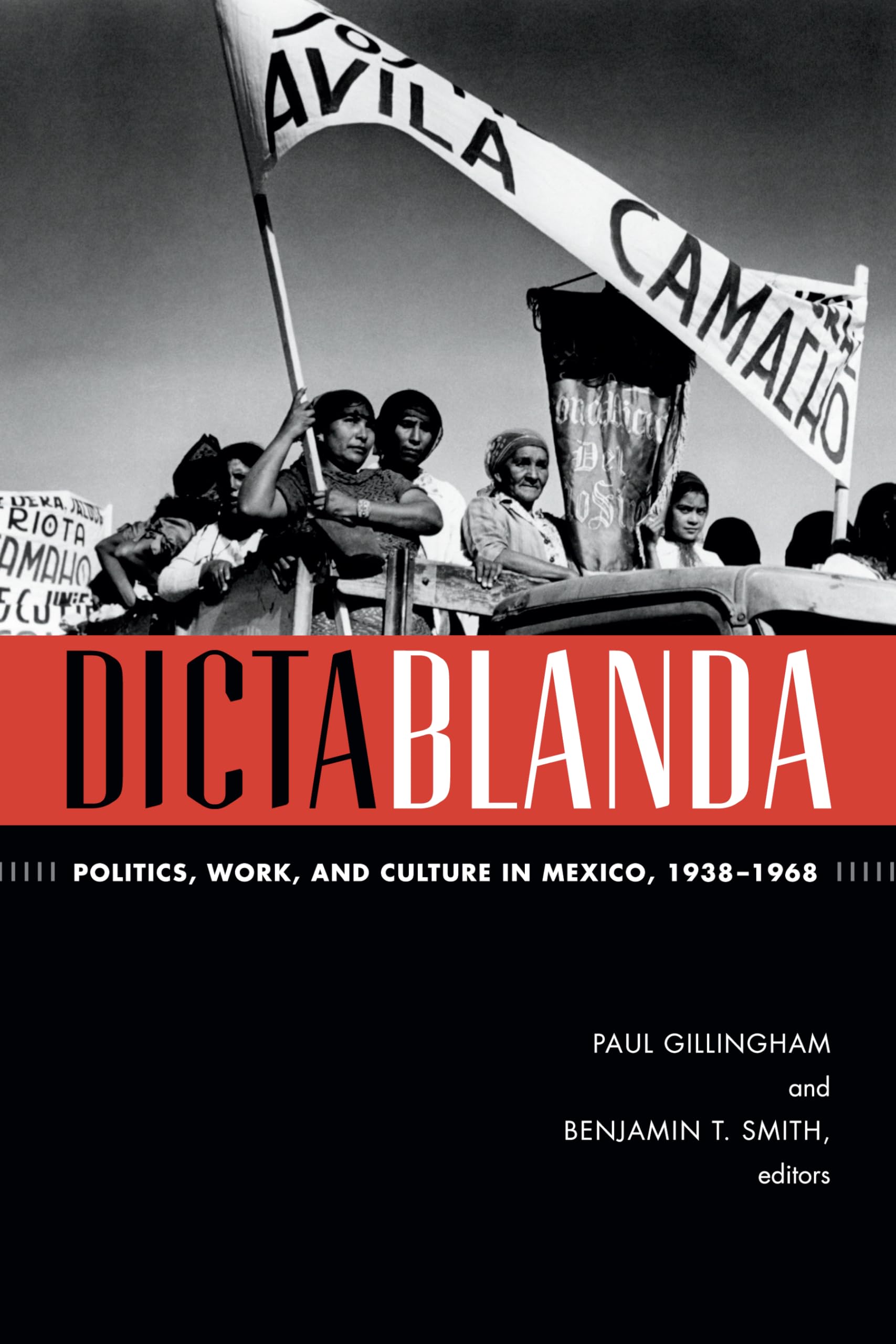
Dictablanda: Politics, Work, and Culture in Mexico, 1938–1968 (American Encounters/Global Interactions)
$28.62
by Paul Gillingham



In 1910 Mexicans rebelled against an imperfect dictatorship; after 1940 they ended up with what some called the perfect dictatorship. A single party ruled Mexico for over seventy years, holding elections and talking about revolution while overseeing one of the world's most inequitable economies. The contributors to this groundbreaking collection revise earlier interpretations, arguing that state power was not based exclusively on hegemony, corporatism, or violence. Force was real, but it was also exercised by the ruled. It went hand-in-hand with consent, produced by resource regulation, political pragmatism, local autonomies and a popular veto. The result was a dictablanda : a soft authoritarian regime. This deliberately heterodox volume brings together social historians, anthropologists, sociologists, and political scientists to offer a radical new understanding of the emergence and persistence of the modern Mexican state. It also proposes bold, multidisciplinary approaches to critical problems in contemporary politics. With its blend of contested elections, authoritarianism, and resistance, Mexico foreshadowed the hybrid regimes that have spread across much of the globe. Dictablanda suggests how they may endure. Contributors . Roberto Blancarte, Christopher R. Boyer, Guillermo de la Peña, María Teresa Fernández Aceves, Paul Gillingham, Rogelio Hernández Rodríguez, Alan Knight, Gladys McCormick, Tanalís Padilla, Wil G. Pansters, Andrew Paxman, Jaime Pensado, Pablo Piccato, Thomas Rath, Jeffrey W. Rubin, Benjamin T. Smith, Michael Snodgrass “[A]n invaluable resource for any nonspecialist seeking a rigorous and in-depth consideration of the topic. . . . A necessary addition to any respectable collection on Latin American history or 20th-century politics. . . . Essential. Upper-division undergraduates and above.” -- J. M. Rosenthal ― Choice “This timely edited volume explores how the country that launched the first social revolution of the twentieth century became one of the world’s most unequal and least democratic societies. Its regional and methodological sweep is impressive. Taken together, the eighteen chapters challenge the conventional wisdom in many ways. Graduate students in particular will mine this volume for promising leads; indeed, this book will likely inspire a wave of interdisciplinary research on the period.” -- Stephen E. Lewis ― Journal of Interdisciplinary History " Dictablanda is a must read for students of Mexican history and politics, and provides a useful synthesis of the emerging works on this under-researched period" -- Amelia M. Kiddle ― Labour/Le Travail " Dictablanda ’s publication marks a watershed in the study of postrevolutionary Mexico. … The collection’s theoretical pluralism and thematic diversity defies easy characterization." -- Ben Fallaw ― The Americas "[T]his volume brings together important case studies and contributes to a debate about how to conceptualize the era. It is essential reading for scholars of post-revolutionary Mexico." -- Louise E. Walker ― Hispanic American Historical Review "Combining two generations of scholarship in the historiography of postrevolutionary Mexico, this collection of essays is a masterpiece. It constitutes the first-ever effort to study in detail the heyday of Mexico’s official revolutionary party from the oil expropriation of 1938 to the government’s massacre of student protesters at Mexico City’s Tlatelolco Square in 1968....it should be required reading for anyone interested in twentieth-century Latin America." -- Jurgen Buchenau ― The Historian "This ambitious volume offers a provocative and timely reconsideration of Mexican state formation. Its diverse and empirically rich case studies examine politics on the ground, providing unusual insights into the mechanisms of Mexico's authoritarian regime. This book will be indispensable reading for anyone seeking to understand the ruling party's astonishing ability to retain power and countless challenges to its legitimacy." -- Jocelyn Olcott, author of ― Revolutionary Women in Post Revolutionary Mexico Paul Gillingham is a Lecturer in Latin American History at the University of Pennsylvania. He is the author of Cuauhtémoc’s Bones: Forging National Identity in Modern Mexico . Benjamin T. Smith is Associate Professor of Latin American History at the University of Warwick. He is author of Pistoleros and Popular Movements: The Politics of State Formation in Postrevolutionary Oaxaca . DICTABLANDA POLITICS, WORK, AND CULTURE IN MEXICO, 1938–1968 By PAUL GILLINGHAM, BENJAMIN T. SMITH Duke University Press Copyright © 2014 Duke University Press All rights reserved. ISBN: 978-0-8223-5637-0 Contents PREFACE
Paul Gillingham, vii, ACKNOWLEDGMENTS, xv, GLOSSARY OF INSTITUTIONS AND ACRONYMS, xvii, INTRODUCTION
Paul Gillingham and Benjamin T. Smith The Paradoxes of Revolution, 1, HIGH AND LOW POLITICS, 45, CHAPTER 1
Alan Knight The End of the Mexican Revol
Paul Gillingham, vii, ACKNOWLEDGMENTS, xv, GLOSSARY OF INSTITUTIONS AND ACRONYMS, xvii, INTRODUCTION
Paul Gillingham and Benjamin T. Smith The Paradoxes of Revolution, 1, HIGH AND LOW POLITICS, 45, CHAPTER 1
Alan Knight The End of the Mexican Revol