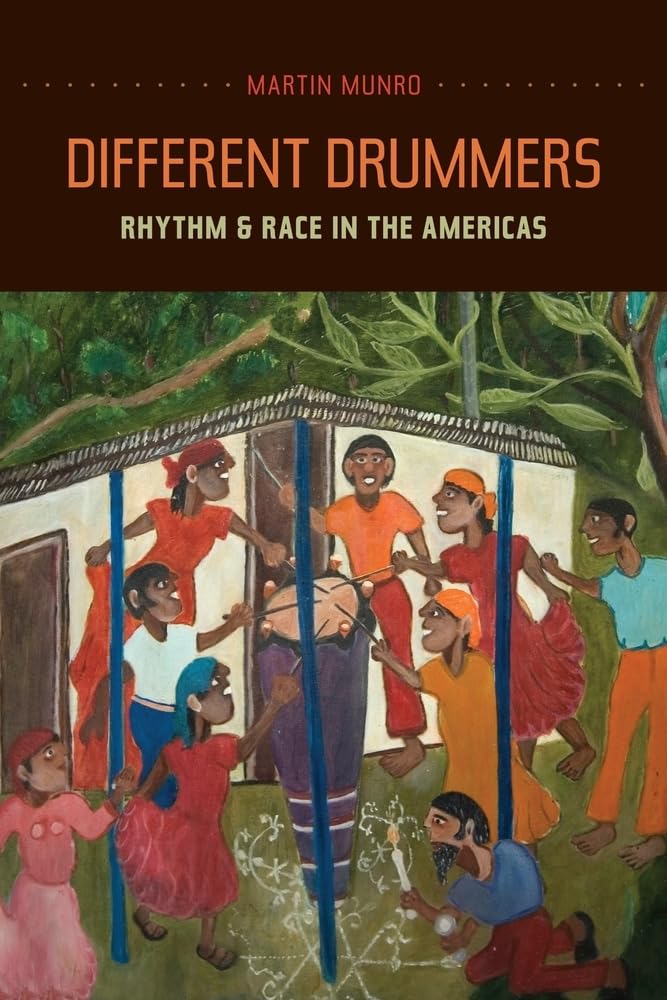
Different Drummers: Rhythm and Race in the Americas (Music of the African Diaspora) (Volume 14)
$23.39
by Martin Munro



Long a taboo subject among critics, rhythm finally takes center stage in this book's dazzling, wide-ranging examination of diverse black cultures across the New World. Martin Munro’s groundbreaking work traces the central―and contested―role of music in shaping identities, politics, social history, and artistic expression. Starting with enslaved African musicians, Munro takes us to Haiti, Trinidad, the French Caribbean, and to the civil rights era in the United States. Along the way, he highlights such figures as Toussaint Louverture, Jacques Roumain, Jean Price-Mars, The Mighty Sparrow, Aimé Césaire, Edouard Glissant, Joseph Zobel, Daniel Maximin, James Brown, and Amiri Baraka. Bringing to light new connections among black cultures, Munro shows how rhythm has been both a persistent marker of race as well as a dynamic force for change at virtually every major turning point in black New World history. “A compelling interdisciplinary exploration of rhythm and sound in the circum-Caribbean.” -- Kaima L. Glover ― Oxford Journal Published On: 2012-07-03 “Examining Black music in the western hemisphere since slavery, this book makes clear the essential role it has played in culture, politics and social change.” ― B.l.a.c. Published On: 2010-08-01 "Munro argues in an informed and imaginative way that greater attention should be paid to the recurring sonic elements of black cultures in the new world. Different Drummers provides profound insights into the importance of rhythm as a marker of resistance and a dynamic facet of everyday life across Caribbean literatures and in African American music." J. Michael Dash, New York University "Munro takes us on a fascinating journey through the music of poetry and the poetry of music, beautifully tying together the cultures and literary texts of a range of Caribbean societies." Laurent Dubois, author of Soccer Empire: The World Cup and the Future of France "Munro argues in an informed and imaginative way that greater attention should be paid to the recurring sonic elements of black cultures in the new world. Different Drummers provides profound insights into the importance of rhythm as a marker of resistance and a dynamic facet of everyday life across Caribbean literatures and in African American music."―J. Michael Dash, New York University "Munro takes us on a fascinating journey through the music of poetry and the poetry of music, beautifully tying together the cultures and literary texts of a range of Caribbean societies."―Laurent Dubois, author of Soccer Empire: The World Cup and the Future of France Martin Munro is Associate Professor of French and Francophone Literatures at Florida State University. Different Drummers Rhythm and Race in the Americas By Martin Munro UNIVERSITY OF CALIFORNIA PRESS Copyright © 2010 The Regents of the University of California All rights reserved. ISBN: 978-0-520-26283-6 Contents Acknowledgments, ix, Introduction: Slaves to the Rhythm, 1, 1. Beating Back Darkness: Rhythm and Revolution in Haiti, 24, 2. Rhythm, Creolization, and Conflict in Trinidad, 78, 3. Rhythm, Music, and Literature in the French Caribbean, 132, 4. James Brown, Rhythm, and Black Power, 182, Conclusion: Listening to New World History, 214, Notes, 227, References, 251, Index, 269, CHAPTER 1 Beating Back Darkness Rhythm and Revolution in Haiti In many crucial ways, the history of the modern Caribbean begins in Haiti in 1804, with Jean-Jacques Dessalines's declaration of independence. It was here that the fallible nature of colonial military power and, more importantly, of colonial ideology in the Caribbean was first exposed. The Haitian Revolution that began in 1791 dealt blows to the notion of innate European, "white" superiority, sending cracks through the colonial edifice that could never be repaired and that, over time, brought the whole enterprise crashing down. The events in Haiti effectively realized the lofty egalitarian ideals of the European Enlightenment: played out on the battlegrounds of colonial Saint-Domingue, the struggle between enslaving, domineering supremacism and liberating universalism demonstrated how notions of liberty, equality, and fraternity could not be applied exclusively but had to include every race, nation, and individual. For this reason alone, Haiti is the single most important point of origin for the Caribbean and perhaps also for broader New World black communities. If Haiti is an exemplar for the postcolonial New World, it is also unremittingly, radically atypical. Haiti is at once the center of Caribbean history and an unknown entity, remaining on the outside, ignored, and misunderstood. To learn about Haiti is to come to know paradox, to understand how its truth often lies in contradictions and disrupted logic. This chapter explores one of these Haitian paradoxes: the way the fabled first black republic in the New World has long neglected and repressed, or else selectively appropri