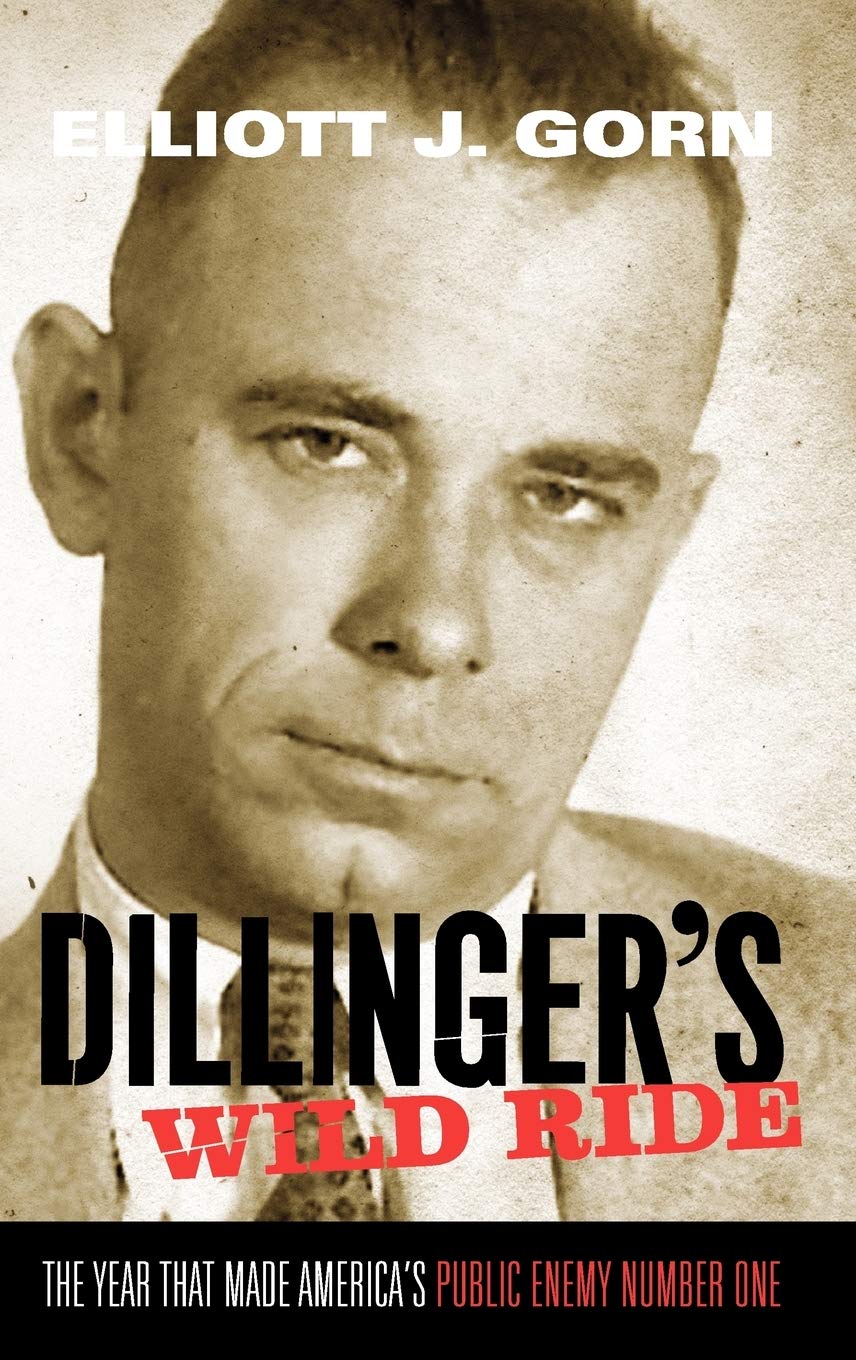
Dillinger's Wild Ride: The Year That Made America's Public Enemy Number One
$12.43
by Elliott J. Gorn



What is the power of Dillinger's story? Why has it lingered so long? Who was John Dillinger? Gorn illuminates the significance of Dillinger's tremendous fame and the endurance of his legacy, arguing that he represented an American fascination with primitive freedom against social convention. Dillinger's story has much to tell us about our enduring fascination with outlaws, crime and violence, about the complexity of our transition from rural to urban life, and about the transformation of America during the Great Depression. Dillinger's Wild Ride is a compulsively readable story with an unforgettable protagonist. In an era that witnessed the rise of celebrity outlaws like Baby Face Nelson, Pretty Boy Floyd, and Bonnie and Clyde, John Dillinger was the most famous and flamboyant of them all. Reports on the man and his misdeeds--spiced with accounts of his swashbuckling bravado and cool daring--provided an America worn down by the Great Depression with a story of sex and violence that proved irresistible. In Dillinger's Wild Ride, Elliott J. Gorn provides a riveting account of the year between 1933 and 1934, when the Dillinger gang pulled over a dozen bank jobs, and stole hundreds of thousands of dollars. A dozen men--police, FBI agents, gangsters, and civilians--lost their lives in the rampage, and American newspapers breathlessly followed every shooting and jail-break. As Dillinger's wild year unfolded, the tale grew larger and larger in newspapers and newsreels. Even today, Dillinger is the subject of pulp literature, poetry, fiction, and films, including a movie starring Johnny Depp. Take a Look Inside (Click on any image to enlarge) "Is this a good time for another Dillinger book? The author thinks so, and readers will too by the end of the book. Gorn... has produced an excellent account - a fast-paced romp that's hard to put down - of the short life and times of the outlaw John Dillinger... With Johnny Depp playing Dillinger in a summer 2009 movie, this should prove a popular book. Recommended for general readers and crime aficionados; history buffs will appreciate the detailed notes."--Library Journal "A solid, unromanticized account of the last year in the short life of famed bank robber John Dillinger."--Publishers Weekly "A solid study of an outlaw and his image."--Kirkus Reviews The gripping story of John Dillinger, America's first Public Enemy Number One Elliott J. Gorn is Professor of History and American Studies at Brown University. He is the author of The Manly Art: Bare-Knuckle Prize Fighting in America and Mother Jones: The Most Dangerous Woman in America , among other books. From The Washington Post's Book World/washingtonpost.com I n knowledge of most aspects of our collective history, most Americans probably would flunk even the easiest of tests, but in one department we are scholars of the first rank: We know our crooks. We don't just know them, we love them: Billy the Kid, Jesse James, Bonnie and Clyde, Baby Face Nelson, Pretty Boy Floyd, Ma Barker, not to mention the fictional ones, most notably Vito and Sonny Corleone, and of course Luca Brasi, who for all eternity sleeps with the fishes. Long after their deaths, they live on in our mythology as what Elliott J. Gorn calls "part of America's deepest hero myths." All these pale, though, next to John Dillinger. His life in the headlines was remarkably brief -- it began in the early summer of 1933 and ended almost exactly a year later, when FBI agents killed him as he left a movie theater in Chicago -- but he had risen to the status of legend long before his death, and he has kept it ever since. He has been the subject of books (both fiction and nonfiction), songs, poems and movies. Played by Johnny Depp, he is the central character in "Public Enemies," a film to be released this week that, considering Depp's huge popularity, is certain to burnish the legend still further. "Dillinger's Wild Ride" is, inevitably, a rehash of familiar stories about Dillinger's crime spree. But Gorn -- a professor of history at Brown University who has a particular interest in popular history and sports -- tries hard to separate fact from myth, and he makes plausible arguments for why Dillinger captured the popular imagination. Born on June 22, 1903, in Indianapolis, he was in prison by the time he was 21 for attempted robbery and assault, and remained there until his release in May 1933. By June or July -- "as with so much of the Dillinger chronicle, there is lots of information, but much of it is unreliable" -- he and his gang were off and running, knocking off banks all over Indiana. It was the beginning of a "rampage" at the end of which "a dozen policemen, gang members, and civilians were dead, hundreds of thousands of dollars had been stolen, and public faith in law enforcement was shaken." This last certainly is true, but it needs to be amended with the caveat that if much of the public was appalled, much of it al