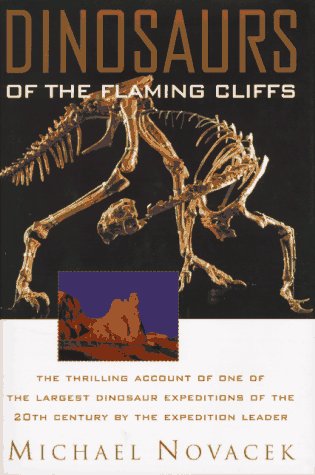



Over the past six years, Michael Novacek, Dean of Science at the American Museum of Natural History, has led a team of international scientists to Mongolia's Gobi Desert on the greatest dinosaur expedition of the late twentieth century. Closed to the West since the 1920s and opened only to Michael Novacek's team, the remote sands of the Gobi Desert constitute the richest fossil site in the world. In Dinosaurs of the Flaming Cliffs , Novacek takes the reader along with his team as he re-creates the day-to-day drama of field exploration over the last six years and recounts the remarkable discoveries that he and his colleagues unearthed. Following early years of relative disappointment, in 1993 the expedition discovered the richest Cretaceous dinosaur site ever found, excavating fossils that have helped to reshape our understanding of the dinosaur and early mammal era. Interweaving the adventure of field research with chapters that offer in depth discussions on contemporary dinosaur research and science, Dinosaurs of the Flaming Cliffs makes for the best kind of science--an engrossing narrative that brings compellingly to life the thrill and excitement of scientific discovery. One of the fields of study opened up by the collapse of Communism is, oddly enough, that of the distant past: Western archeologists have for the first time in six decades been allowed to explore the Gobi Desert in Mongolia. This is the region explored in the 1930s by the famed Roy Chapman Andrews of the American Museum of Natural History. It is also the region wonderfully described in this stirring book by Michael Novacek, the current curator of the museum's department of vertebrate paleontology, who led the recent expeditions onto the high desert and into the heart of the Cretaceous Period in Asia. In 1993, Novacek's expedition found an astonishing trove of fossils in a wasteland called Ukhaa Tolgod, not too far from the Flaming Cliffs where Andrews made his most important finds. But, as with all great travel adventure stories, getting to Ukhaa Tolgod is the real tale. Novacek, senior vice-president and provost of science at the American Museum of Natural History, brings the search for dinosaurs to life with this first-person account of the six years of joint expeditions into the Gobi Desert of Mongolia. He vividly describes the logistical nightmares and the political realities of these Mongolian-American joint ventures as well as the excitement of discovering new kinds of dinosaurs and mammals. As a bonus to this story, he also provides an engaging introduction to vertebrate paleontology along with its related sciences. Technical terminology occasionally sneaks through without full explanation, yet the book is eminently readable. Excellent illustrations by Ed Heck complement the text. Highly recommended for any library serving patrons with an interest in fossils, especially dinosaurs.?Jeanne R. Davidson, Oregon State Univ., Corvallis Copyright 1996 Reed Business Information, Inc. Field paleontology in Mongolia's Gobi Desert is at once the most difficult and the most rewarding of scientific endeavors; here's a firsthand account by the leader of a major expedition. Dinosaur buffs already know the spectacular fossils brought back from the Gobi by previous generations of paleontologists. But the Cold War intervened, preventing Western scientists from exploring the fossil beds for six decades. With the breakup of the Soviet empire, Novacek (curator of vertebrate paleontology at the American Museum of Natural History) decided to seize the opportunity to explore the Gobi. The expedition had to overcome incredible logistical and political barriers: scorching heat, deadly sandstorms, and obtaining food and fuel in a country whose economy is in free fall. But as Novacek and his colleagues quickly realized once they reached the vast desert, there were spectacular fossil beds awaiting them. In some places a scientist could pick up dozens of well-preserved specimens in a short walk. Among their discoveries: dinosaur nests, some with the skeletons of brooding parents preserved with the eggshells; small theropods (carnivorous dinosaurs), including the now-famous Velociraptor; herds of the sheep-size grazer Protoceratops, at all ages from juvenile to adult; and a wealth of early birds and mammals. The book alternates descriptions of the various expeditions (the team has returned several times to explore new areas) with informative and up-to-date discussions of modern paleontology. The reader will learn a great deal not only about the Gobi discoveries, but about such related concepts as how a fossil is created and preserved, plate tectonics, the evolution of birds (probably from a theropod ancestor), and theories of why the dinosaurs became extinct (Novacek is cautious about the asteroid impact theory). A fine treatment for the general reader and a treasure trove for dinosaur buffs. (30 b&w illustrations, not seen) -- Copyright ©1996, Kirkus Associ