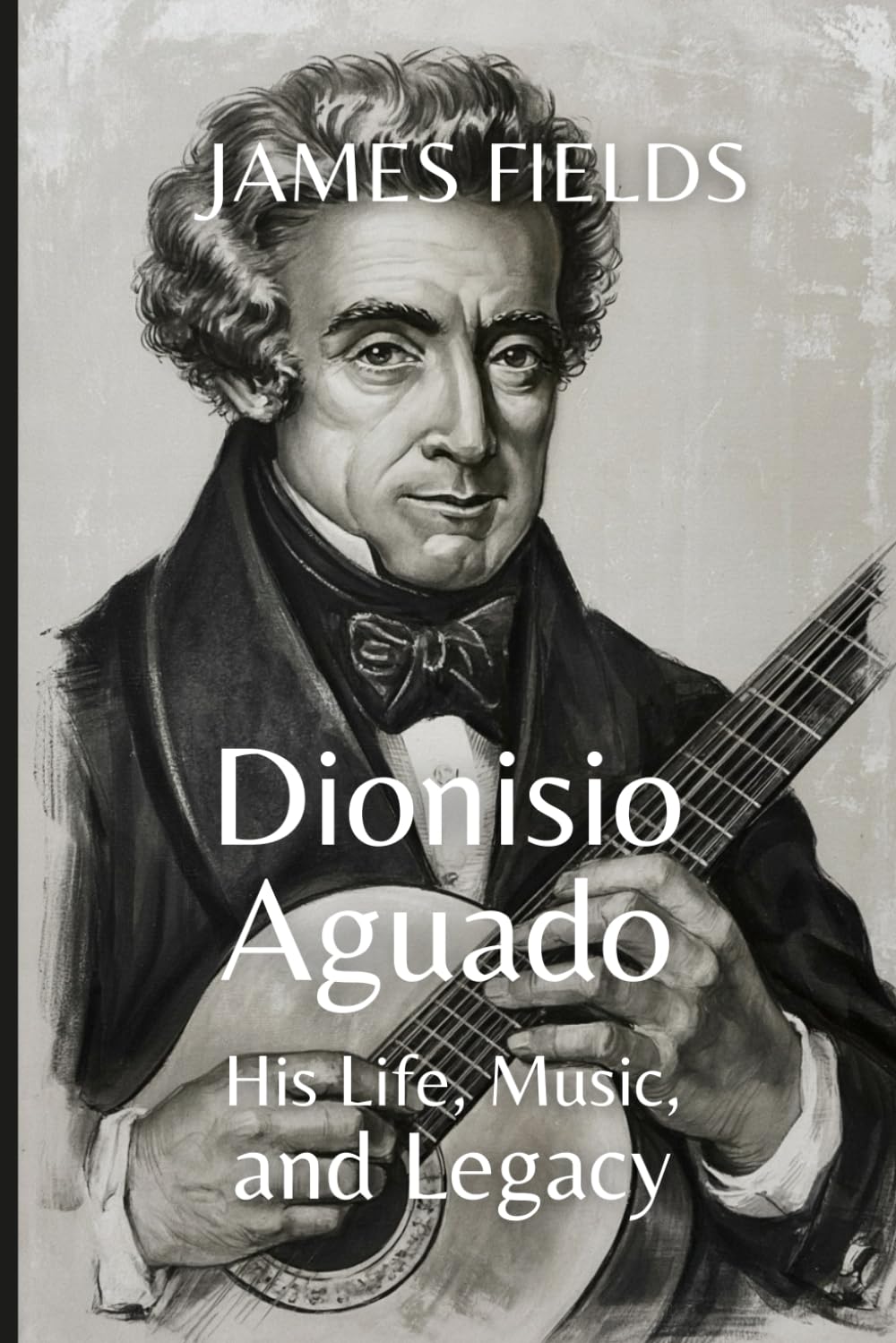
Dionisio Aguado: His Life, Music, and Legacy (Classical Guitar Masters)
$17.95
by James Fields



Dionisio Aguado: His Life, Music, and Legacy offers the first comprehensive portrait of one of the nineteenth century’s most important yet least understood musicians. Born in Madrid in 1784, Aguado’s life spanned a period of extraordinary political upheaval and artistic transformation—from the Enlightenment reforms of Charles III to the Romantic revolutions of mid-nineteenth-century Europe. Trained in the traditions of Spanish dance and classical counterpoint, Aguado witnessed the guitar’s evolution from a rustic folk instrument to a medium of refined concert expression. His career unfolded across the salons of Madrid and Paris, where he forged lasting ties with Fernando Sor and helped define the artistic and pedagogical foundations of the modern classical guitar. Through vivid historical narrative and rigorous musicological analysis, this study situates Aguado within the wider European context of composers and pedagogues such as Giuliani, Carcassi, and Coste. It explores the philosophical depth behind his celebrated Escuela de Guitarra (1825; rev. 1838), a work that transformed guitar instruction into an intellectual discipline. Aguado’s innovations—his systematic right-hand technique, the invention of the tripodison, and his insistence on tone control and expressive clarity—are examined not merely as technical refinements but as reflections of a broader aesthetic vision shaped by Enlightenment rationalism and Romantic sensibility. At once biography, cultural history, and musical study, Dionisio Aguado illuminates how one Spanish musician helped forge the instrument’s modern identity. Blending historical research with interpretive insight, the book traces Aguado’s enduring legacy in the teaching practices of later masters such as Tárrega and Segovia. For scholars, performers, and enthusiasts alike, this is a definitive exploration of how Dionisio Aguado transformed the guitar from accompaniment to art—an instrument capable of expressing the full range of human intellect and emotion.