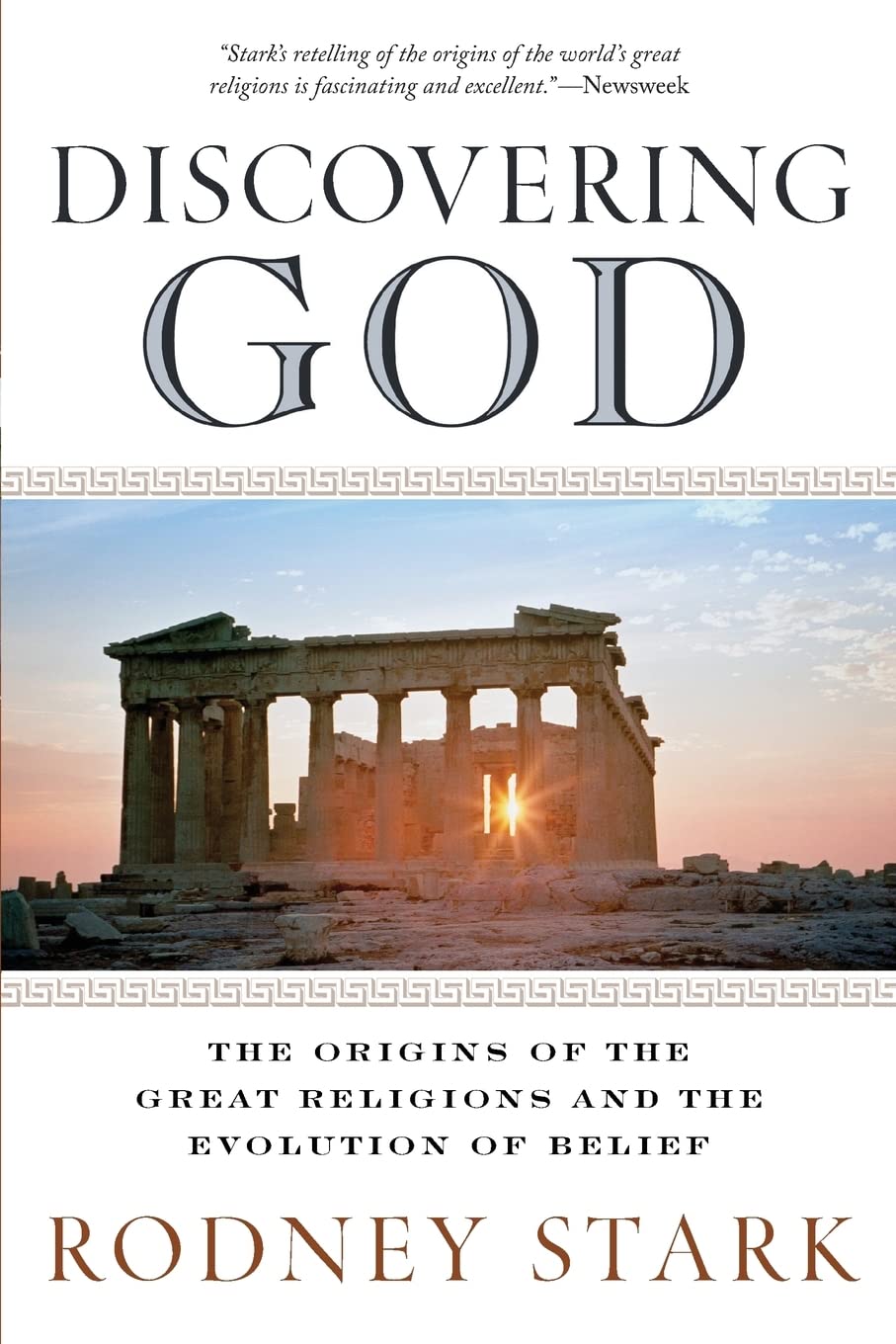
Discovering God: The Origins of the Great Religions and the Evolution of Belief – A Christianity Today Award-Winning History of Theology and Ethics
$10.32
by Rodney Stark



Winner of the 2008 Christianity Today Award of Merit in Theology/Ethics The History of God In Discovering God , award-winning sociologist Rodney Stark presents a monumental history of the origins of the great religions from the Stone Age to the Modern Age and wrestles with the central questions of religion and belief. “[A] wide-ranging investigation...serious students of religion will recognize this as an essential sourcebook.” - Booklist “Professor Stark’s new book is a tour de force of scholarship, economy in presentation and shrewd observation. As a social scientist he brings out many contrasts that other scholars miss. His comparison of Islam with Christianity is especially penetrating.” - Michael Novak, George Frederick Jewett Chair in Religion, Philosophy, and Public Policy at the American Enterprise Institute Stark’s retelling of the origins of the world’s great religions is fascinating and excellent. - Newsweek “Writing with his accustomed clarity and sure command of his subject, Rodney Stark here offers the newest masterful book in his distinguished series on religion. Stark’s views, supported firmly by the evidence, should bring about a profound reorientation in the study of religion. Discovering God is rich, deep, and enjoyably readable.” - Jeffrey Burton Russell, author of A History of Heaven and of Paradise Mislaid “A highly provocative book, proposing a model for interaction among the study of religions, theological methodologies, and the social and physical sciences. A daring departure from many of the traditional treatments of such matters.” - Justo L. Gonzalez, author of The Story of Christianity and A History of Christian Thought “In an intellectual marketplace full of crude, prejudiced and dogmatic speculations about the genetic basis of religion, for good or (mostly) for ill, a properly historical and cultural study is extremely welcome. Rodney Stark, as ever, writes clearly and with erudition for a lay as well as a learned public and explores the hypothesis that God is discovered, not merely projected or fabricated.” - David Martin, Emeritus Professor of Sociology, London School of Economics Winner of the 2008 Christianity Today Award of Merit in Theology/Ethics The History of God In Discovering God , award-winning sociologist Rodney Stark presents a monumental history of the origins of the great religions from the Stone Age to the Modern Age and wrestles with the central questions of religion and belief. Rodney Stark is the Distinguished Professor of the Social Sciences at Baylor University. His thirty books on the history and sociology of religion include The Rise of Christianity , Cities of God , For the Glory of God , Discovering God , and The Victory of Reason: How Christianity Led to Freedom, Capitalism, and Western Success . Stark received his Ph.D. from the University of California, Berkeley. Discovering God The Origins of the Great Religions and the Evolution of Belief By Rodney Stark HarperCollins Publishers, Inc. Copyright © 2008 Rodney Stark All right reserved. ISBN: 9780061626012 Chapter One Gods in Primitive Societies Much has been said about the religious life of primitive 1 humans, despite the fact that very little is known about it with any certainty. We do know that for thousands of years, some human burials have included grave goods, which may be taken as evidence that our distant ancestors believed in life after death. Deep inside caves we also have found structures that might have been altars, and some caves contained collections of such things as bear skulls that might have had religious significance, too. In early Neolithic (New Stone Age) sites such as Çatalhöyük in Turkey, 2 there is some evidence that bulls may have been sacred, and here and there archaeologists have found small figurines that might have represented a very ample mother goddess, or not. 3 Beyond that, all is conjecture. 4 These conjectures take two forms. The more reasonable of these is based on the assumption that recent observations of surviving primitive cultures can be taken as representative of those long gone. But is that true? If these cultures are not significantly different from those of early times, why did they not keep up? A common answer has been that most human progress is the result of diffusion, not independent innovation, and these particular groups failed to keep up because they were too isolated to benefit from the spread of innovations that carried other cultures forward. On these grounds it is claimed that surviving primitive cultures present a reliable image of the past. Although I am among those who regard this as a somewhat "unsound" assumption, 5 I agree that the ethnographic accounts of the religions of these groups deserve careful analysis. The second conjecture proposes that not too long ago humans lacked sufficient intelligence and consciousness to entertain such things as religious notions, having very little mental