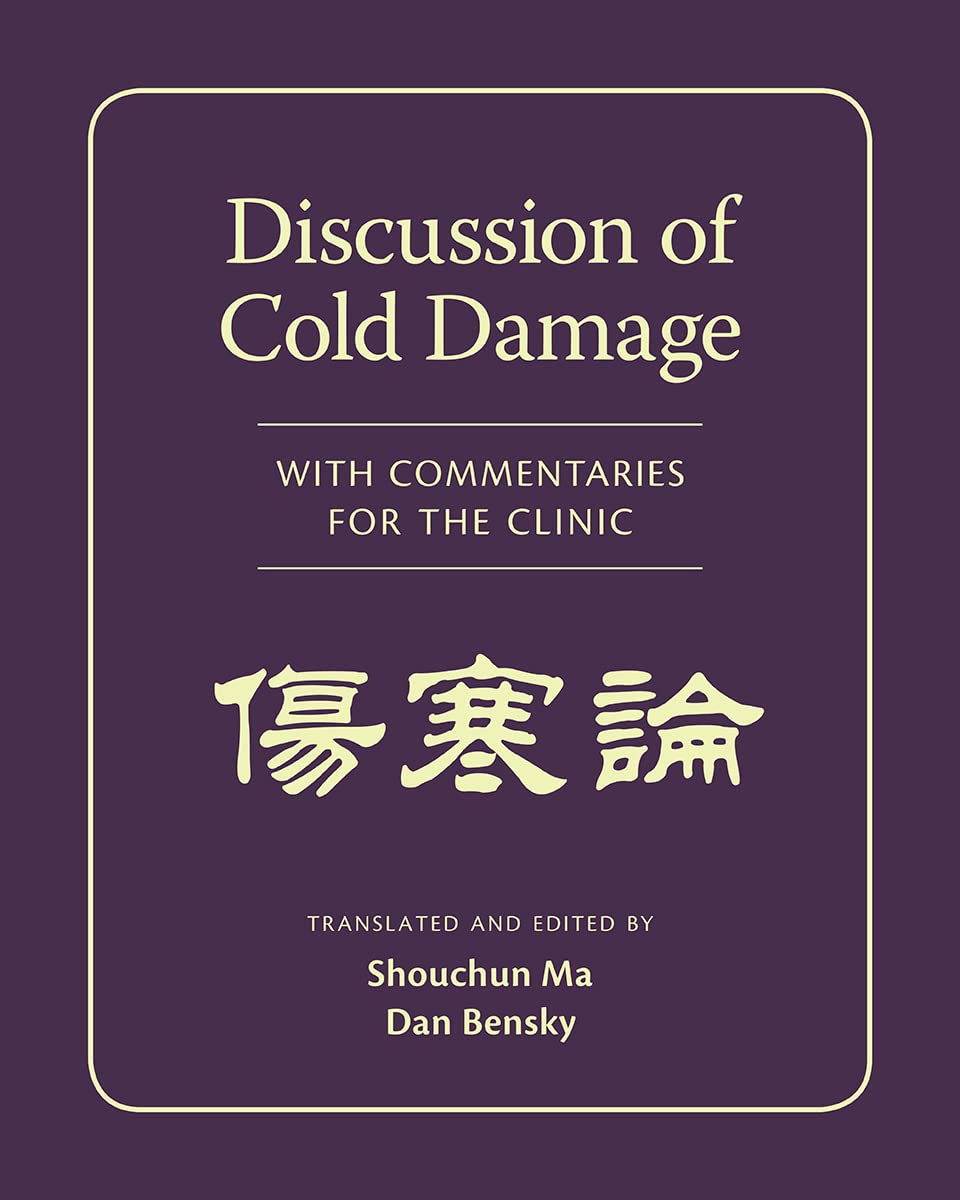



This book is a new translation and annotated guide to the text and clinical applications of Zhang Zhong-Jing’s Discussion of Cold Damage (Shäng hán lùn), which since the 3rd century has been the most important classical reference for treating externally-contracted diseases in traditional East Asian medicine. The core of the book are translations of the 398 main paragraphs of the Song dynasty edition (11th century), which covers tài yáng, yáng míng, shào yáng, tài yīn, shào yīn, jué yīn as well as sudden turmoil, yin-yang exchange, and relapse after recovery due to consumption. Each entry begins with the original text of the paragraph in Chinese and its translation. This is followed by an explanation of the text and its significance, touching upon the specific clinical relevance of the passage as well as background issues. For paragraphs that include herbal formulas, the original Chinese is presented together with a translation and brief explanation of the composition. Methods of preparation, both original and modern, are included. A distinguishing feature of this book are the commentaries that are provided for each paragraph, selected from amongst the most respected scholar-practitioners on the Discussion of Cold Damage during the past thousand years. The reader is thereby given direct access to how prominent physicians have interacted with this text in the past, illuminating some of the more practical approaches to it. Carefully selected case histories are appended to relevant paragraphs to help the reader gain further insight into the clinical utility of the formulas they contain. Throughout the book the authors, both of whom are practitioners with many decades of experience in Chinese medicine, provide their own comments about issues raised in the text. This includes textual interpretation as well as discussion of the clinical aspects of the paragraphs. There is also a glossary, table of people noted in the text, bibliography, and full index. I really don’t think that the readers of The Lantern need an explanation of why the Shang Han Lun (Discussion of Cold Damage) is such a crucial text for Chinese medicine studies. So let’s go right to the most important question for a book review: How does this translation compare to the several that are already out? Shang Han Lun: On Cold Damage by Craig Mitchell, Feng Ye, and Nigel Wiseman The Mitchell-Feng-Wiseman Shang Han Lun: On Cold Damage is fabulous for learning the language of the Shang Han Lun, including pinyin with tones and characters for each passage, and explanations of the nuances of various technical terms that are important for Shang Han Lun studies. But the attention to language--which I hasten to say is highly valuable for the Shang Han Lun literature in English as a whole--can tend to obscure the immediate clinical application of each clause. Shang Han Lun Explained by Greta Young and Robin Marchment Young and Marchment’s Shang Han Lun Explained is great on content, clinically handy and concise and includes case histories, but is heavily pinyin oriented. This is perfect for Australia where pinyin is the standard for both teaching and prescription guidelines, but may be somewhat off-putting elsewhere. Too, the book layout in Shang Han Lun Explained is rather cramped and dense, whereas the Eastland book layout and design is, as usual, a delight and makes reading a pleasure. Simple differences in word choice can make the difference between easy comprehension and confusion that brings the reader up short, wondering Huh? As a small example, chosen at random from Young and Marchment’s text, paragraph 238 starts off: “Yang Ming disease, there is purgation, if there is anguish and vexation …” The Bensky translation is more clear: “For yáng míng diseases that have been purged, if there is anguish and vexation …” Again, Shang Han Lun Explained describes the traditional dosages, but does not explain until an appendix at the end what may be meant by “liang” or “sheng.” The cooking method does explain that “one dou” is “(2L)” and “2 sheng” is (400 mL), but it is inconsistent and the reader is often left having to stop reading and run some simple math through her head to get the complete directions. Discussion of Cold Damage: with commentaries for the clinic avoids this by clearly writing out both the traditional dosages (ie liang or sheng) but also describes the process in modern measurements. Discussion of Cold Damage by Guohui Liu and Henry McCann Guohui Liu and Henry McCann’s Discussion of Cold Damage is the scholar’s dream, going into great depth on almost every possible point. This true wealth of detail can however tend to overwhelm the most clinically important issues. This pitfall is avoided in the Eastland book. For example, Liu’s book goes into seven pages of detail on Clause 100, paying especial attention to the question regarding the meaning of “yang pulse” and “yin pulse.” The Eastland book, true to its principle of adhering to the consensus of th