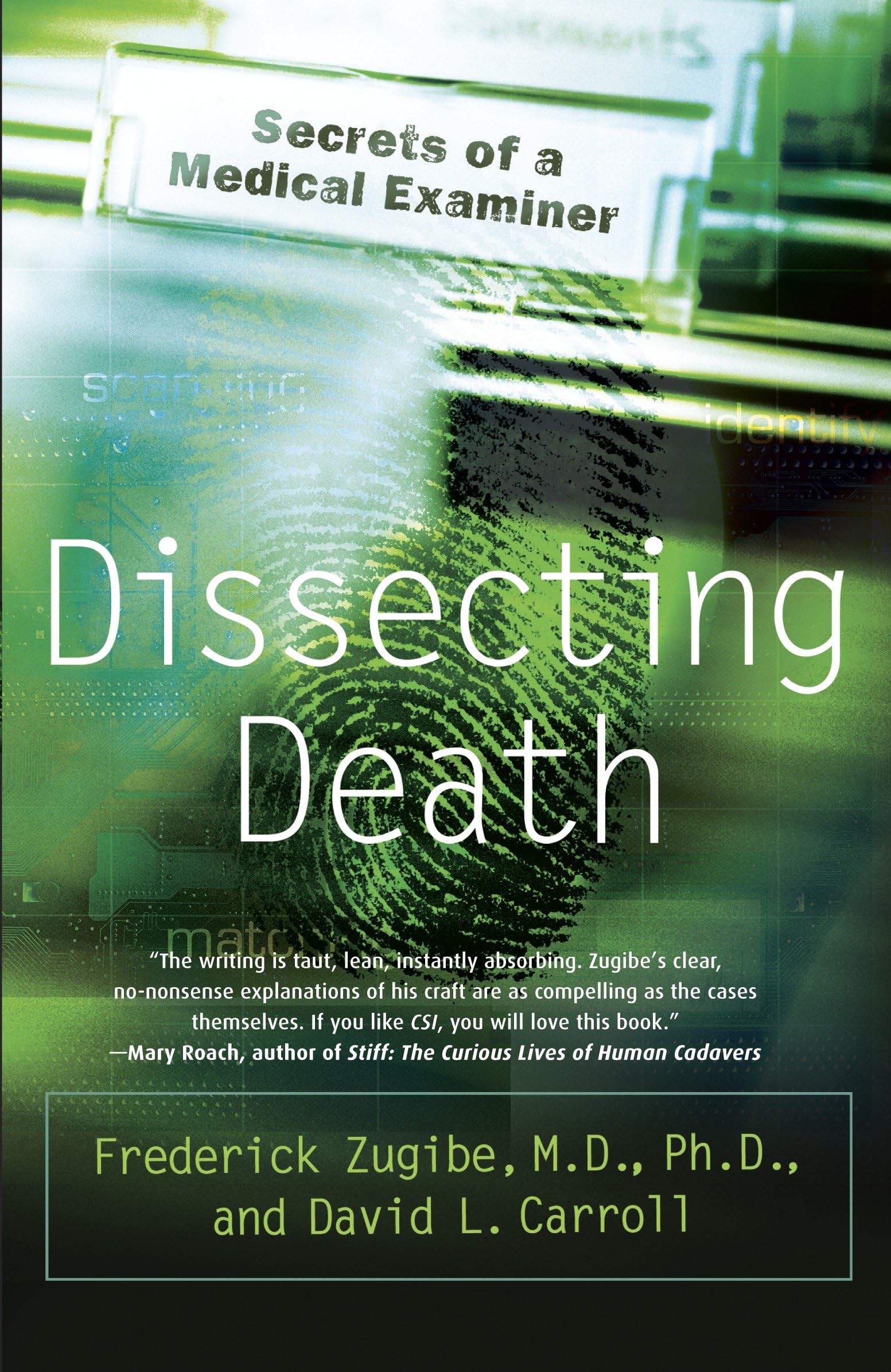



From TV’s CSI to bestsellers by Patricia Cornwell and Kathy Reichs, interest in forensics is at an all-time high. Now one of our most respected forensic pathologists gives a behind-the-scenes look at eleven of his most notorious cases, cracked by scientific analysis and Sherlock Holmesian deduction. As chief medical examiner of Rockland County, New York, for almost thirty-five years, Dr. Frederick Zugibe literally wrote the book on the subject—his widely used textbook is considered the definitive text. Over the years he has pioneered countless innovations, including the invention of a formula to soften mummified fingers—enabling fingerprinting, and thus identification, of a long-deceased victim. He has appeared as an expert hundreds of times in the media and in the courtroom—and not once has a jury failed to accept his testimony over opposing expert witnesses. And now, in Dissecting Death , he has opened the door to the world of forensic pathology in all its gruesome and fascinating mystery. Dr. Zugibe takes us through the process all good pathologists follow, using eleven of his most challenging cases. With him, we visit the often grisly—though sometimes shockingly banal—crime scene. We inspect the body, palpate the wounds, search for clues in the hair and skin. We employ ultraviolet light, strange measuring devices, optical instruments. We see how a forensic pathologist determines the hour of death, the type of weapon used, the killer’s escape route. And then we enter the lab, the world of high-tech criminal detection: DNA testing, fingerprinting, gunshot patterns, dental patterns, X-rays. But not every case ends in a conviction, and in a closing chapter Dr. Zugibe examines some recent high-profile cases in which blunders led to killers going free, either because the wrong party was brought to trial or because the evidence presented didn’t do the trick—including Jon-Benet Ramsey’s murder and, of course, the O.J. Simpson trial. “Compelling reading for fans of insider accounts of forensics.” — Publishers Weekly “This is the sort of book that makes you miss your bus stop. Ten of Dr. Zugibe’s most puzzling murder cases serve as gripping examples of the medical examiner’s gruesome magic.” —Mary Roach, author of Stiff: The Curious Lives of Human Cadavers FREDERICK ZUGIBE, M.D., Ph.D., is the former chief medical examiner of Rockland County and remains one of the nation’s most respected forensics experts. DAVID L. CARROLL has cowritten thirty-one books and produced twelve network television films. Both men live in Rockland County, New York. CHAPTER 1 Of Ice Men and the Lure of Forensics The great and constant need of those who investigate homicide and practice forensic pathology or criminal law is a warm humanism. --RAMSEY CLARK, FORMER U.S. ATTORNEY GENERAL Seeking truth to protect life. --MOTTO OF THE ROCKLAND COUNTY MEDICAL EXAMINER'S OFFICE CORPSE BY THE WALL Nyack, new york, is a historic hudson river valley town famous for its antique stores and sensible restaurants. People frequently make the twenty-mile drive up from New York City to spend a lazy afternoon drifting in and out of the town's quaint shops, or walking Nyack's network of shore trails that fronts the mighty Palisades. The house of the painter Edward Hopper is now a museum and a major tourist attraction. The cottage where the writer Carson McCullers died is frequently visited. Small Town, USA, but with a lot of polish. Not a neighborhood for gruesome frolics. Yet on a warm September day in 1983, along the heavily forested Clausland Mountain Road a quarter mile out of town, Patrolman Edwin Gonzalez, a Palisades Park police officer on morning patrol, spies a woman's blouse crumpled up near an old stone wall along the south side of the road. Patrolman Gonzalez gets out of his car to investigate. As he walks toward the blouse he notices an even more suspicious-looking object, a stuffed, heavy-duty garbage bag, the type contractors use to dispose of construction materials. The bag was apparently dumped over the wall, then rolled down a slight incline before stopping between two rocks. It is wrapped with a great deal of tape and rope. It gives off a rank odor and displays bulges where arms and feet and heads might be. The officer surveys the bag for several minutes, senses trouble, but knows how risky it can be, forensically speaking, to touch a suspicious piece of evidence. Since he is in the Orangetown district of Rockland County, he calls Lieutenant Youngman from the Orangetown Police to come over and investigate. Lieutenant Youngman is quickly on the scene. And he agrees, unwrapping the bag would be unsound procedure at this point. Nor is it necessary: circling the bundle, he notices a human foot jutting out from a hole in the bottom of the wrapping. Lieutenant Youngman calls the Rockland County Medical Examiner's Office. Since I am the chief medical examiner for the County of Rockland, it is my duty to examine the body