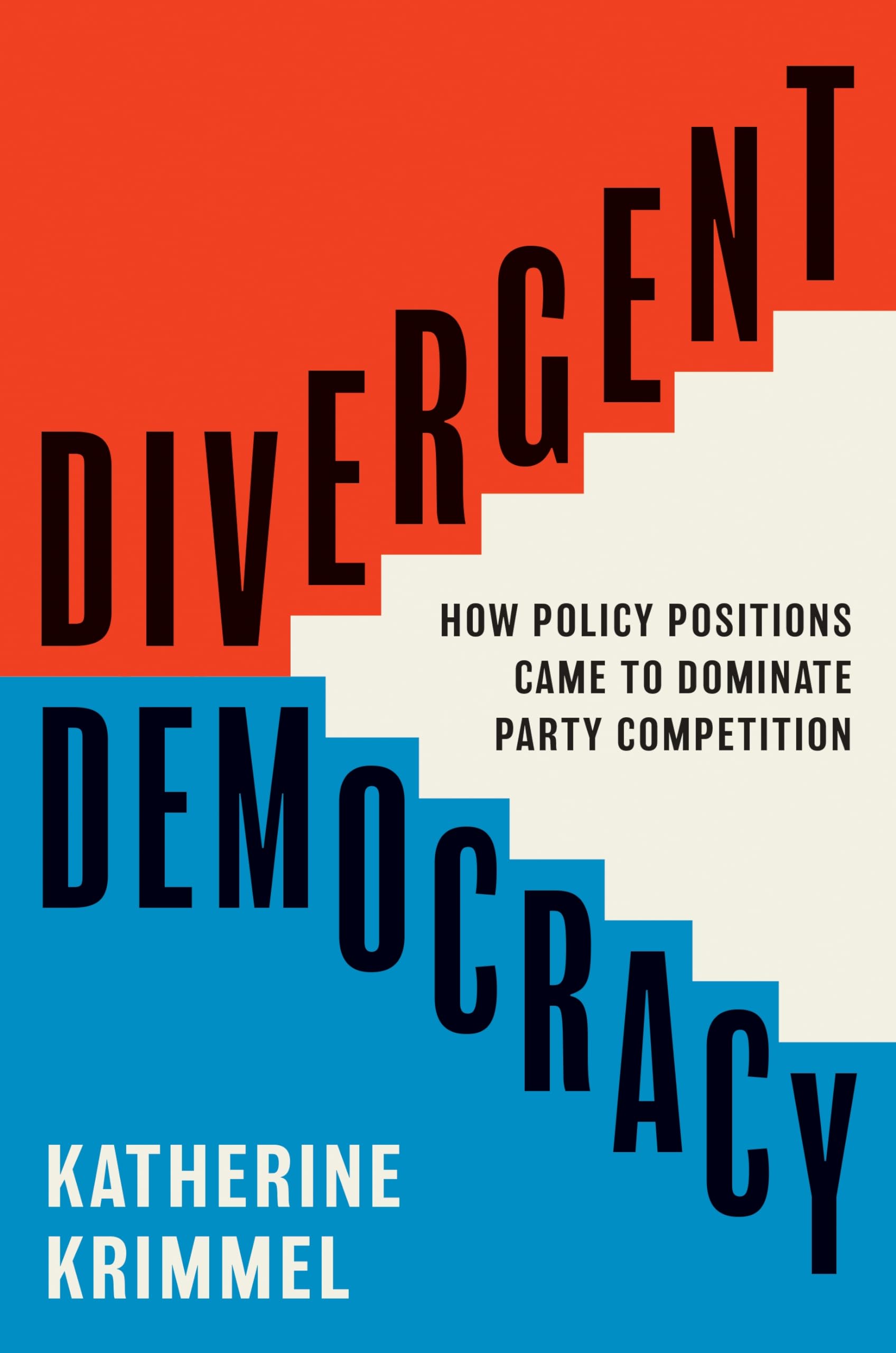
Divergent Democracy: How Policy Positions Came to Dominate Party Competition (Princeton Studies in American Politics)
$19.31
by Katherine Krimmel



An innovative examination of the shift by American political parties toward issue-based differentiation Recent Democratic and Republican party platforms display clear differences on such issues as abortion, LGBTQ+ rights, gun control, and the environment. These distinctions reflect a programmatic party system—that is, one in which policy positions serve as a key basis of electoral competition. Yet party politics were not always so issue-oriented; the rise of policy positions as the dominant marker of party appeal occurred largely over the last fifty years. In Divergent Democracy , Katherine Krimmel examines this transformation of the American party system, using innovative machine learning techniques to develop and present the first measure of party differentiation on issues since Democrats and Republicans began competing with each other in 1856. Why did the shift to issue-based party competition take more than a century to materialize? Krimmel offers a groundbreaking theory, focusing on what aids and constrains parties’ abilities to do the difficult, conflict-ridden work of developing issue positions. She argues that clientelistic subnational party organizations, promising material support or jobs in return for votes, long impeded programmatic partisanship while the growth of national party organizations facilitated it. Moreover, institutions and agents of racial oppression extended the life of nonprogrammatic practices, as they attempted to shield discriminatory laws and institutions from interparty competition. Following the civil rights revolution of the 1960s, space opened for programmatic competition to grow. Using both quantitative and qualitative tools, Krimmel offers a vital view of the foundations of today’s issue-based party competition and its alternatives. " Divergent Democracy gives us new conceptual leverage on party development over time. Although U.S. national politics has been dominated by Republicans and Democrats for more than 150 years, the consistency of party labels masks important changes. Krimmel’s rich history of intraparty debates over when and whether issues should even be the focus of national party competition uncovers a new dimension of party development. The book also raises interesting questions about whether issue-based politics should be regarded as a straightforward improvement in democratic terms." ---Frances Lee, Political Science Quarterly "Innovative. . . . [A] rich trove of evidence regarding party history and the present state of American party politics." ― Choice "An interesting. . . . [and] excellent book." ---Allison G. S. Knox, International Social Science review “ Divergent Democracy provides a genuinely new take on polarization, and what makes today’s partisan differences so distinctive in US history. It is an impressive achievement.”— David Bateman, Cornell University “The most historically and institutionally sophisticated treatment of national party divergence yet published.”— Daniel Carpenter, Harvard University “Katherine Krimmel’s invaluable and thought-provoking research invites us to consider whether today’s divisive partisan conflicts over competing policy visions still represent necessary progress from the issue-averse, patronage-fueled parties of the past. This persuasive book shows that the American party system has not only become polarized—it has been fundamentally transformed.”— David A. Hopkins, Boston College “This book is a significant advancement in how we should understand—conceptually, methodologically, even normatively—the changing relationship between political parties and the role of policy in American political life.”— Chloe Thurston, Northwestern University Katherine Krimmel is assistant professor in the department of political science at Barnard College, Columbia University.