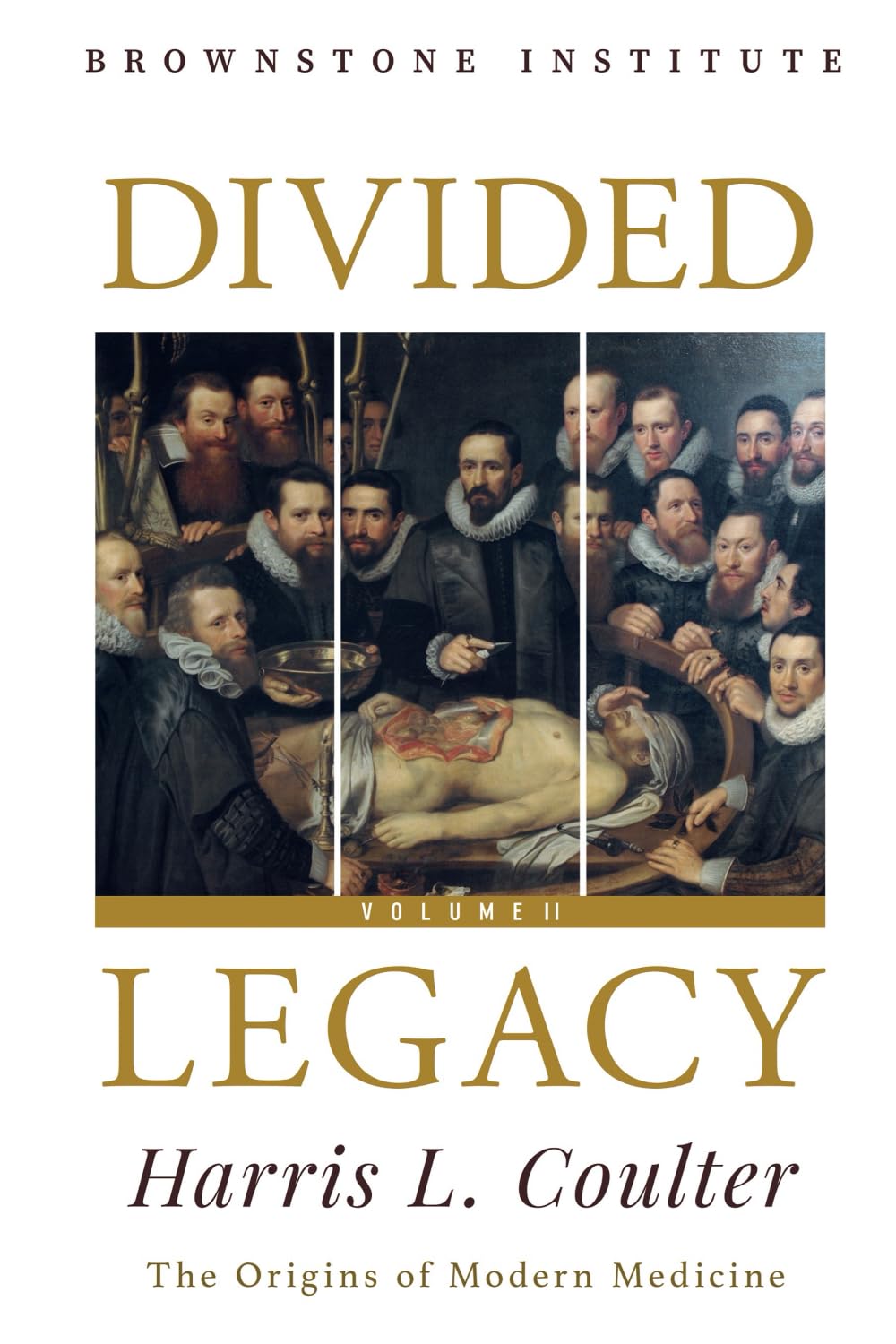
Divided Legacy: Volume II: Progress and Regress: J.B. Van Helmont to Claude Bernard
$25.00
by Harris Coulter



Divided Legacy (Vols. I-IV) is a history of Western medical philosophy from the time of Hippocrates to the twentieth century, treating it as a unified system of thought rather than a series of fortuitous discoveries. Dr. Coulter interprets the development of medical ideas as the product of a conflict between two opposed systems of thought, Empiricism and Rationalism. This second volume of Divided Legacy analyzes the dispute in the seventeenth, eighteenth, and nineteenth centuries over the criterion of reliability of medical thought and practice. It also traces the history of the Galenic and Paracelsan legacies across these centuries. The second volume treats the figures who are viewed as the founders of "scientific" medicine. A major issue in this volume is the relationship between these thinkers and a scientific method in medicine. To Coulter, the distinction between an earlier "pre-scientific" and a later "scientific" period in medicine is incorrect. An essentially scientific approach to therapeutic problems has been present in medicine since the dawn of Western civilization and did not emerge suddenly in the seventeenth, eighteenth, nineteenth, or twentieth century. Volume II concludes with the Methodist reaction to Trousseau's Empiricism. This reaction culminated in the reductionist physiology of Claude Bernard, whose conviction that therapeutics rests on an intimate knowledge of proximate causes, interpreted in physiological terms, sets the stage for twentieth-century medicine. Dr. Harris Coulter (1932-2009) was a native of Baltimore, Maryland, and a graduate of Yale University. He received his PhD from Columbia University. He is the author of numerous articles and several books on acupuncture, osteopathy, herbalism, and alternative health care.