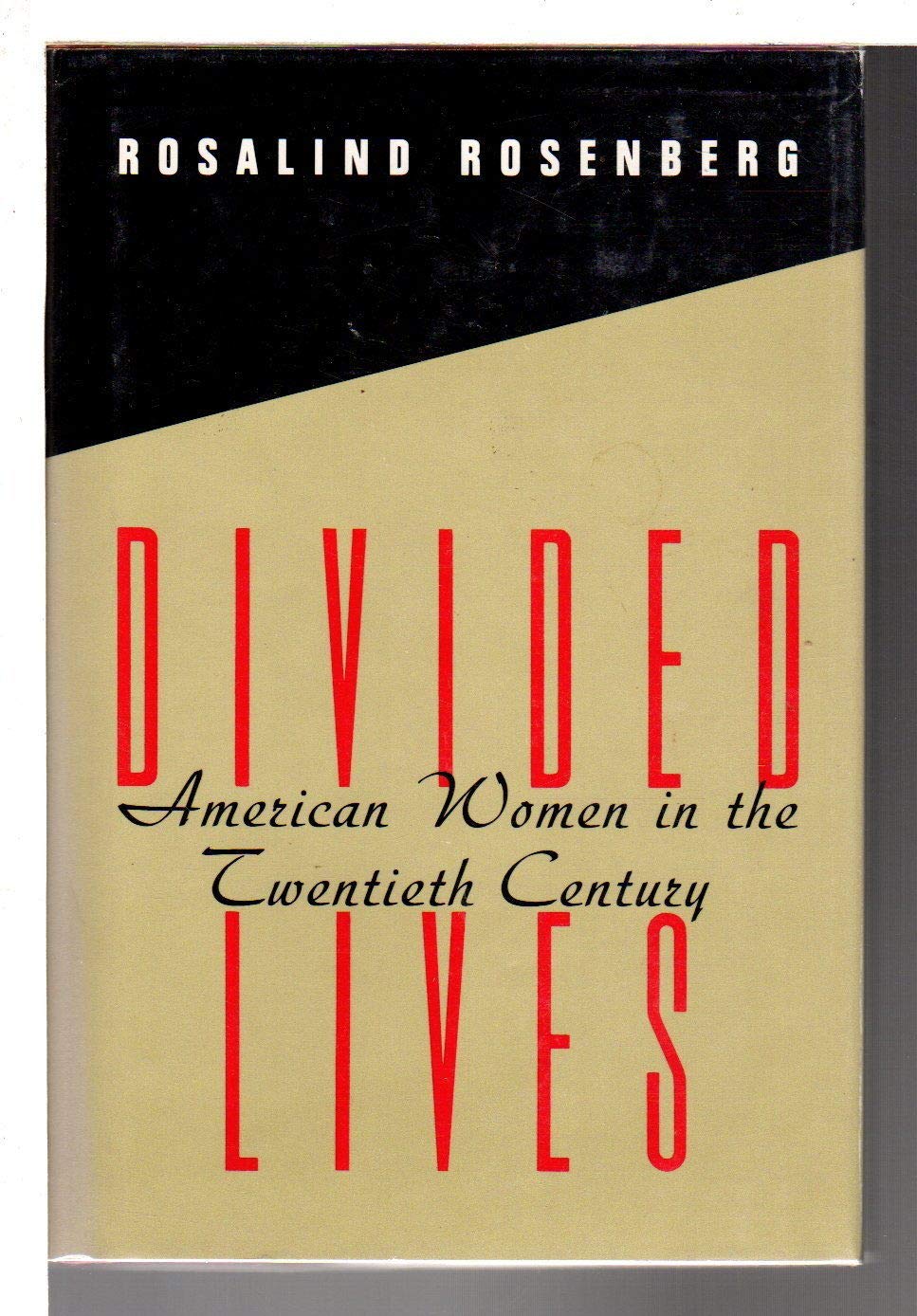
Divided Lives: American Women in the Twentieth Century (American Century Series)
$18.99
by Rosalind Rosenberg



The lives of American women have changed dramatically in the nine decades since the turn of the century. Women have made extraordinary strides in winning personal autonomy, sexual freedom, economic independence, and legal rights. They won the right to vote, the legal right to equal pay for equal work, and the right to control their reproductive lives. Nonetheless, the vast majority of women still assume the domestic burdens that leave men free to play their traditional role outside the home; paradoxically, the bedrock of liberal individualism that has made women's great gains possible clashes with the powerful tradition of gender inequality. Moreover, it has impeded the growth of social services--health care, maternal aid, and child care--that could further promote equality for women. Equality in practice remains elusive. Rosalind Rosenberg writes a lively history. She includes vignettes of many of the great leaders who during a turbulent century-long struggle have achieved so much for their sex: reformers Jane Addams and Frances Peck; labor leaders Elizabeth Gurley Flynn and Ruth Young; birth-control advocates Emma Goldman and Margaret Sanger; civil-rights leaders Ida Wells-Barnett and Pauli Murray; feminists Alice Paul and Betty Friedan; and many lesser-known women. Enjoyable, colorful, informed, Ms. Rosenberg's book maintains a clear focus as it deals with the leaders, the goals (some contradictory), and triumphs (and occasional setbacks) of the women's movement in the twentieth century. A solid and well-written, if analytically unexceptional, overview of the complex experience of modern American women. Attempting to unify conflicting theoretical approaches to woman's experience, Rosenberg (History/Barnard) traces the origins and interactions of conceptual schemes (which stress, variously, the essential sameness of men and women, women's uniqueness, and the importance of race and class) against the larger context of social, political, and economic change. She identifies a central dilemma of 20-century American women--that of ``divided lives- -divided between domestic and paid labor, and divided from one another''--and charts its manifestations through a straightforward, chronological narrative. Skillfully interweaving a wealth of secondary sources, including autobiography, scholarly studies, and statistical data, the author moves from the world of Progressive Era reformers through the WW II mobilization of ``womanpower,'' the cold war return to domesticity, the activism of the 1960's, and on to today's fundamentally different but still evolving landscape. Unfortunately, this framework undermines the text's analytical potential by diffusing recurrent themes (e.g., an emphasis on the shared experience of motherhood, or the comparable-vs.-equal-work debate) instead of exploring them systematically. The book's largely admirable inclusiveness also gives it a certain superficiality, as in the frustratingly brief sketches of such notables as ERA-stalwart Alice Paul and legal scholar Pauli Murray. These deficiencies blunt the impact of Rosenberg's otherwise provocative conclusion that ``women are changing more quickly than men'' and that ``until men catch up, inequality will persist and tensions continue.'' A sturdy jumping-off point that should leave interested readers poised to plunge into deeper, more challenging works. -- Copyright ©1992, Kirkus Associates, LP. All rights reserved. Used Book in Good Condition