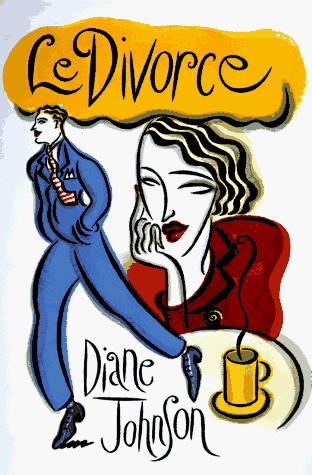



When a pregnant Roxeanne Walker de Persand has her husband run out on her, her rough-edged sister, Isabel, comes to help her through this period as the powerful Persand family begins pushing for a divorce and control of a valuable Walker family heirloom. Diane Johnson updates the transatlantic novel so gorgeously rendered by Henry James , Edith Wharton , William Dean Howells , and Nathaniel Hawthorne ; evokes the spirit of such expatriates sojourning in Paris as Ernest Hemingway and F. Scott Fitzgerald ; and mines the pathos of modern fiction in creating this wonderful and important novel. Isabel Walker, eerily reminiscent of James's Isabel Archer, is a young film-school dropout who travels to Paris to aid her stepsister, who is going through a divorce. Isabel's California cool, American freedoms, and feminist slants comingle, successfully and fractiously, with the customs, biases, and complex sexuality of modern Europe. The result modulates between introspection and hilarity, and a quick, Hollywood-inspired sweep of violent action in the end doesn't undermine the author's mastery of Old World vs. New--in fact, it provides an ironic scrim. In this frothy, forgettable tale of the vicissitudes experienced by two American sisters in Paris, Johnson (Health and Happiness, LJ, 9/15/90) introduces a winsome narrator and a somewhat interesting group of supporting characters. When college dropout Isabel Walker comes to Paris to help her pregnant sister, she gets more than she bargains for. Not only must she cope with Roxy's near-suicidal depression following the abrupt departure of her French husband and the resulting fuss over a potentially valuable family heirloom that has become a sticking point in the divorce settlement, but Isabel falls in love with Oscar, Roxy's 70-year-old uncle by marriage, a war hero and intellectual whose reputation for philandering equals his not inconsiderable charm and formidable intelligence. Johnson's ability to delineate characters in a line or two, her obvious fondness for Isabel (which readers will share), and her tart views of both French and American attitudes render plot pretty much beside the point. A pleasant way to spend an hour or two, this novel will add little to Johnson's reputation. In fact, fans of her earlier novels will have a hard time believing this is by the same author.?Nancy Linn Pearl, Washington Ctr. for the Book, Seattle Copyright 1996 Reed Business Information, Inc. Echoes of Henry James reverberate loudly throughout Johnson's well-written story of not-so-innocent Americans abroad. Film-school dropout Isabel Walker arrives in Paris intending to baby-sit for her sister Roxanne and figure out her next move. Unfortunately, Roxanne's French husband, Charles-Henri Persand, has abandoned her for another woman, and the pregnant Roxanne seems suicidal. As the divorce proceedings heat up, the rights to an extremely valuable painting that Roxanne has had since childhood are suddenly in dispute. Meanwhile, Isabel has become the mistress of a famous 70-year-old Persand relative, much to the Persands' distress, and as Isabel and Roxy's family descend on Paris, the American and French families face off. It's hard to sympathize with any of the heartless characters profiled in this complex morality tale, in which everyone is, to some degree, corrupt. Nonetheless, Johnson seems to be having a great deal of nasty fun satirizing both American and French cultures, especially in the acerbic denouement, in which members of both families are taken hostage at EuroDisney. Cold and clever. Joanne Wilkinson A modern collision of French and American mores begins in near farce but ends in tragedy in Johnson's bright, unsparing novel. Johnson (Health and Happiness, 1990, etc.) traces what happens as uncomprehending members of two very different cultures attempt to understand one another. The often droll results are catalogued by Isabel Walker, a young woman sent from her native California to help her beleaguered stepsister. Roxanne Walker de Persand--a poet long resident in Paris, with a French husband (Charles-Henri, a moderately successful painter) and a young daughter--is pregnant again when she learns that her husband is having an affair with a married woman. Charles-Henri's elegant family, led by a daunting matriarch, become involved in the efforts to resolve the domestic drama. After all, they suggest, men must have their little follies. Isabel, bright, inquisitive, anxious to sample life, serves as a go-between, and along the way herself begins an affair with Edgar, an urbane diplomat and wonderfully self-assured lover some 50 years her senior. The rest of Isabel's well-heeled but somewhat contentious family arrive, and a marvelous scene ensues in which the Walkers and de Persands sit down for a meal and gradually realize that their tastes and ideas are hopelessly at odds. Johnson is especially good at catching the class-bound, cool, utter self- assurance of the French uppe