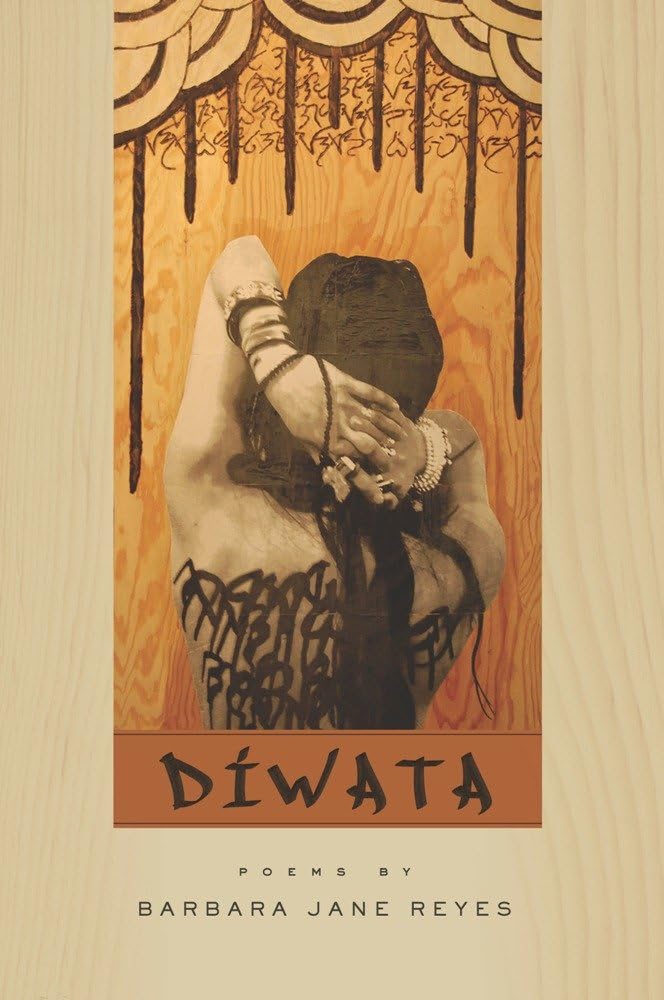



Tagalog is a language spoken by about 22 million people in the Philippines. Diwata is a Tagalog term meaning, “muse.” Diwata is also a term for a mythical figure or being who resides in nature, and whom human communities must acknowledge, respect, and appease, in order to live safely, harmoniously, and prosperously in this world. In her book Diwata , Reyes uses such Filipino oral tradition devices as meter, repetition and refrain, call and response, incantatory verses which verge on song, and the pantoum (which has Southeast Asian origins). She frames her poems between the Book of Genesis creation story, and the Tagalog creation myth, placing her work somewhere culturally in between both traditions. Also setting the tone for her stories is the death and large shadow cast by her grandfather, a World War II veteran and Bataan Death March survivor, who has passed onto her the responsibility of remembering. Reyes’ voice is grounded in her community’s traditions and histories, despite war and geographical dislocation "We are offered Reyes' own version of oral history, the history of her split heritage, the story of survival, and myths of Reyes' own creation that add an additional emtional truth despite their deliberate inaccuracy. We leave this book both shellshocked and empowered, reborn and rib–torn." ― Coal Hill Review "These retellings of myths and folk tales become a modality through which ahistory is rendered into history, history itself is investigated, and variations of diwatas, their quarries, and their hunters are revealed as inhabiting multiple narrative, linguistic, and cultural sites." ― Lantern Review "Triumphant and plaintive, Diwata is a living document, offering both succor and claws." ― Rain Taxi "Myth and story, telling and retelling, the claiming of an indigenous history and also a dislocation from that history form a thematic crux in this gorgeous text…" ― American Poet "We are offered Reyes' own version of oral history, the history of her split heritage, the story of survival, and myths of Reyes' own creation that add an additional emtional truth despite their deliberate inaccuracy. We leave this book both shellshocked and empowered, reborn and ribtorn." Coal Hill Review "These retellings of myths and folk tales become a modality through which ahistory is rendered into history, history itself is investigated, and variations of diwatas, their quarries, and their hunters are revealed as inhabiting multiple narrative, linguistic, and cultural sites." Lantern Review "Triumphant and plaintive, Diwata is a living document, offering both succor and claws." Rain Taxi "Myth and story, telling and retelling, the claiming of an indigenous history and also a dislocation from that history form a thematic crux in this gorgeous text
" American Poet Barbara Jane Reyes was born in Manila, Philippines, and was raised in the San Francisco Bay Area. She is the author of five previous collections of poetry: Gravities of Center (Arkipelago Books, 2003), Poeta en San Francisco (Tinfish Press, 2006), which received the James Laughlin Award of the Academy of American Poets, Diwata (BOA, 2010), which received the Global Filipino Literary Award for Poetry, To Love as Aswang (PAWA, Inc. Publications, 2015), Invocation to Daughters (City Lights, 2017), and Letters to a Young Brown Girl (BOA, 2020). She is an adjunct professor at University of San Francisco’s Yuchengco Philippine Studies Program. She lives with her husband, poet Oscar Bermeo, in Oakland, CA. For more information about Barbara Jane Reyes, visit barbarajanereyes.com. From "Estuary 2": She was born with fins and fishtail, A quick blade slicing water. She was her father's mermaid child, A river demon, elders said. She mimicked her cetaceous brothers, Abalone diving bluest depths. She polished smooth her brothers' masks, Inlaid nacre half moon eyes. She lit oak pyres and bade the wind A whispered requiem. Used Book in Good Condition