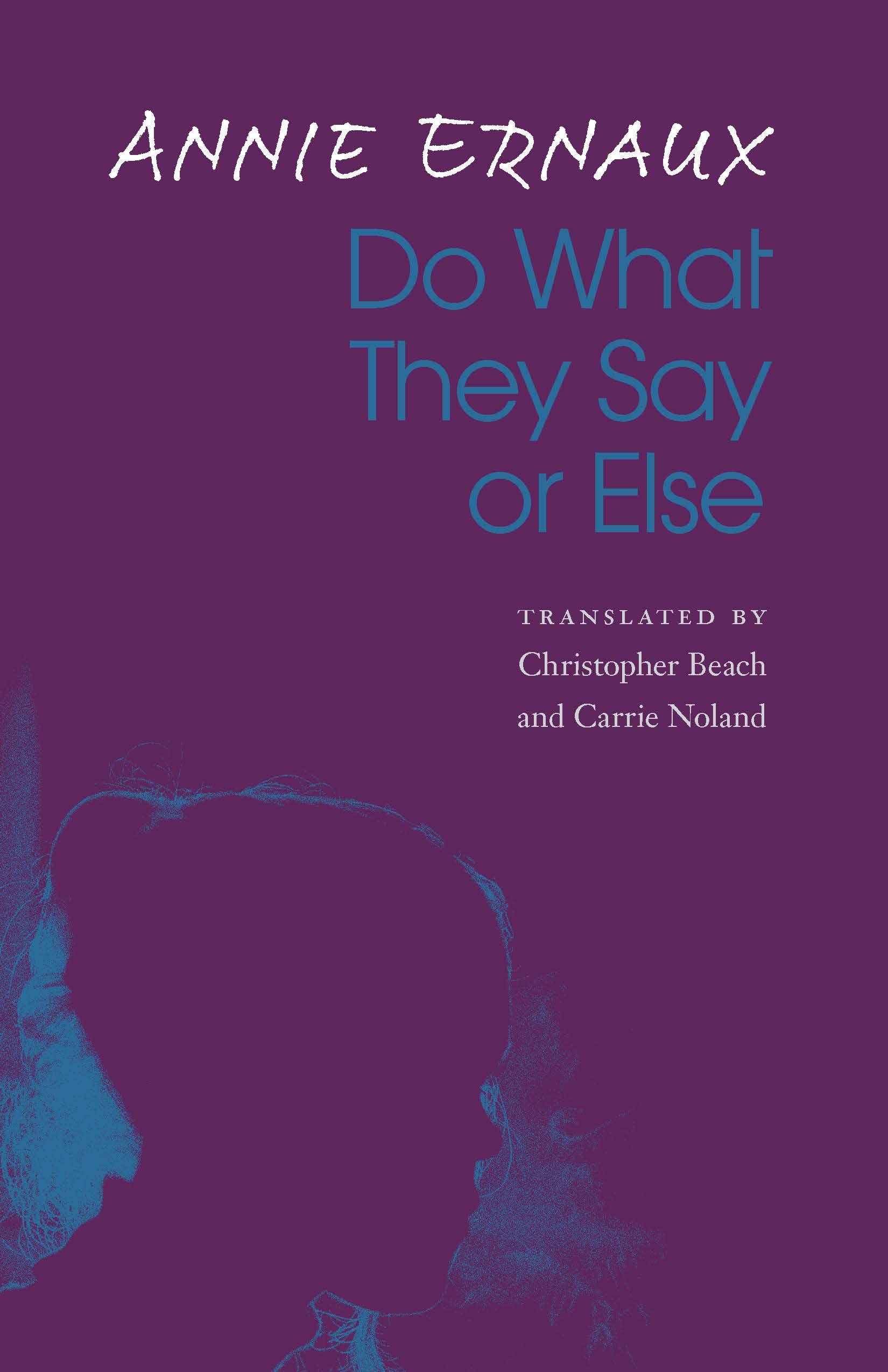



Winner of the 2022 Nobel Prize in Literature Originally published in 1977, Do What They Say or Else is the second novel by French author Annie Ernaux. Set in a small town in Normandy, France, the novel tells the story of a fifteen-year-old girl named Anne, who lives with her working-class parents. The story, which takes place during the summer and fall of Anne’s transition from middle school to high school, is narrated in a stream-of-consciousness style from her point of view. Ernaux captures Anne’s adolescent voice, through which she expresses her keen observations in a highly colloquial style. As the novel progresses and Anne’s feelings about her parents, her education, and her sexual encounters evolve, she grows into a more mature but also more conflicted and unhappy character, leaving behind the innocence of her middle school years. Not only must she navigate the often-confusing signals she receives from boys, but she also finds herself moving further and further away from her parents as she surpasses their educational level and worldview. “A powerful portrait of a searching adolescent.”— Publishers Weekly “In this, her second published novel, Annie Ernaux writes the psycho-biology of being fifteen years old with perfect recall. Do What They Say or Else conveys the cost of upward mobility and the desire to just throw it all away. Ernaux is in perfect control of her narrator’s wildness. The result is vivid and tough.”—Chris Kraus, author of After Kathy Acker: A Literary Biography “Annie Ernaux is often celebrated for her minimalist and documentary style. Yet this second novel, very funny at times, is narrated from the perspective of a teenage girl, with a vindictive and self-deprecating tone that ranges from the colloquial to the outright vulgar. This translation is a true tour de force!”—Bruno Thibault, author of Danièle Sallenave et le don des morts Annie Ernaux , winner of the 2022 Nobel Prize in Literature, was born in 1940 in Lillebonne, France. Her novels have won many awards and recognitions, including the 2008 Marguerite Duras Prize and the Prix Renaudot, and three of her novels have been named New York Times Notable Books. She is also the author of Things Seen (Nebraska, 2010). Sometimes I have the feeling that I have secrets. They aren’t really secrets, because I don’t want to talk about them, and besides, they’re things that can’t be told to anyone. They’re too strange. Céline is going out with a guy from our high school, a junior. He’s waiting to meet her at four o’clock on the corner next to the post office. At least it’s clear what her secret is. If I was her I wouldn’t even hide it. But the person who I am has no shape. Just thinking about it makes me feel heavy, like a real fatso. I’d like to sleep until a time when I could understand myself better—maybe when I’m eighteen or twenty-one. There must come a day when everything is clear, when everything falls into place. From then on, there’s nothing to do but walk the straight and narrow, married with two children and with a job that isn’t too pitiful. There was a theme for a paper: “Talk about your dreams for the future.” I got a good grade on it. The future. When I see all those years of reading books stretching out in front of me, I feel like I have a hole in my head. There are all these things that I don’t know yet and that I will have to be able to write and say. When I was little I would slide down, on purpose, all the way to the bottom of the bed. I didn’t want to get up, and it was dark and warm there. I feel the same way now. Last year I was only thinking about starting high school. Of course, the teachers were trying to scare us: “Your grades are just barely good enough . . .” They acted calm and dignified, but that didn’t help us much when it came to getting onto the academic track in high school. “You just have to be more intelligent. It’s not our fault if you don’t make it.” At home, my mother was always bitching: “You only got an 8 out of 20 in math! That’s not good. If you just put in a little effort, you’d do better. Do you want to end up working in a factory?” I know she’s right, and there’s nothing I can say back. If I didn’t go to high school—wham!—I would have to start working. Even so, when she was nagging me, around the time of the high school orientation last March, I didn’t like it. It would have been better if she hadn’t said anything. Now she’s feeling reassured. There won’t be any more fuss until the exam for the bac. I didn’t tell her that at the end of the first year you could be kicked out of high school or switched to a technical track. She would’ve made a big deal about it all year long. My parents don’t have their high school diplomas, and yet they’re a thousand times more annoying about it than Céline’s parents, who are engineers or something. It’s true that her parents don’t need to yell at her. They’re the living example of success, whereas in t