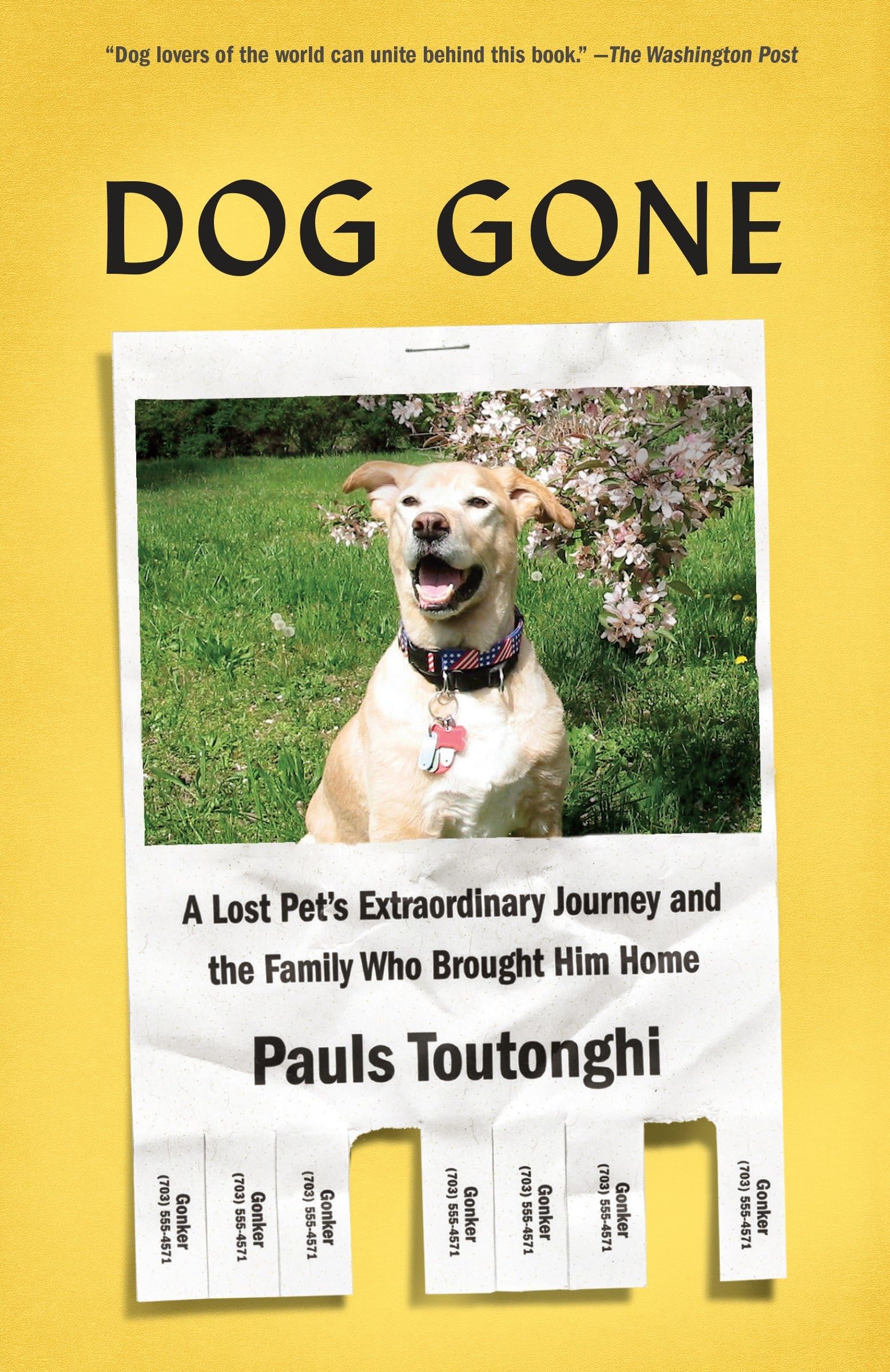
Dog Gone: A Lost Pet's Extraordinary Journey and the Family Who Brought Him Home
$17.00
by Pauls Toutonghi



The true story of a lost dog’s journey and a family’s furious search to find him before it is too late. Along the way, a father and son discover their own lost bond. Suspenseful, heartbreaking, and ultimately life-affirming, Dog Gone shows us the way heroism can assert itself in the little things we do each day. • Now a Netflix Film Starring Rob Lowe. October 10, 1998. Fielding Marshall is hiking on the Appalachian Trail. His beloved dog—a six-year-old golden retriever mix named Gonker—bolts into the woods. Just like that, he’s vanished. And Gonker has Addison’s disease. If he’s not found in twenty-three days, he will die. Dog Gone is the story of the Marshall family—Fielding and his parents, John and Virginia—and their epic hunt to track down Gonker. As their search continues, covered by news outlets and drawing in the community at large, old wounds reemerge, threatening to undo the Marshalls—but also presenting the opportunity for long-overdue healing. "Toutonghi’s narrative is well-written and fast-paced. . . . Like a good novel, “Dog Gone” is full of twists that keep the reader engaged until the very end. . . . Don’t be surprised if, at the finish of “Dog Gone,” you find yourself wanting to rush to an animal rescue shelter. . . . Dog lovers of the world can unite behind this book." — The Washington Post “Lovely. . . . He’ll make you laugh…and he’ll evoke your tears. . . . It’s a story about the triumph of hope over despair. And a story of persistence, courage, and determination. And in its most profound and universal sense, a love story.” — Richmond Times-Dispatch "A moving nail-biter." — Good Housekeeping "A beautifully told story of a lost childhood, and a woman's efforts to make things right with herself, her children, and the world." — The Oregonian "The story of loss, love and resilience is told by Toutonghi with lots of heart and humor. The book stresses how heroism can assert itself in the little things we do each day." — The News & Observer PAULS TOUTONGHI is a first-generation American. He has been awarded a Pushcart Prize, and he has written for The New Yorker, The New York Times, Virginia Quarterly Review, Granta, Tin House, and numerous other periodicals. He lives in Oregon, where he teaches at Lewis & Clark College. 1 Here is Virginia Newman Corbett. She will go on to be Fielding Marshall’s mother, and Gonker Marshall’s grandmother, but right now she is seven years old, a little girl in a bright-red polka-dot dress and bright-red patent-leather shoes. It is 1949. She is in Japan with her parents, and living like a storybook princess. Here is Lieutenant Colonel William Henry Corbett—Virginia’s father, my wife’s grandfather—an officer in the United States Army’s Special Services Unit, based in Yokohama. Colonel Corbett’s job is to approve recreational activities for the soldiers of the American occupation. And so he has to visit—with his family—the hotels and restaurants vying for the business of American GIs. Based on these visits, he recommends certain establishments, and removes others from the lists for officer leave. Here’s how a typical evening went: The car pulled up—a limousine—bearing Virginia and her parents. The driver opened the door, and the Corbetts stepped out of the vehicle, often onto a red strip of carpet. The staff of the hotel had already assembled in a receiving line; they wore their finest ceremonial dress. The Corbett family then proceeded down that line like royalty—greeting each member of the staff, receiving formal bow after formal bow. Then they went to the central dining room, where they had a many-course meal. There was often a geisha standing near the table who had the sole responsibility of keeping little Virginia happy. Bright silk kimonos, amaranth lipstick, white facial powder, obsidian hair. An intricacy of manners and service. At the end of these meals, a finger bowl would be put in front of Virginia, a little silver container with warm fragrant water in it—and a white chrysanthemum floating on its surface. She’d dip her fingertips into the bowl, and her geisha would suddenly be there, holding a finely embroidered cloth for her to dry her hands. Virginia thought it was all quite normal and wonderful. “Eloise at the Plaza,” she said, “had nothing on us.” The reality of the economic climate, of course, was this: During the war, Allied forces had firebombed the nation’s main industrial centers to rubble. For example, on May 29, 1945, 454 Boeing Superfortress B-29s had hit Yokohama Prefecture, destroying 42 percent of it in just over an hour, killing more than seven thousand people. General Curtis LeMay’s 468th Bomb Group had used AN-M76 incendiary bombs filled with PT-1 (Pyrogel) to blanket the city with fire. Napalm—blooming in the air and boiling human flesh, nine hundred to a thousand degrees Celsius at the point of ignition. After LeMay’s campaign—and the destruction of Hiroshima and Nagasaki—Japan’s econo