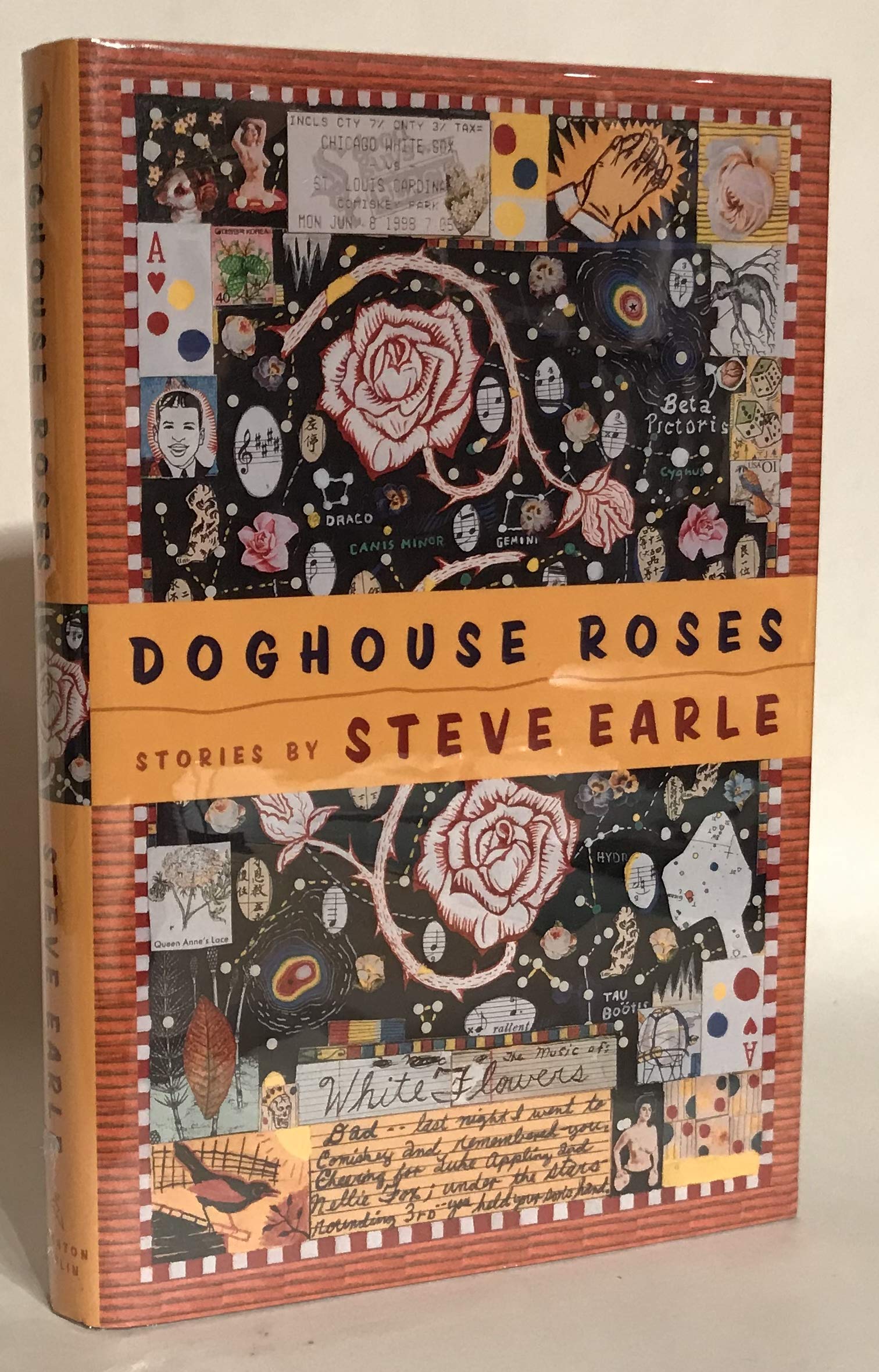



A debut collection of short fiction by the popular singer-songwriter features brutally honest, sometimes autobiographical tales, including the title story about a singer whose life has nearly been destroyed by drugs, "Wheeler County" about a hitchhiker stranded for years in a small Texas town, "Billy the Kid," and more. 30,000 first printing. Fans of Steve Earle's music will recognize many familiar themes in his first collection of short stories, Doghouse Roses . Here are tales of drug addiction, the nightmare of Vietnam, and the price of failure (or success) in the music industry. Not surprisingly, the latter topic elicits some of Earle's best work: in "Billy the Kid," for example, he traces the meteoric rise of Nashville's last authentic country-music prodigy, whose early fame was abruptly terminated by a car accident. And in "Doghouse Roses," Bobby Charles's career nose-dives as he grapples with heroin, speedballs, and crack: "He suspended all pretence of taking care of himself, going for days without showering and living on a steady diet of ice cream and Dr. Pepper. He left the house only to cop, driving straight home and sitting in the tiny half bath in the hallway for hours with his pipe." Yet the protagonist, like his creator, finally regains a grip on sobriety, along with a revived career. Earle misses the mark in "Taneytown," a first-person narrative told through the eyes of a mentally retarded black child. And his focus on the harsh (and very masculine) world of junkies, country music, and execution chambers can grow a little thin. Still, Doghouse Roses offers up an ample dose of optimism. After all, in a world where cold-blooded murderers let innocent men take the rap, and junkies watch their dealers die, the gods of forgiveness can still be summoned with a single rose sold at a convenience store--the age-old remedy for men in the proverbial doghouse. --Gregory Bensinger Earle's first collection of short fiction runs true to the colorful pattern of his own life as an alternative-country musician, rehabilitated drug addict, and both winner and loser at love. The title story depicts the final straw that breaks drug-abuser musician Bobby's tautly stretched marriage. "Reunion" brings the Vietnam War to life from the perspective of former enemies haunted by their experiences, and "Jaguar Dance" illuminates a nightmarish episode in the life of a drug-smuggling pilot. There are also bittersweet stories, such as "Billy the Kid," in which a talented unknown musician, about to take the business by storm, proves he's truly the stuff of which legends are made. Earle's widening reputation as a musician is soon to be rivaled by his renown as a talented storyteller. Suitable for most collections. - Margee Smith, Grace A. Dow Memorial Lib., Midland, MI Copyright 2001 Reed Business Information, Inc. Singer-songwriter Earle, an anti-death-penalty activist, a former heroin addict, and a veteran of six divorces, packs his perspective on all these issues into his first collection of short stories, which feature junkies, guitarists, doomed love affairs, and lonely drifters. His characters inhabit the dusty corners of border towns, trailer parks, hotel rooms, and dimly lit bars, where they struggle to undo the consequences of bad choices and to make sense of life, love, and record contracts. The stories featuring musicians, particularly musicians struggling with drug problems, are written with the most heart, further proof of the wisdom of "writing what you know." The plots are often predictable, but their familiarity is almost comforting--not unlike a good rock ballad. It is when Earle tries on other points of view (a kindly retarded man, a black child, a Vietnamese colonel) that the stories feel most flat and cliched. The collection never forms a cohesive whole, but its heart is in the right place, and Earle's name is sure to generate interest. Carrie Bissey Copyright © American Library Association. All rights reserved "A heartfelt, beautifully observed collection of stories." -- The Oregonian "They haven't been shaped by the small magazines or mainstream monthly editors. There's an appealing sort of innocence to them." -- Salon "[A] surprisingly fine short story collection " -- The Star Tribune "[Earle's] ability to write so close to the bone makes Doghouse Roses such an entertaining read." -- The Los Angeles Times "Earle's narrative voice sounds like an sage in a smoky bar..." -- Kirkus Reviews "They haven't been shaped…by the small magazines or mainstream monthly editors. There's an appealing sort of innocence to them." -- Review STEVE EARLE is a singer-songwriter who has released ten critically acclaimed albums since his 1986 debut album, Guitar Town, burst onto the Nashville scene and made him a star overnight. A prolonged struggle with drug addiction resulted in jail time in the early 1990s, but Earle’s recovery and comeback albums, beginning wth the 1995 Grammy-nominated Train A Comi