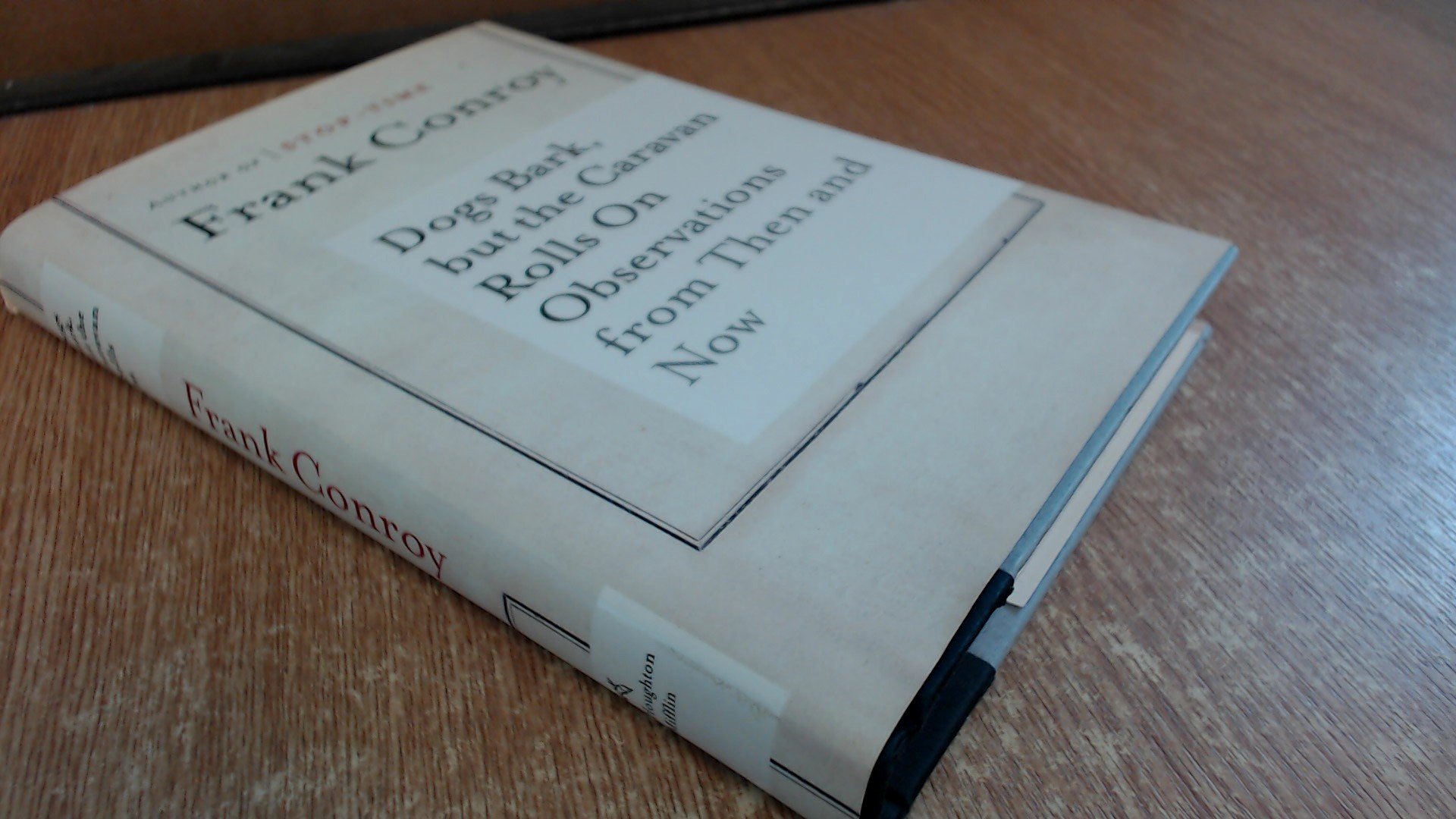



The author provides an autobiographical collection of his commentaries on life, music, and writing from the New York Times Magazine, Harper's Magazine, Esquire, and GQ, revealing his lifelong dreams and aspirations over three decades of exceptional journalism. 15,000 first printing. Dogs Bark, but the Caravan Rolls On: Observations Then and Now , Frank Conroy's first nonfiction work since his acclaimed memoir Stop-Time , contains thoughtful pieces on jazz, writing, his father, and fathering. In addition to directing the Iowa Writers' Workshop, Conroy is a jazz pianist of some skill, as he proudly notes in this collection, taken primarily from articles published in Esquire and GQ . Profiles of Keith Jarrett, Wynton Marsalis, and the Rolling Stones are complemented by pieces about Conroy's own musical background, including a wonderful story of the Harlem club where Conroy became a regular, and of playing piano at a club without his bass player, who was late, only to have Charles Mingus arise from dinner and sit in. On writing, there are some useful pieces regarding the process itself, particularly in "The Writers' Workshop." Conroy is direct and engaging, and he humbly discusses his childhood truancy, his flawed writings, and his family life. While some writers mythologize or sepia-coat their lives, Conroy tells it like it is, or was, but with careful thought and personal meaning to which readers can relate. As Conroy humbly jams with Marsalis, he confesses: "I feel like a child who has the skills to ride a pony but has been mistakenly mounted on Man o' War." After his first experience with Mingus, the great bassist said, "'You are ... an authentic primitive. That is true.' He leaned forward and lowered his voice. 'But you swing.'" Conroy's writings swing, too, and Dogs Bark, but the Caravan Rolls On has something for everyone, especially writers and jazz enthusiasts. --Michael Ferch The director of the famous Writers' Workshop at the University of Iowa, Conroy has contributed to such publications as Esquire, Harper's magazine, and the New York Times Magazine, as well as to books on writing, for many years. His miscellaneous essays are now collected in this interesting and well-done anthology. Conroy takes on such topics as learning to play pool, fatherhood, the value of now-disappearing small towns in instilling family values, the enthusiasms of jazz musician Wynton Marsalis, and, of course, the Writers' Workshop. Conroy is a jazz pianist as well as a teacher and writer, so it is natural that a number of essays deal with music and musicians. Previous works by this author include a well-received memoir, Stop-Time, and the novel Body & Soul, whose reception was more mixed. Academic and public collections, particularly those strong in modern American literature or music, will want to consider this title. Nancy P. Shires, East Carolina Univ. Lib., Greenville, NC Copyright 2002 Cahners Business Information, Inc. Interesting and well-done anthology -- Review FRANK CONROY is the director of the Writers Workshop at the University of Iowa. He is also an accomplished jazz pianist. Some Observations Now In 1968 a pal of mine who worked for The New Yorker was sent to cover the Democratic convention in Chicago. During the infamous police riots he was struck two or three times by a cop with a nightstick, and when he managed to get back to his hotel he found himself pissing blood. He eventually recovered, wrote his piece and left out the attack on himself. "Michael," I asked my always elegantly dressed, highly polite friend, "how could you leave it out? You weren"t protesting. It shows the scope of the violence. It"s important." He respectfully disagreed. "I wasn"t sent to write about myself," he said, with a certain amount of hauteur. New Journalism was in the air back then--an approach in which the observer was taken to be as important, or more important, than the stuff observed (Tom Wolfe, for instance, writing about auto shows, well before taking on the more ambitious role of American Balzac). The New Yorker frowned on New Journalism. People took sides. I never did, whether from laziness or a reluctance to box myself in, I don"t know. I dealt with each piece I wrote as seemed appropriate at the time. The closest I came to New Journalism was probably a long piece (endlessly long, in fact) about the late movie star Steve McQueen, written for what was then considered not the best but the hippest magazine around, Esquire. McQueen, whom I had never thought much of as an actor, turned out to be a nice guy. Unassuming, straightforward, easygoing if a touch wired, he was good company. We had fun riding 250 cc dirt bikes in the desert around Palm Springs, drinking beer, eating Mexican food at out-of-the-way joints and swimming in the pool behind his Palm Springs house, his getaway pad (his mansion was in Beverly Hills, of course). It was my first "big" magazine piece. Still in my twenties,