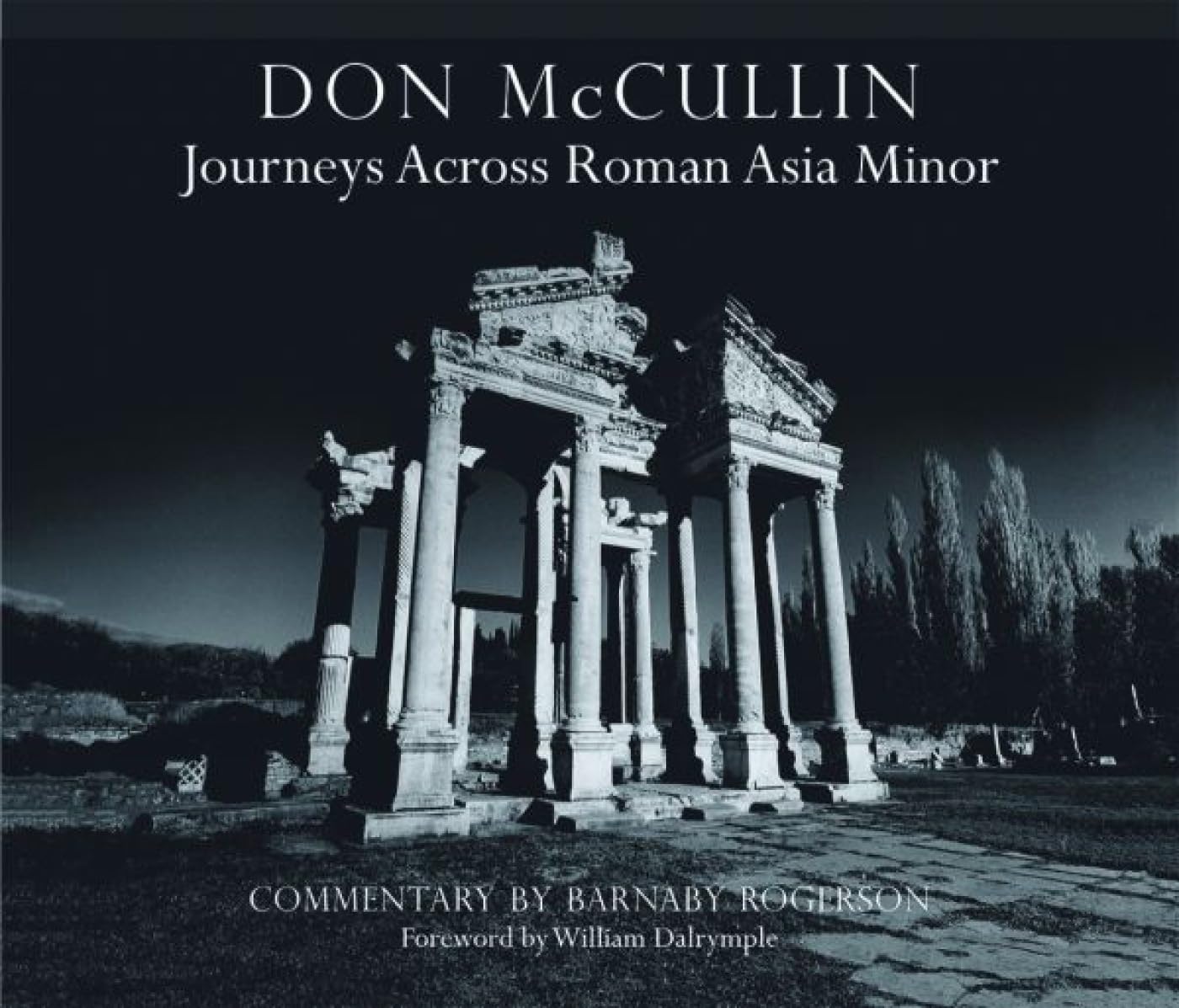
Don McCullin - Journeys Across Roman Asia Minor: Journeys Across Roman Asia Minor
$140.00
by Don McCullin



Join Don McCullin as he reveals a world full of wonder from the pavements once trodden by Aristotle and Alexander the Great to the poignant ruins of the once powerful Roman Empire. "Photography for me is not looking, it’s feeling. If you can’t feel what you’re looking at, then you’re never going to get others to feel anything when they look at your pictures." – Don McCullin Sir Donald McCullin’s Journeys Across Roman Asia Minor is driven by an eye for beauty and an ear for history. On his 5,000-mile travels in western Turkey he works his ineffable magic, moving from a sanctuary known to Homer to the broken face of an exhausted Roman emperor, before turning his eye on the sensuous torso of a goddess. While most of us were sheltering from Covid, Don explored the mountains, valleys and coast of western Turkey, hunting out the most poignant and powerful ruins of the Roman Empire. He has created a meditation on landscape, the effects of light on ancient stone, the way clouds animate the past, but this book is also inescapably about conquest, imperium and power. Journeys Across Roman Asia Minor reveals a world full of wonder. We see pavements once trodden by Aristotle and Alexander the Great, Julius Caesar, St Paul and the Emperor Hadrian. Through his lens we discover ancient theaters cascading down the slopes of mountains, 2,000-year-old bridges used by hill farmers to this day, and spring water flowing into fountains still dominated by statues of the gods. Journeys Across Roman Asia Minor is consciously focused on just one specific period within Turkey’s dazzlingly rich parade of historical cultures (that stretch back over 12,000 years), but by choosing the 500 years of the Roman Empire, we can also celebrate a time that we can all share in. Journeys Across Roman Asia Minor is a companion to an earlier volume, Southern Frontiers , where Don had observed the landscapes of the Roman Empire in North Africa and Syria. Journeys Across Roman Asia Minor was created through a series of journeys across western Turkey commissioned by Cornucopia Magazine. His companion during all these journeys was the writer Barnaby Rogerson, who was not only able to watch the master at work but was able to listen to the astonishing tales from Don’s adventurous life, as they traveled along Roman roads. So we get the context and the historical story behind every chosen photograph. Don McCullin has won himself the reputation of being one of the greatest living photographers of conflict, but this has always co-existed with his other role as a great traveler. He also takes pride in the craft, so he delights in developing all his own film. The far frontiers of the Roman Empire are a lifelong obsession that had been accidentally been kick-started by an incident in his early career when he worked alongside Bruce Chatwin. Table of Contents FOREWORD William Dalrymple Page 11 INTRODUCTION Barnaby Rogerson Page 13 PREFACE Sir Donald McCullin Page 17 PART I ANCIENT ART IN ISTANBUL Page 21 PART II PERGAMON Page 43 PART III BERGAMA MUSEUM Page 55 PART IV THE TROAD Page 61 PART V TROY MUSEUM Page 71 PART VI APHRODISIAS Page 83 PART VII APHRODISIAS MUSEUM Page 99 PART VIII SARDIS TO EPHESUS Page 119 PART IX EPHESUS ARCHAEOLOGICAL MUSEUM Page 135 PART XVIII FROM PHRYGIA TO THE LYCIAN SHORE Page 147 PART XI ANTALYA MUSEUM Page 179 PART XII PISIDIA Page 211 PART XIII BURDUR MUSEUM Page 225 PART XIV PAMPHYLIA Page 235 ACHILLES TO AUGUSTUS: THE STORY OF ASIA MINOR Barnaby Rogerson Page 250 THE STORIES BEHIND THE PICTURES Page 262 ACKNOWLEDGEMENTS Page 286 BIBLIOGRAPHY Page 287 Don McCullin is one of the worlds greatest living photographers. Few have enjoyed a career so long; none one of such variety and critical acclaim. For the past 50 years he has proved himself a photojournalist without equal, whether documenting the poverty of London’s East End, or the horrors of wars in Africa, Asia or the Middle East. Simultaneously he has proved an adroit artist capable of beautifully arranged still lifes, soulful portraits and moving landscapes. In 1993 he was the first British photojournalist to be awarded a CBE. This first would be capped by a knighthood and then by a solo exhibition at the Tate Gallery. Don was born in 1935. He survived an impoverished north London childhood further blighted by Hitler’s bombs and evacuation. The early death of his father, meant the end of any hopes of further education. Young McCullin was called up for National Service with the RAF. After postings to Egypt, Kenya and Cyprus he returned to London armed with a twin reflex Rolleicord camera and began photographing friends from a local gang named The Guv’nors. Persuaded to show them to the picture editor at the Observer in 1959, aged 23, he earned his first commission and began his long and distinguished career in photography more by accident than design. In 1961 he won the British Press Award for his essay on the construction o