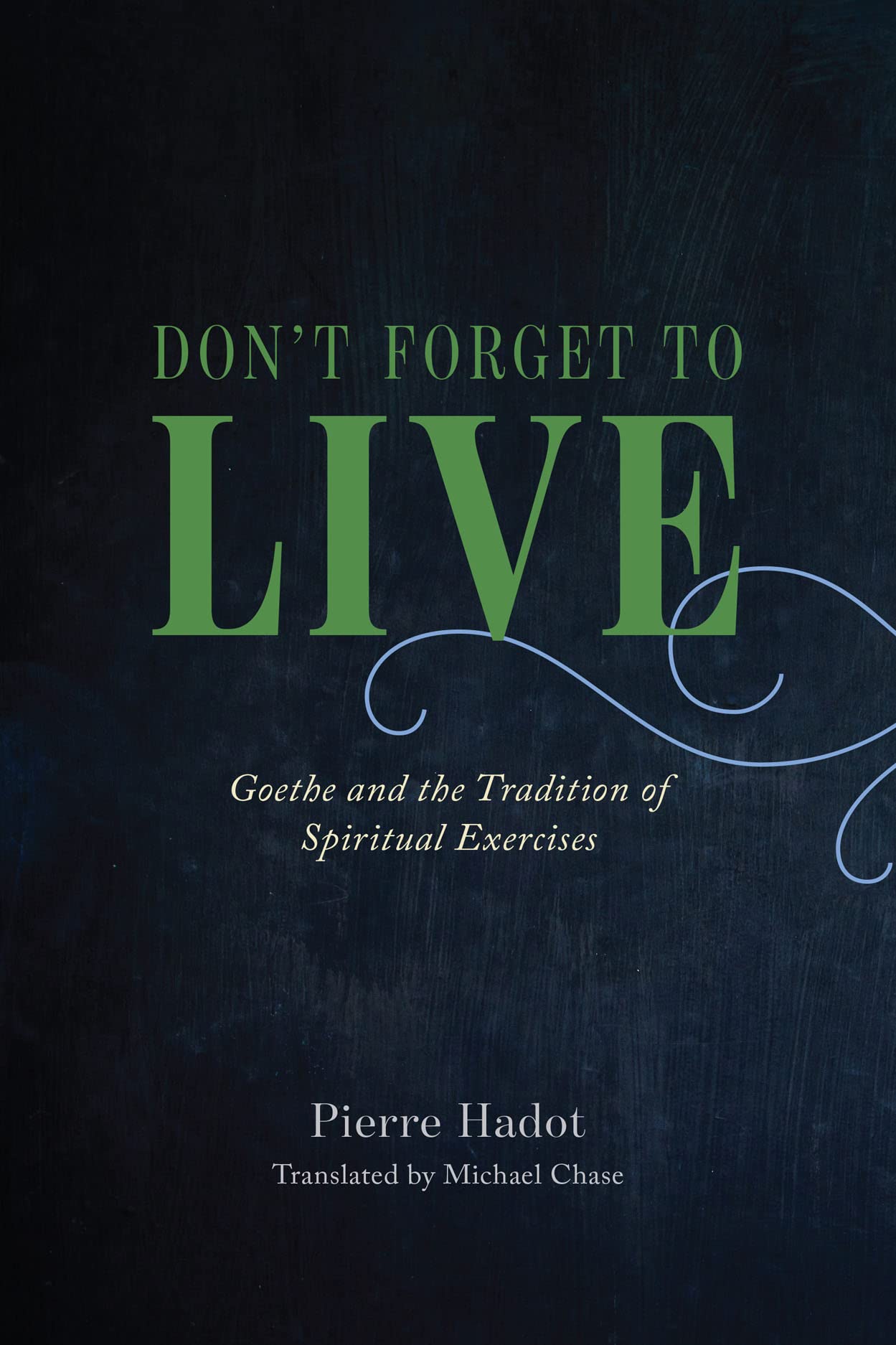
Don't Forget to Live: Goethe and the Tradition of Spiritual Exercises (The France Chicago Collection)
$25.00
by Pierre Hadot



The esteemed French philosopher Pierre Hadot’s final work, now available in English. With a foreword by Arnold I. Davidson and Daniele Lorenzini. In his final book, renowned philosopher Pierre Hadot explores Goethe’s relationship with ancient spiritual exercises—transformative acts of intellect, imagination, or will. Goethe sought both an intense experience of the present moment as well as a kind of cosmic consciousness, both of which are rooted in ancient philosophical practices. These practices shaped Goethe’s audacious contrast to the traditional maxim memento mori (Don’t forget that you will die) with the aim of transforming our ordinary consciousness. Ultimately, Hadot reveals how Goethe cultivated a deep love for life that brings to the forefront a new maxim: Don’t forget to live. "There are few figures in Western literature whose legacies are as bound up with their work as Goethe, and Hadot’s powerful interpretation is undoubtedly an important milestone in that legacy’s history. Even apart from it many other virtues, that reason alone makes this volume a necessary addition to the libraries of Goethe scholars." ― Journal of Religion "With its remarkable erudition, skillful integration and explication of numerous specific quotations, and a style that in spite of its scholarliness is clear and accessible, Hadot’s methodology of careful reading as a lived practice . . . not only recommend[s] but also instantiate[s] an exuberant yet disciplined practice of spending time with key passages extracted from celebrated works of fiction and philosophy." ― The European Legacy “To read Pierre Hadot sparks enormous joy.” ― Charlie Hebdo, on the French edition “No one is more qualified to describe this spiritual line of descent than Pierre Hadot” ― Le Figaro, on the French edition “A very beautiful book that celebrates action, the duty to serve, and joy.” ― Valeurs Actuelles, on the French edition “This deeply personal work, by one of the greatest of French classical philosophers, featuring one of his major inspirations, the great German author and philosopher Goethe, excellently translated by Michael Chase, might just change your life. It is the culmination of Hadot’s long-term concern with ‘philosophy as a way of life,’ and constitutes a significant expansion and deepening of this theme.” -- John Dillon, Trinity College Dublin “Renowned for reviving the classical idea of philosophy as an art of living, Pierre Hadot combines his expertise in Greco-Roman thought with an extensive study of Goethe to produce a fascinating book, rich in both erudition and relevance for the conduct of life—reinterpreting, with compelling nuance and philosophical sophistication, the deeper, more mindful meaning of the Horatian maxim carpe diem . What you learn from this book can change your life.” -- Richard Shusterman, Florida Atlantic University "Pointing to similarities to the ancient philosophers Goethe knew intimately, Hadot observes that Goethe owes a debt to them but surpasses them in his emphasis on remembering to live a joyfully fulfilling life. Beautifully translated." -- E. G. Wickersham ― Choice Pierre Hadot (1922–2010) was professor of the history of Hellenistic and Roman thought at the Collège de France. He was the author of many books, including Plotinus or the Simplicity of Vision . Michael Chase is senior researcher at the Centre National de la Recherche Scientifique Centre Jean Pépin and adjunct professor of Greek and Roman studies at the University of Victoria. He is the author and translator of many books, including Ammonius: Interpretation of Porphyry’s Introduction to Aristotle’s Five Terms . Arnold I. Davidson is Distinguished Professor of Humanities at The Hebrew University of Jerusalem, where he teaches principally in the Department of Jewish Thought and the Department of Romance Studies. He is also the Robert O. Anderson Distinguished Service Professor Emeritus at the University of Chicago. Daniele Lorenzini is associate professor of philosophy at the University of Pennsylvania.