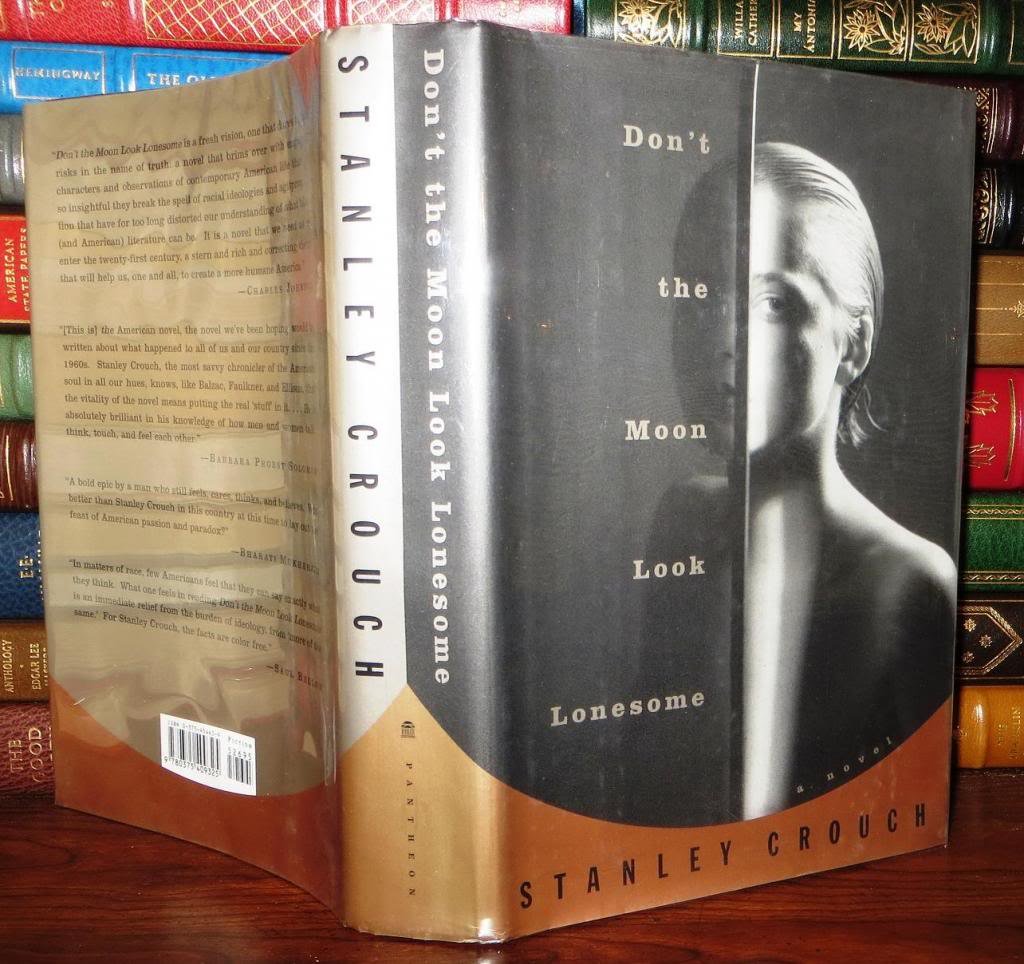



This is flap copy.... Stanley Crouch is one of the great provocateurs in American letters, which has led Salon to call him "the bull in the black-intelligentsia China shop." Infamous for his controversial views on race, he loves to treat iconic figures such as Toni Morrison and Spike Lee as critical pincushions. However, he has built his career primarily as a reviewer and essayist. Don't the Moon Look Lonesome , then, represents his first attempt at fiction. Crouch's novel tells the story of a mixed-race couple, both musicians, living in New York City. Maxwell is a black sax player; Carla is a white jazz singer. Their love for each other seems to transcend race--yet the great American dilemma keeps interfering, and as they try to gain acceptance from friends and family, jazz is the one thing that soothes them. In a typical altercation, a black man in a parking lot derides Carla as a "stringy-haired white girl." But as she listens to Maxwell perform immediately afterward, the very notes he plays seem like the best possible rebuttal, "more masculine and more tender and more androgynous and more than male or female or happy or sad or frightened or brave or knowing or befuddled than anything she had ever heard her man play." Don't the Moon Look Lonesome is an awkwardly written novel, and a slow-moving one at that. Long passages are devoted to descriptions of the music Carla and Maxwell create, and while Crouch has inherited Albert Murray's mantle as one of our most lively jazz critics, his own voice merges with those of his characters in an odd and distracting way. They end up sharing both the author's appetite for provocation and his wordiness, which undermines the greatest mystery of music in the first place--its wordlessness. Crouch also has a propensity for bizarre metaphors attributed to inner states, a prime example being this thorny item: "the sudden spread of this interior cactus." Finally, female readers should be warned: one of Carla's major strengths is that despite her white skin, she has a black ass. Perhaps that's progress. And perhaps Crouch's editors were so intimidated by his reputation that they neglected to tell him when he was playing out of tune. --Emily White Jazz critic and essayist Crouch's first novel is a stylish love story told against the backdrop of the New York jazz scene. Carla, a white singer from South Dakota, and Maxwell, a black saxophone player of some renown, have been together for five years, but the pressures of race, art, success, and family threaten their future. As Carla searches through her memories of former loves for ways to break down the barriers between her and Maxwell, she struggles to find her own place in the competitive world of jazz. Crouch is at his best when writing about the music. His descriptions have a flow that makes the reader feel as though he or she is listening to a blues band or a gospel choir. Carla's thoughts have the cadence of an improvisational solo, going in various directions before returning to the original theme. While some of the dialog is talky and the main characters distant, those familiar with Crouch's nonfiction will want to read this novel, if only for its style. Recommended for larger collections. ---Ellen Flexman, Indianapolis-Marion Cty. P.L. Copyright 2000 Reed Business Information, Inc. QUOTE This is flap copy.... " Don't the Moon Look Lonesome is a fresh vision, one that dares to take risks in the name of truth: a novel that brims over with engaging characters and observations of contemporary American life that are so insightful they break the spell of racial ideologies and agitprop fiction that have for too long distorted our understanding of what black (and American) literature can be. It is a novel that we need as we enter the twenty-first century, a stern and rich and correcting vision that will help us, one and all, to create a more humane America." -- Charles Johnson "[This is] the American novel, the novel we've been hoping would be written about what happened to all of us and our country since the 1960s. Stanley Crouch, the most savvy chronicler of the American soul in all our hues, knows, like Balzac, Faulkner, and Ellison, that the vitality of the novel means putting the real 'stuff' in it. . . . He is absolutely brilliant in his knowledge of how men and women talk, think, touch, and feel each other." -- Barbara Probst Solomon "A bold epic by a man who still feels, cares, thinks, and believes. Who better than Stanley Crouch in this country at this time to lay out the feast of American passion and paradox?" -- Bharati Mukherjee "In matters of race, few Americans feel that they can say exactly what they think. What one feels in reading Don't the Moon Look Lonesome is an immediate relief from the burden of ideology, from 'more of the same.' For Stanley Crouch, the facts are color free." -- Saul Bellow THis i s the rich teafjka' sfjas fjs asdfsd sdf Chapter One: Gee, Baby When Carla flew to Houston