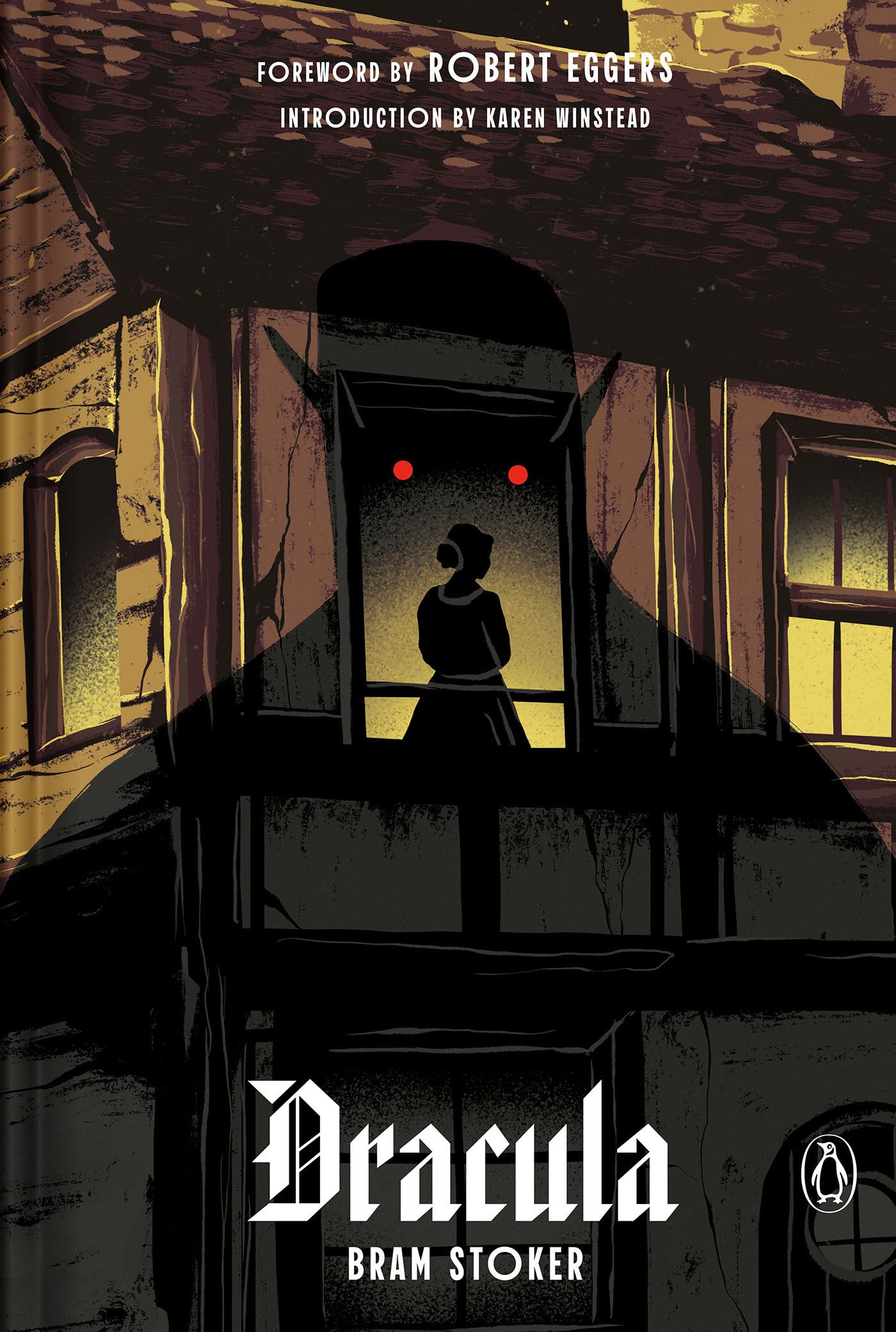



Bram Stoker's iconic and immortal tale of desperate battle against a powerful, ancient vampire, with a foreword by acclaimed director Robert Eggers, in a new Penguin Classics hardcover, a Penguin Speculative Fiction Special. A Penguin Classic Hardcover One of Library Journal's Best Books of the Year When Jonathan Harker visits Transylvania to help Count Dracula purchase a London house, he makes horrifying discoveries in his client's castle. Soon afterwards, disturbing incidents unfold in England: a ship runs aground on the shores of Whitby, its crew vanished; beautiful Lucy Westenra slowly succumbs to a mysterious, wasting illness, her blood drained away; and the lunatic Renfield raves about the imminent arrival of his "master." In the ensuing battle of wills between the sinister Count and a determined group of adversaries - led by the intrepid vampire hunter Abraham van Helsing - Bram Stoker created a masterpiece of the horror genre, probing into questions of identity, sanity and the dark corners of Victorian sexuality and desire. Penguin Speculative Fiction Special is a hardcover series of horror, science fiction, fantasy, and more published by Penguin Classics. Featuring custom endpapers, specially commissioned cover art, and introductions by scholars and notable figures, these collectible editions celebrate classics that invite us to ask, “What if?” and that, through bold imagination, alternative visions, and magical realms, transform our perception of our world. "These days, it's distressingly easy for modern-day vamp fans to forget where it all began. That's why this annotated Dracula is such a gift; Mort Castle reminds us that the novel's legacy lies with its author's monstrous talent, intelligence, and imagination. This is a must for any emerging writer's reference bookshelf." -- Alison Lang , Rue Morgue Magazine Abraham 'Bram' Stoker (1847 - 1912) was educated at Trinity College, Dublin and joined the Irish Civil Service before his love of theatre led him to become the unpaid drama critic for the Dublin Mail. He went on to act as as manager and secretary for the actor Sir Henry Irving, while writing his novels, the most famous of which is Dracula . Robert Eggers (foreword) is an American filmmaker and production designer. He is best known for writing and directing the historical horror films The Witch (2015) and The Lighthouse (2019), as well as The Northman (2022) and the forthcoming Nosferatu (2024). His films are noted for their folkloric elements, as well as his efforts to ensure historical authenticity. Karen Winstead (introduction) is professor of English at Ohio State University. She is the author and translator of a number of books, including Fifteenth-Century Lives: Writing Sainthood in England (2020), and teaches on Special Topics in Film and Literature (“Monsters Without and Within”) and Special Topics in Popular Culture (“Vampires”). Chapter I Jonathan Harker’s Journal (Kept in shorthand.) 3 May. Bistritz.1–Left Munich at 8:35 p. m., on 1st May, arriving at Vienna early next morning; should have arrived at 6:46, but train was an hour late. Buda-Pesth seems a wonderful place, from the glimpse which I got of it from the train and the little I could walk through the streets. I feared to go very far from the station, as we arrived late and would start as near the correct time as possible. The impression I had was that we were leaving the West and entering the East; the most western of splendid bridges over the Danube,2 which is here of noble width and depth, took us among the traditions of Turkish rule. We left in pretty good time, and came after nightfall to Klausenburgh.3 Here I stopped for the night at the Hotel Royale. I had for dinner, or rather supper, a chicken done up some way with red pepper, which was very good but thirsty. (Mem., get recipe for Mina.) I asked the waiter, and he said it was called “paprika hendl,” and that, as it was a national dish, I should be able to get it anywhere along the Carpathians.4 I found my smattering of German very useful here; indeed, I don’t know how I should be able to get on without it. Having had some time at my disposal when in London, I had visited the British Museum,5 and made search among the books and maps in the library regarding Transylvania: it had struck me that some foreknowledge of the country could hardly fail to have some importance in dealing with a nobleman of that country. I find that the district he named is in the extreme east of the country, just on the borders of three states, Transylvania, Moldavia andBukovina,6 in the midst of the Carpathian mountains; one of the wildest and least known portions of Europe. I was not able to light on any map or work giving the exact locality of the Castle Dracula, as there are no maps of this country as yet to compare with our own Ordnance Survey maps;7 but I found that Bistritz, the post town named by Count Dracula, is a fairly well-known place. I shall enter