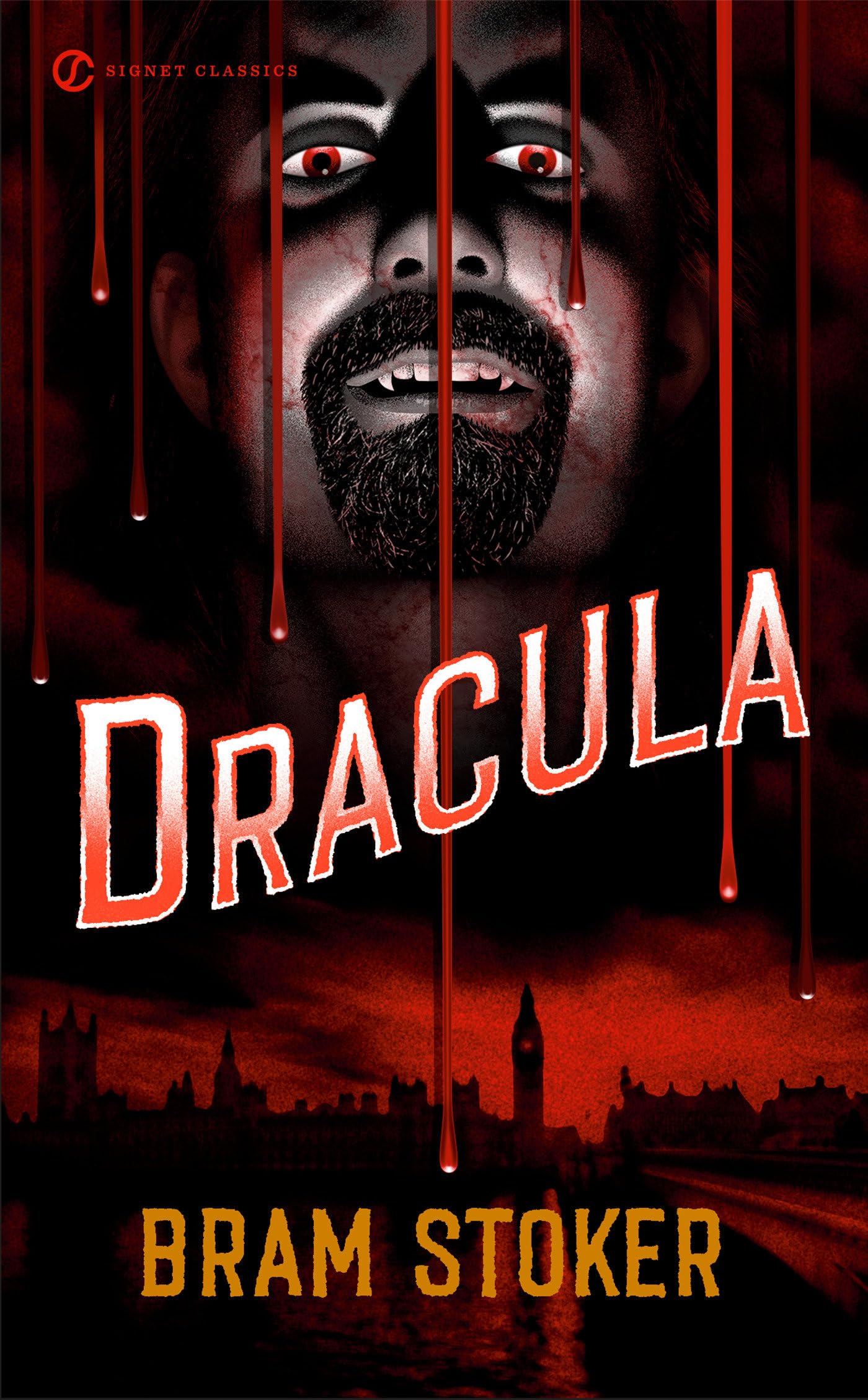



Bram Stoker’s gothic horror masterpiece pits good against evil and life against death, all under the thrall of the original vampire.... “Listen to them—the children of the night. What music they make!” He is a creature of darkness. His face deathly pale, his eyes ablaze with the fires of hell. He has been dead for centuries, yet he may never die. He waits in his crumbling castle in the mountains of Transylvania, as his prey draws closer and closer to destruction.... Here begins one of the most celebrated horror stories in history, the tale of an undead monster who craves the blood of his victims and relishes his dominance over mankind. With its delicious mix of action, suspense, and looming dread, Bram Stoker’s Dracula has terrified and inspired readers for more than a hundred years. With an Introduction by Leonard Wolf and an Afterword by Jeffrey Meyers “Stoker gives us the most remarkable scenes of horror...each is unforgettable, and no movie has quite done justice to any of them.”—Stephen King Bram Stoker (1847-1912) was born in Dublin. After attending Dublin University, he spent ten years as an Irish civil servant, trying to keep up his writing in his free time. By 1871, he had become the drama critic for the Dublin Mail and had gained experience as a newspaper editor, reporter, and short story writer. In 1878 he became the personal assistant to Sir Henry Irving, the foremost Shakespearean actor of his day, accompanying him on tours and managing Irving’s theater. After Irving’s death in 1905, Stoker worked on the literary staff of the London Telegraph . Dracula , his most famous work, was published in 1897. Leonard Wolf is a teacher, an author, a leading translator of Yiddish literature, and an award-winning authority on Gothic literature and film. He has edited such volumes as Wolf’s Complete Book of Terror and Blood Thirst: 100 Years of Vampire Literature . Jeffrey Meyers has published forty-five books and 630 articles on literature, film, and art. A distinguished biographer, he’s written lives of Hemingway, Lawrence, Conrad, Poe, Fitzgerald, Frost, Orwell, Bogart, and Modigliani. He’s had twenty-five works translated into twelve languages and published on six continents. He is one of ten Americans who are Fellows of the Royal Society of Literature, and in 2005 he received an Award in Literature “to honor exceptional achievement” from the American Academy of Arts and Letters. Chapter I Jonathan Harker’s Journal (Kept in shorthand.) 3 May. Bistritz.1–Left Munich at 8:35 p. m., on 1st May, arriving at Vienna early next morning; should have arrived at 6:46, but train was an hour late. Buda-Pesth seems a wonderful place, from the glimpse which I got of it from the train and the little I could walk through the streets. I feared to go very far from the station, as we arrived late and would start as near the correct time as possible. The impression I had was that we were leaving the West and entering the East; the most western of splendid bridges over the Danube,2 which is here of noble width and depth, took us among the traditions of Turkish rule. We left in pretty good time, and came after nightfall to Klausenburgh.3 Here I stopped for the night at the Hotel Royale. I had for dinner, or rather supper, a chicken done up some way with red pepper, which was very good but thirsty. (Mem., get recipe for Mina.) I asked the waiter, and he said it was called “paprika hendl,” and that, as it was a national dish, I should be able to get it anywhere along the Carpathians.4 I found my smattering of German very useful here; indeed, I don’t know how I should be able to get on without it. Having had some time at my disposal when in London, I had visited the British Museum,5 and made search among the books and maps in the library regarding Transylvania: it had struck me that some foreknowledge of the country could hardly fail to have some importance in dealing with a nobleman of that country. I find that the district he named is in the extreme east of the country, just on the borders of three states, Transylvania, Moldavia and Bukovina,6 in the midst of the Carpathian mountains; one of the wildest and least known portions of Europe. I was not able to light on any map or work giving the exact locality of the Castle Dracula, as there are no maps of this country as yet to compare with our own Ordnance Survey maps;7 but I found that Bistritz, the post town named by Count Dracula, is a fairly well-known place. I shall enter here some of my notes, as they may refresh my memory when I talk over my travels with Mina. In the population of Transylvania there are four distinct nationalities: Saxons in the South, and mixed with them the Wallachs, who are the descendants of the Dacians; Magyars in the West, and Szekelys8 in the East and North. I am going among the latter, who claim to be descended from Attila and the Huns. This may be so, for when the Magyars conquered the country in the eleventh cent