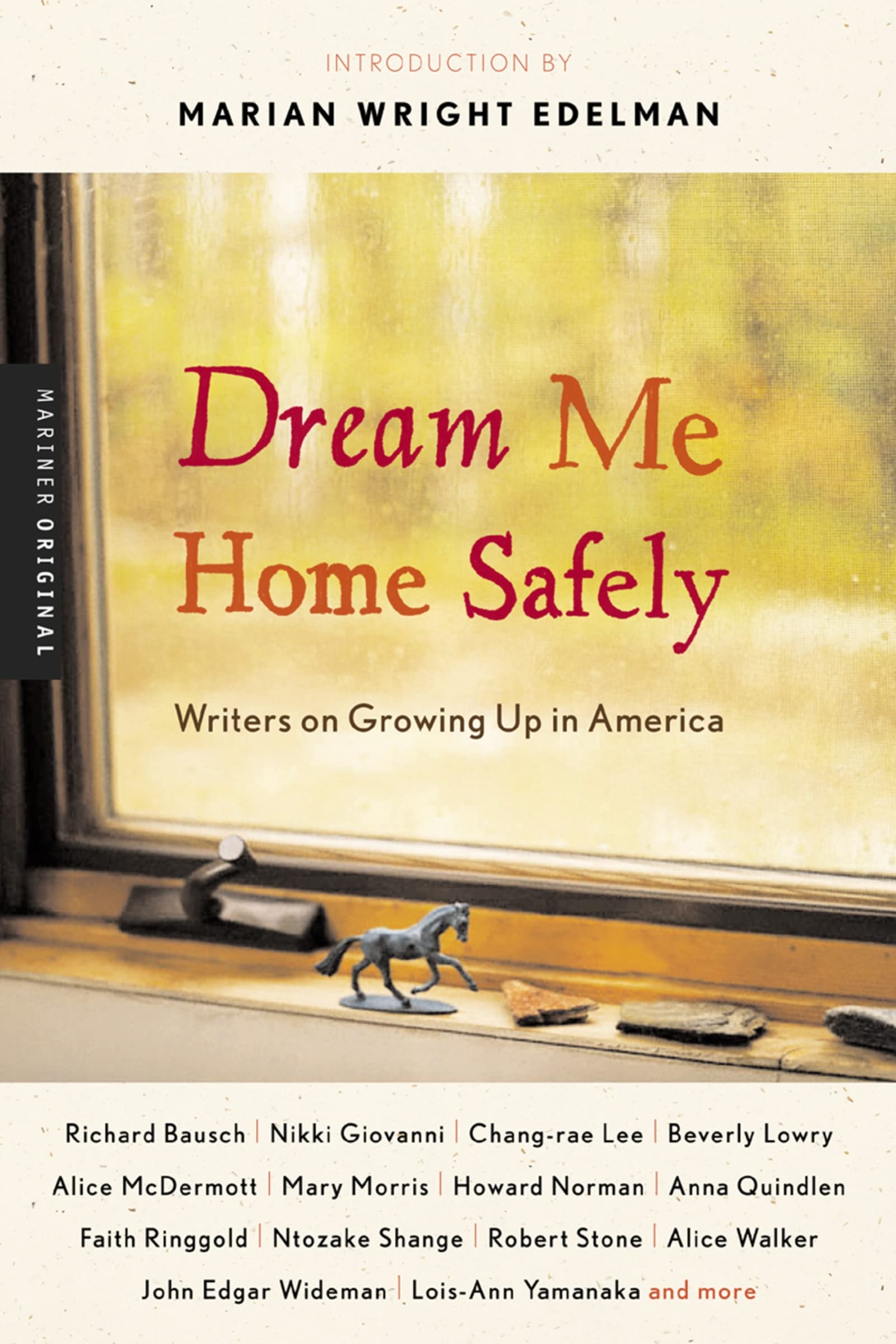
Dream Me Home Safely: Writers on Growing Up in America – Intimate Essays on Diverse Childhoods
$12.99
by Susan Richards Shreve



In the title essay of this extraordinary keepsake of childhood in America, John Edgar Wideman pays fierce tribute to a complex mother who "used to dream me home safely by sitting up and waiting for me to stumble in." The young writer Bich Minh Nguyen remembers arriving in Michigan from Vietnam in 1975 and a classmate who said, "Your house smells funny," and Michael Parker recalls a sister's vivid -- and hilarious -- act of defiance on a particular North Carolina evening in 1971. These and many more intensely intimate memories make Dream Me Home Safely a collection as diverse and powerful as all of American letters. Thirty-four American writers share memories of their formative years, providing windows onto the reservoirs of experience from which they draw their inspiration. Tina McElroy Ansa, whose novels of southern family life ring so true, writes of her childhood in Macon, the place that lives inside her, wherever she may be. Duty to family, the importance of religion, growing up with one parent, the threat of polio, how race defines a child's reality, the strength gleaned from knowing you are loved unconditionally by at least one person, and the necessity of "downtime" in the creative process--these are facets of childhood deemed crucial in the lives of these gifted writers. Those whose families emigrated to the U.S. have unique memories of what it is to be an outsider, exemplified by Nina Revoyr's poignant portrayal of life in a small Wisconsin town, where she was "the only Asian kid, the enemy, the freak." Appropriately celebrating the thirtieth anniversary of the Children's Defense Fund, this collection constitutes a memorable portrait of coming-of-age in America. Deborah Donovan Copyright © American Library Association. All rights reserved "This collection constitutes a memorable portrait of coming-of-age in America." Booklist, ALA Susan Richards Shreve's published novels include A Student of Living Things and Warm Springs . She has worked as a Professor of English at George Mason University and was previously Co-Chair and President of the PEN/Faulkner Foundation. She has received several grants for fiction writing, including a Guggenheim fellowship and a National Endowment for the Arts award. FOREWORD I am so grateful for this book celebrating the Children’s Defense Fund’s thirtieth anniversary. This gift of thirty-four extraordinary American writers sharing their stories of growing up in America paints a complex, richly detailed, and achingly real portrait of American childhood. Every reader will catch glimpses of his or her own childhood and see the childhoods of others with new eyes. Tina McElroy Ansa remembers her nurturing black Georgia family and community as a world made up of stories,” and listening at her mother’s side as she whipped up batter for one of her light-as-air, sweet-as-mother’s- love desserts.” In a town on Chicago’s North Shore, Mary Morris learns early on how girls and women can get into trouble,” while boys and men escape blame and, since she is a girl, she makes an exit plan, just in case. Michael Patrick MacDonald sees his father’s face for the first time at his funeral and leaves the service with a renewed appreciation for the family he does have and the unspoken community of love and loyalty that surrounds him in his poor and desperate white trash” South Boston neighborhood: For once in my life I felt I should be proud of where I came from, who I was, and who I might become, and for a moment was ashamed for having ever felt otherwise.” Lois-Ann Yamanaka writes about trying not to panic when the autistic son she loves so fiercely sees balloons in the supermarket checkout line, knowing the moment is about to escalate into a .t of frustrated screaming and thrashing that will force her to drag him from the store while other customers stare in disgust: In JohnJohn’s world, I can afford to buy him every balloon on every trip to the market. In JohnJohn’s world, he takes all of the shiny balloons home to our yard full of white ginger blossoms and lets all of them go . . . [a] moment of beauty, his silent freedom.” Anna Quindlen looks at the overscheduled lives of today’s children and mourns what’s been lost: Pickup games. Hanging out. How boring it was. Of course, it was the making of me, as a human being and a writer. Downtime is where we become ourselves, looking into the middle distance, kicking at the curb, lying on the grass or sitting on the stoop and staring at the tedious blue of the summer sky. I don’t believe you can write poetry or compose music or become an actor without downtime, and plenty of it, a hiatus that passes for boredom but is really the quiet moving of the wheels inside that fuel creativity.” Alan Cheuse writes about his especially fortunate circumstances growing up on the water: I don’t know how it would have been, born into a town without a coastline . . . The ebb and flow of waters, the detritus, flotsam, treasures left behind on the sand,