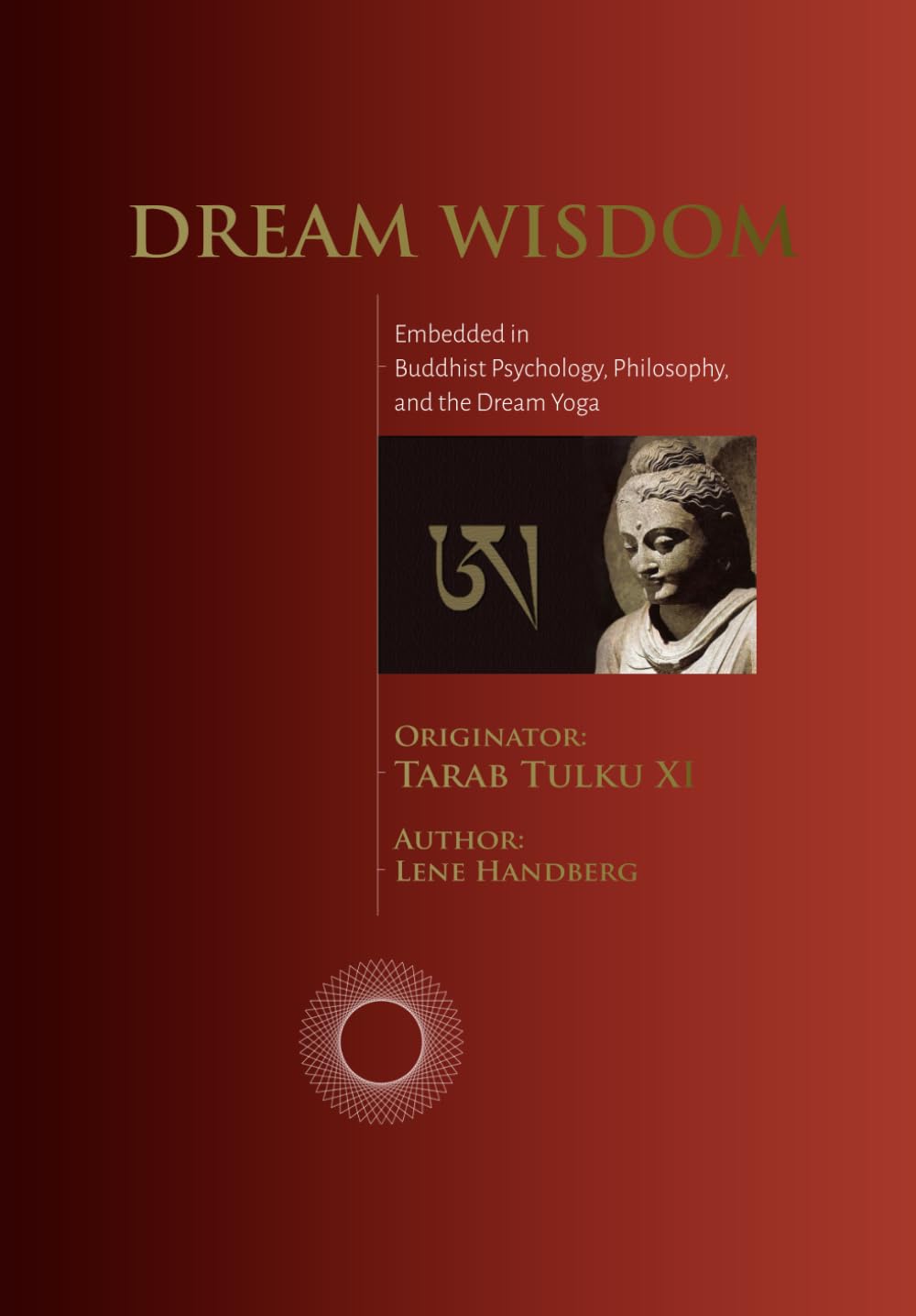
Dream Wisdom: Embedded in Buddhist Psychology, Philosphy, and the Dream Yoga (Ud-Education)
$25.66
by Lene Handberg



Tibetan dream work has an extensive history that includes pre-Buddhist folk tradition, Bön and Buddhism. There is little literature on the pre-Buddhist traditions, but we have living evidence of this folk tradition which points to its lasting effect on the way contemporary Tibetan folk culture deals with dreams. Awareness of natural energies, working with dreams and consulting with oracles are practices with a long- and well-established history in Tibetan culture and even in Tibetan politics where, to this day, the Tibetan Government in Exile uses an official Tibetan State Oracle. It is believed that every Tibetan has a protector spirit or deity, similar in concept to most Tibetans as the Western idea of a guardian angel, which helps the person throughout his or her life. Tibetan Buddhism also includes practices for dealing with different types of spiritual energies, and reincarnation lamas9 of a particular lineage are known to connect with protector spirits which relate to specific energies of nature the lama has tamed. The protector then helps the lineage lama and his institution. Such energies of nature feature strongly in the folk culture of Tibet both in waking life and in dreams. When a negative energy disturbs people, they call on their helper. This facility of working with these energies in the dream state still prevails among many Tibetans today. Tibetan Buddhism developed a sophisticated system of working with dreams and the dream state that incorporated some features of the earlier folk and B ö n traditions. This started with the transmission of the Six Yogas which belong to Tantra, an ancient Eastern spiritual tradition known as Vajray āna the practices of which are part of Buddhism and Hinduism alike, the former particularly kept alive in Tibet and the Himalayan area of India. Tantric dream work is connected with the attainment of lucid dreaming and mastery of the dream state, especially for spiritual purposes. The most well-known transmission lines of the Six Yogas are those of Naropa10, Suggasiddhi and Niguma11 from North India to Tibet. As a Tibetan reincarnation lama, I worked with dreams from an early age. In the beginning, I was strongly influenced by folk religion and dealt with the harmful energies of nature by calling on my protector. This was not something I learned from a book; as a Tibetan child I simply listened to adults talking about protectors and other natural energies and by the time of my second birthday I had taken part in many such rituals. Lene Handberg is the co-originator of the Unity in Duality Training and Educational Director of Tarab Institute International, an organisation with branches in Denmark, Germany, Finland, France, Sweden, Holland, Slovakia, Spain and India, devoted to advancing the universalities of ancient Indo-Tibetan personal and spiritual wisdom. A native of Denmark, Lene Handberg was a student and protégé of Tibetan Buddhist lama, Dr Tarab Tulku XI, Lharampa Geshe, a contemporary scholar, who developed a very complete modern presentation of advanced Indo-Tibetan teachings, he called Unity in Duality, Tendrel. Lene Handberg helped Tarab Rinpoche to develop the Unity in Duality Training and to disseminate this knowledge and investigative practice-oriented tradition. Tarab Tulku Rinpoche PhD. (1935-2004) also known as the Tarab Tulku XI, was a Tibetan reincarnation Lama holding the highest Tibetan degree (Lharampa Geshe) from Drepung University-monastery of Tibet. Apart from being one of the best Indo-Tibetan scholars of our time, in accordance with Prof. Samdhong Rinpoche, he was also an accomplished Tantric Master and Dream Yogi, who from an early age had mastered the art of lucid dreaming. He was a person with natural abilities and able to use the dream state to solve the problems of his fellow monks and made Dream Yoga the main platform for his spiritual development.