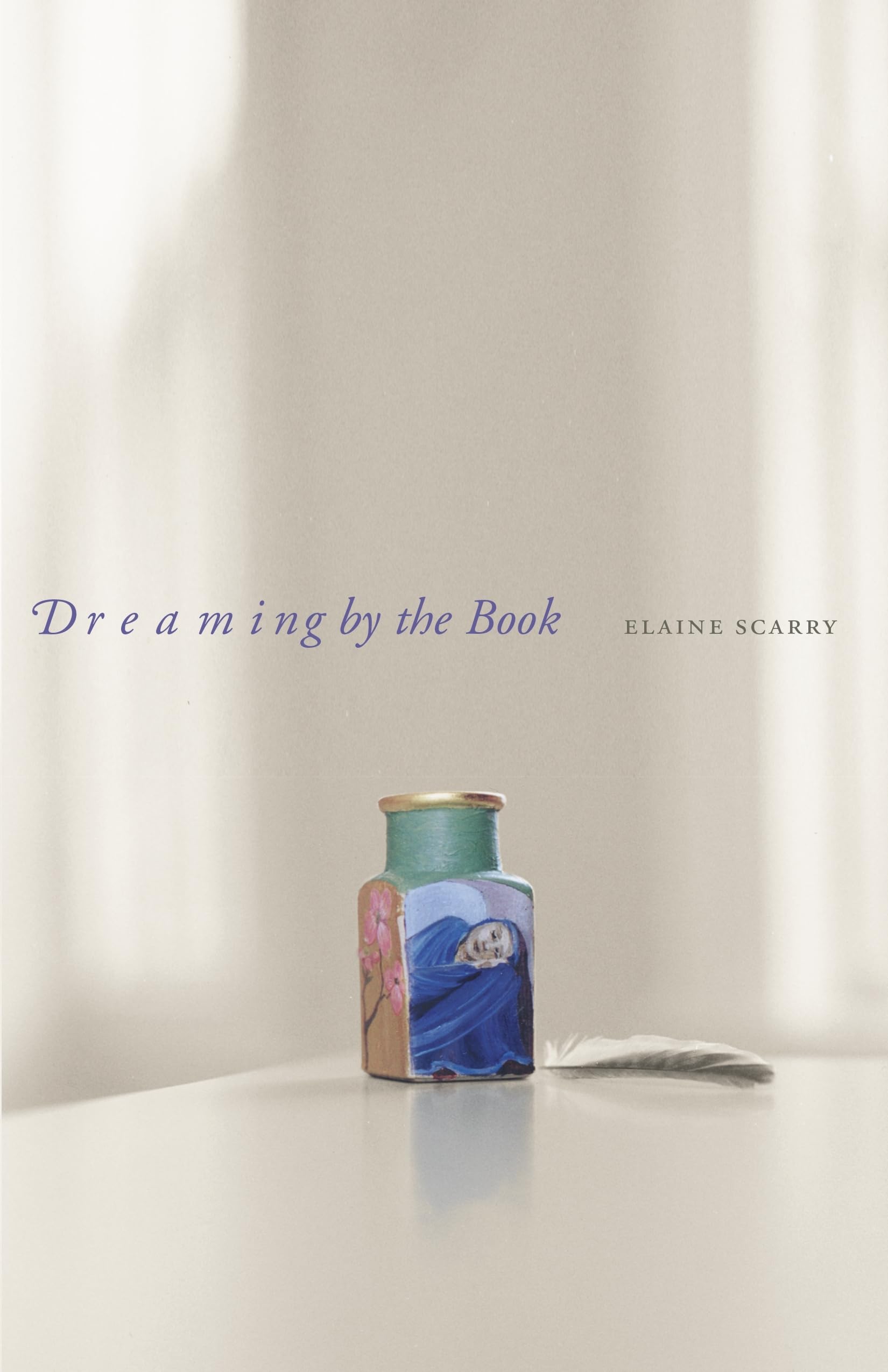



Dreaming by the Book explores the almost miraculous processes by which poets and writers teach us the work of imaginative creation. Writers from Homer to Heaney instruct us in the art of mental composition, even as their poems progress. Just as painters understand paint, composers musical instruments, and sculptors stone or metal, verbal artists understand the only material in which their creations will get made--the back-lit tissue of the human brain. In her brilliant synthesis of literary criticism, philosophy, and cognitive psychology, Elaine Scarry explores the principal practices by which writers bring things to life for their readers. Co-Winner of the 2000 Truman Capote Award, Literary Criticism A startling inquiry . . . a truly revealing phenomenology of imagination. . . . Dreaming by the Book will affect how one reads fiction and poetry as few critical works have done before. ---Kenneth Baker, art critic, San Francisco Chronicle [Scarry] is extremely ambitious, seeking nothing less than a theory of literary cognition. . . . Her interest, which is really in aesthetic success, makes her an original. ---James Wood, New Republic Her approach often recalls that of . . . Descartes and Hume as she attempts to solve the riddle of how the mind works. Scarry is an original, interdisciplinary thinker. She writes like someone enraptured by both the natural world . . . and by language. ( Publishers Weekly ) [Scarry] has written an appendix to Aristotle, perhaps best entitled De Imaginatione , though I wonder whether it fits better to the end of his De Anima , 'On the Soul,' or his Poetics . ( Virginia Quarterly Review ) "Part reverie, part rhapsody, and lucid analysis throughout." ―Robert Fagles, translator of Homer's Iliad "I finished Dreaming by the Book feeling that fundamental aspects of the nature of consciousness had been peeled open and exposed to view." ―Stephen M. Kosslyn, author of Image and Brain I was very excited by Elaine Scarry’s dizzily ambitious Dreaming by the Book. Scarry’s brilliantly original project is to describe a kind of grammar or algebra of the instructions by which a writer causes a mental image to be constructed in the mind of the reader.” A. S. Byatt TLS (The Times Literary Supplement) "Part reverie, part rhapsody, and lucid analysis throughout." ―Robert Fagles, translator of Homer's Iliad "I finished Dreaming by the Book feeling that fundamental aspects of the nature of consciousness had been peeled open and exposed to view." ―Stephen M. Kosslyn, author of Image and Brain "Part reverie, part rhapsody, and lucid analysis throughout." --Robert Fagles, translator of Homer's Iliad "I finished Dreaming by the Book feeling that fundamental aspects of the nature of consciousness had been peeled open and exposed to view." --Stephen M. Kosslyn, author of Image and Brain Elaine Scarry is Walter M. Cabot Professor of Aesthetics at Harvard University. Her many writings include On Beauty and Being Just (Princeton) and The Body In Pain (1986). Dreaming by the Book By Elaine Scarry Princeton University Press Copyright © 2001 Elaine Scarry All right reserved. ISBN: 9780691070766 Chapter One On Vivacity * * * When we speak in everyday conversation about theimagination, we often attribute to it powers that aregreater than ordinary sensation. But when we areasked to perform the concrete experiment of comparing animagined object with a perceptual one?that is, of actually stopping,closing our eyes, concentrating on the imagined face orthe imagined room, then opening our eyes and comparing its attributesto whatever greets us when we return to the sensoryworld?we at once reach the opposite conclusion: the imaginedobject lacks the vitality and vivacity of the perceived one; it is infact these very attributes of vitality and vivacity that enable us todifferentiate the actual world present to our senses from the onethat we introduce through the exercise of the imagination. Evenif, as Jean-Paul Sartre observed, the object we select to imaginein this experiment is the face of a beloved friend, one we knowin intricate detail (as Sartre knew the faces of Annie and Pierre),it will be, by comparison with an actually present face, "thin,""dry," "two-dimensional," and "inert." It seems that we tend to notice the inadequacy of daydreamedfaces only when we are especially keen on seeing aspecific person's face, only when we desperately care to have itpresent in the mind with clarity and force. We then notice thedeficiency, and, like Proust's Marcel, who berates himself for hisinability to picture the face of Albertine or the face of his grandmother,we conclude that the vacuity of our imagining is somehowpeculiar to our feeling about this particular person and thatthere must be a hidden defect in our affection. But the vacuityis instead general, and all that is peculiar or particular to suchcases is the intensity of "wishing to imagine" that m