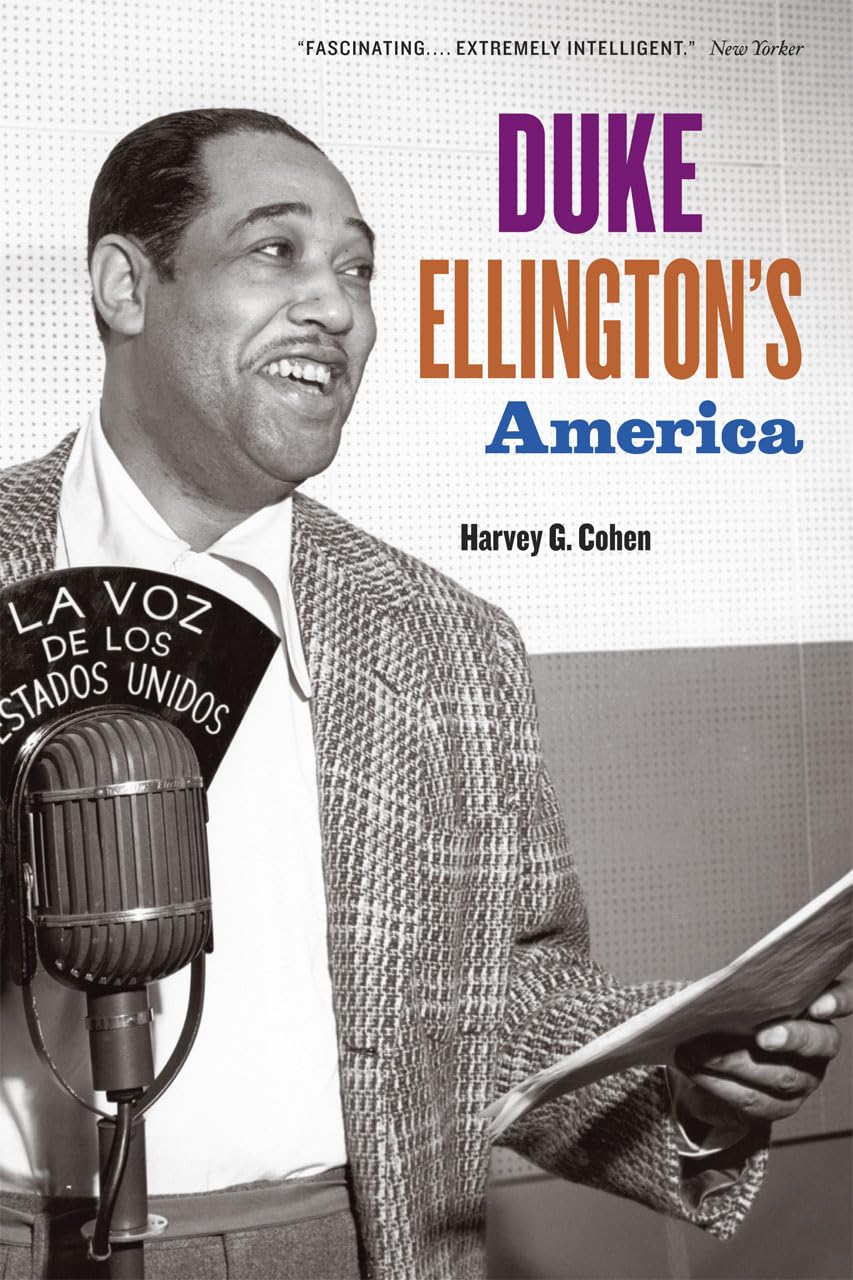



Few American artists in any medium have enjoyed the international and lasting cultural impact of Duke Ellington. From jazz standards such as “Mood Indigo” and “Don’t Get Around Much Anymore,” to his longer, more orchestral suites, to his leadership of the stellar big band he toured and performed with for decades after most big bands folded, Ellington represented a singular, pathbreaking force in music over the course of a half-century. At the same time, as one of the most prominent black public figures in history, Ellington demonstrated leadership on questions of civil rights, equality, and America’s role in the world. With Duke Ellington’s America , Harvey G. Cohen paints a vivid picture of Ellington’s life and times, taking him from his youth in the black middle class enclave of Washington, D.C., to the heights of worldwide acclaim. Mining extensive archives, many never before available, plus new interviews with Ellington’s friends, family, band members, and business associates, Cohen illuminates his constantly evolving approach to composition, performance, and the music business—as well as issues of race, equality and religion. Ellington’s own voice, meanwhile, animates the book throughout, giving Duke Ellington’s America an intimacy and immediacy unmatched by any previous account. By far the most thorough and nuanced portrait yet of this towering figure, Duke Ellington’s America highlights Ellington’s importance as a figure in American history as well as in American music. “Harvey Cohen is the first scholar to make extensive use of the Ellington papers in the Smithsonian Institution, and Duke Ellington's America is the most detailed and probing examination of Ellington’s later career. It offers sensitive coverage of all of Ellington’s albums and major compositions, particularly after 1960, while virtually every other book on Ellington skirts over or neglects certain productions. Unlike almost all his predecessors, Cohen has produced a book that does justice to the complexity and importance of Duke Ellington’s life.” -- Burton Peretti, author of Lift Every Voice: The History of African American Music “Cohen adds to the dozens of books about jazz great Duke Ellington with a new approach.. . . Cohen delivers a social history that firmly places the bandleader within his time. The author first describes the racial mores of Washington, DC, at the turn of the last century that shaped the young Ellington and attributes Ellington’s success during the 1930s to the marketing campaign of manager Irving Mills, who branded him as a suave, elegant genius who could appeal to black and white audiences. Cohen covers Ellington’s postwar challenges, his return to fame, his State Department tours, the ‘sacred concerts,’ and his death in May 1974. Along the way, he focuses on changes in the record industry and music technology and the progress in civil rights. . . . Cohen offers a fascinating, exhaustively researched social history of Duke Ellington’s world. Highly recommended for general readers and jazz aficionados alike.” ― Library Journal “Cohen’s volume. . . . is substantial, richly sourced, intelligent, and, in many ways, persuasive. And unlike many other writers on Ellington, Cohen gives proper attention to all phases of Ellington’s career, and in so doing unveils information that is new or has been overlooked. . . . This is an important work and one that Ellington scholarship will benefit from and draw on for new debates.” ― Times Higher Education " Duke Ellington's America attempts to get under the skin of this apparently most imperturbable of men, and the results, if hardly conclusive, are fascinating. . . . Extremely intelligent and formidably documented book—a welcome change from much that has been published about Ellington." ― New Yorker “Taking full advantage of [the Smithsonian Institution's] Ellington Archive, Harvey G. Cohen’s new book illuminates Ellington’s career as never before, and also helps to deepen our understanding of larger trends and issues in American politics and culture. No previous book on Ellington has followed the money so rigorously, laying bare the interworkings of art and capital. Neither biography nor musical analysis, Duke Ellington’s America is a social history of Ellington’s career, a double portrait of musician and society that situates the music within three large issues: the struggle for African American civil rights, the growth of the popular music industry, and the emergence of the United States as a global power whose most effective cultural weapon was African American music. If Cohen has an overarching thesis, it may be that Ellington’s personality and talents uniquely thrived in all three of these areas, despite the constant threats of appropriation, exploitation and even physical violence that hobbled or curtailed the careers of many of his contemporaries. Although Cohen’s historical approach is not theory-driven, he skillfully lays out the cultur