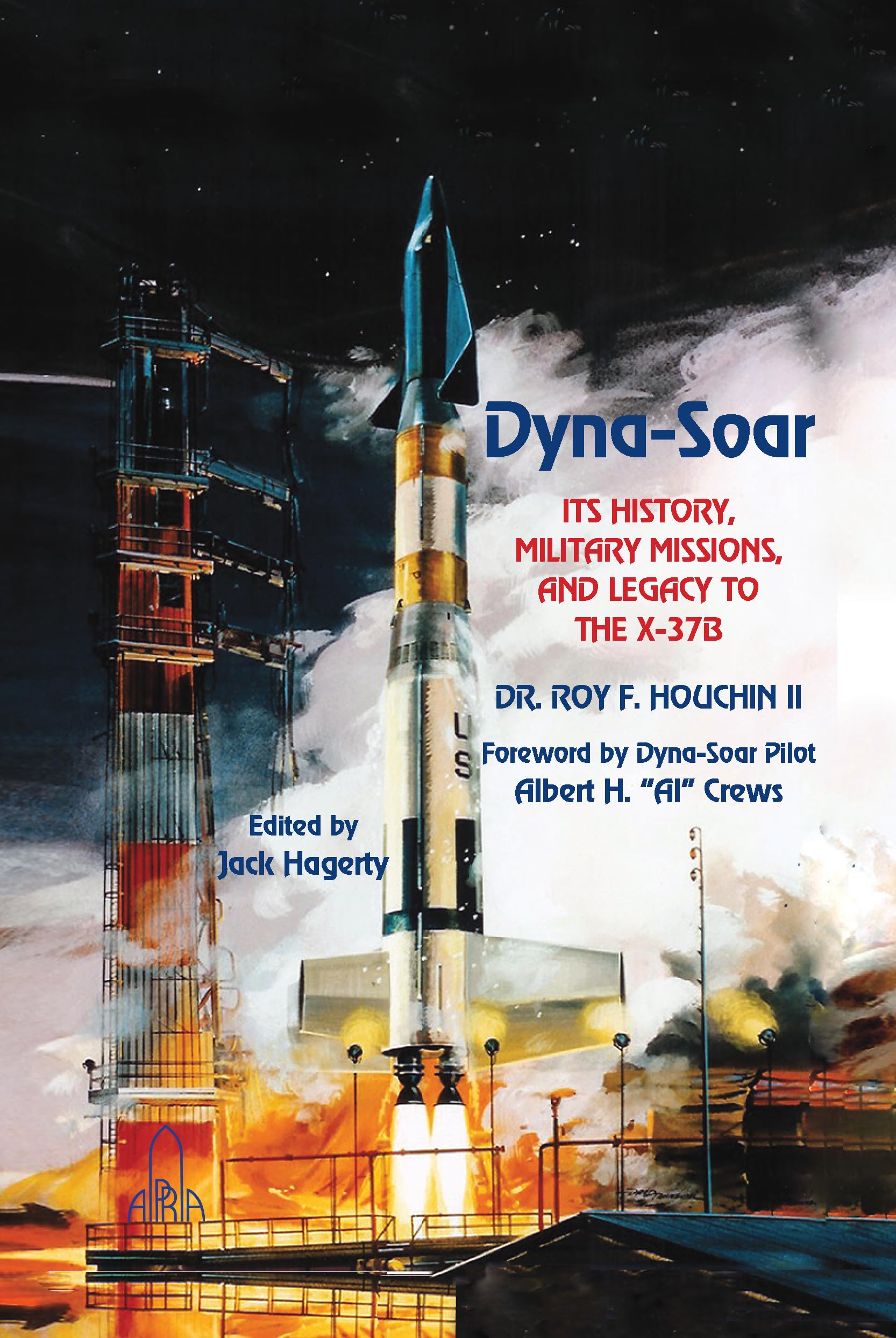
Dyna-Soar: ITS HISTORY, MILITARY MISSIONS, AND LEGACY TO THE X-37B
$39.95
by II Roy F. Houchins



Based on Eügen Sanger's German WWII research for an "antipodal bomber," the Dyna-Soar (“Dynamic Soaring”) glider would be launched on a large booster, be over the "area of interest" at any spot in the world in less than an hour, collect its intel and land on a conventional runway anywhere in the western US. Total mission time: less than two hours from liftoff to touchdown. Other versions had full orbital capabilities to service any of the Air Force space stations being proposed in the early '60s. Part I, written by Air Force historian Dr. Roy Houchin with full access to all official documents, details the history of the program. Part II, written by the editor and aerospace historian, Jack Hagerty, covers the amazing technology developed to allow the Dyna-Soar to accomplish its seemingly impossible mission and all of the subsequent programs that benefited from that research. This book will be the definitive work on the program for some time to come. Got the book and it is AMAZING! This far much more than I bargained for. Excellent, excellent job! - Bill Ober, preorder customer This book is priceless - J E Thompson, preorder customer What a great book! The depth of coverage and the story make for a great read. Thanks for producing this super resource - John Brohm, NAR National Champion scale modeler [This book] has the best quality of any I’ve seen. Thanks again, I am proud to have been a supporter of your work - Ken Glaze, Kickstarter supporter Dr. Roy F. Houchin II joined the faculty of the Air War College Department of Warfighting in 2006 following his retirement from active duty with the Air Force. He has taught previously at the School of Advanced Airpower Studies, Air Command and Staff College and in the Department of History at the U.S. Air Force Academy. While on active duty, Houchin served as Director of Operations and Chief, Combat Operations, 607th Combat Operations Squadron, Osan, South Korea. He also held various air battle management assignments in the Tactical Air Command, Air Force Space Command, Air Combat Command and Headquarters USAF. He is the author of U.S. Hypersonic Research and Development: The Rise and Fall of Dyna-Soar, 1944-1963, Taylor and Francis Publishing, 2006, several chapters in edited works and numerous articles in professional journals. He is the Military Space editor for Quest: the History of Spaceflight Quarterly. Houchin holds a B.A. and M.A. from Western Kentucky University, and a Ph.D. from Auburn University. His areas of interest and expertise are history of technology and military history, particularly space and World War I, as well as airpower history, theory and doctrine. Jack Hagerty is a Mechanical Engineer working in the Medical Device and Automation/Robotics industries. He is the co-founder of LUNAR, the Livermore Unit of the National Association of Rocketry, the largest rocket club in the country (and, possibly, the world). He started ARA Press nearly 20 years ago to provide modelers interested in science fiction and real aerospace subjects access to accurate, high-quality reference books at reasonable prices. After publishing his own, now classic titles Spaceship Handbook and The Saucer Fleet, he broadened ARA’s scope by publishing other authors’ work such as 2010: A Scrap-book Odyssey, and two titles on Lost in Space history and hardware. ARA also provides continuing publication of books to the rocket hobby that had been abandoned by their publishers such as Rockets of the World (and all of its supplements), and the Extreme Rocketry technical series of booklets. Hardcover, 80# coated stock, Smythe-sewen binding, color photos throughout