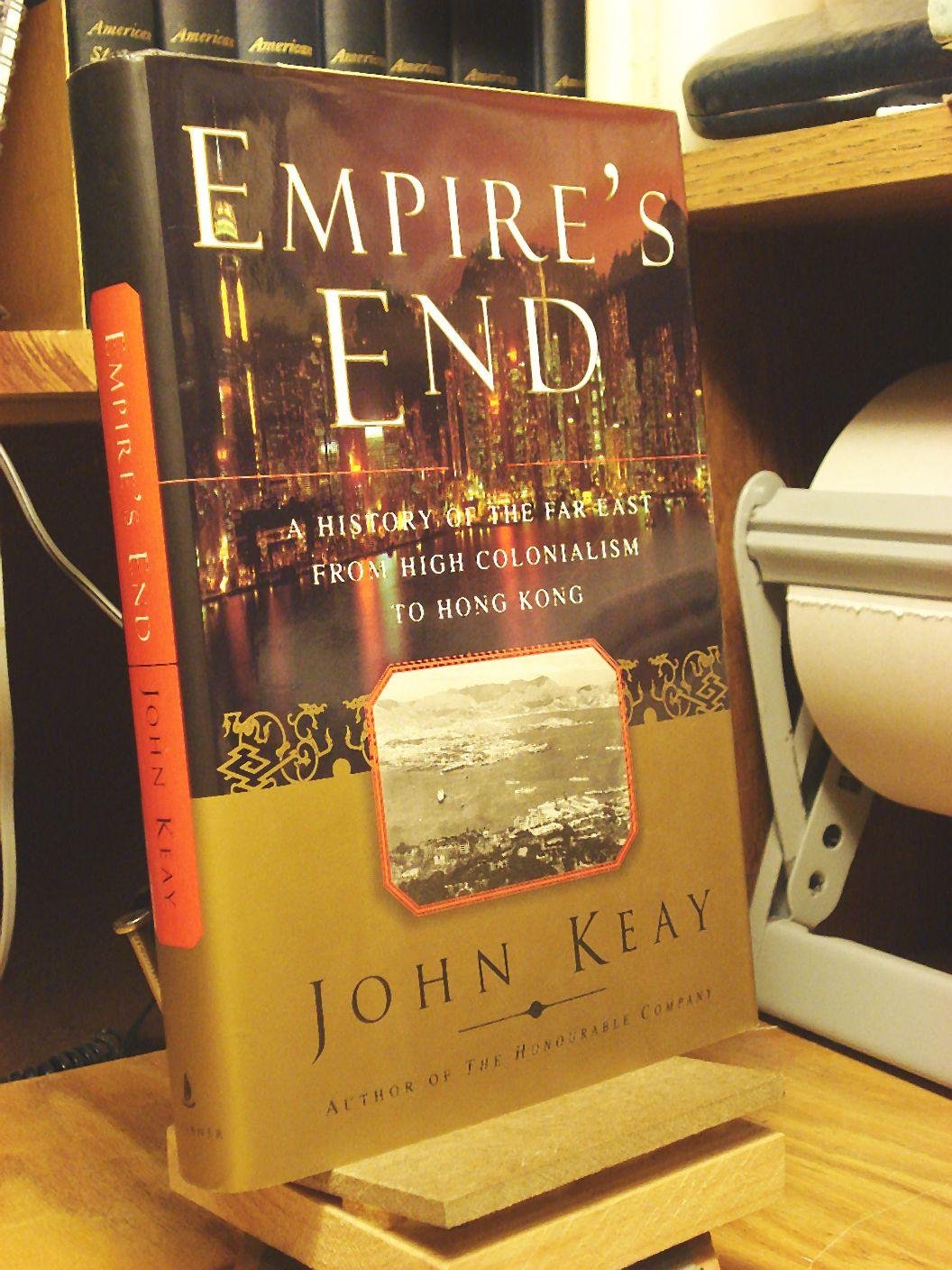



As the British prepare to disengage themselves from Hong Kong, a study of the involvement of Europe and America in the Far East explores more than five hundred years of Western colonial presence in Asia and speculates about the future of the region's political and economic geography. 15,000 first printing. On July 1, 1997, the last European-ruled province in Asia, Hong Kong, will revert to Chinese rule, marking the first time in 500 years that Europe did not have a colonial presence on the continent. During much of that five-century span, Keay writes, the European powers behaved rather badly far from home in the headlong rush to secure riches. The Asian nations took much time to respond, but when they did, Europe was sent reeling from much of the continent, especially after World War II when countries newly liberated from Japan decided not to accept another yoke. Keay takes on a huge subject and covers it well, at least in outline, in 400 pages. He raises enough questions, however, to send the reader on to many other books. Keay (The Honorable Company, Macmillan, 1994) provides a solid overview of the British, French, Dutch, and American empires in the Far East, concentrating on the years after 1930. He examines the effects of the Pacific War on empire and on the emerging nationalistic movements. He also discusses the Vietnam War and insurgency movements and ends by speculating on the future of Hong Kong. "There seems to be a continuum in the history of the East," he explains, "to which, albeit for its own purposes, empire substantially contributed." A solid work; highly recommended.?William L. Wuerch, Micronesian Area Research Ctr., Univ. of Guam Copyright 1997 Reed Business Information, Inc. With Hong Kong ready to revert back to mainland China, Keay's look at the decline of Western colonial powers in Asia is timely indeed. His focus is from 1930 to the present, a period when such entrenched colonials as the British, French, Dutch, and Americans see their overseas possessions disappear. Keay finds three main reasons for this dramatic shift: Asia's long, rich history created a strong sense among Asians that they would prevail over their oppressors; the rapid growth of Communism as an ideology and as a response to imperialism; and advances in twentieth-century communications that disseminated the anticolonial message like never before. One could also add Western blindness as another factor. How else to explain the post^-World War II belief among the English, French, and Dutch that native peoples would welcome a return to their rule? An extremely accessible history, enlivened by scores of fascinating stories and telling anecdotes. Brian McCombie An absorbing, anecdotal overview of the West's protracted imperial involvement in the Pacific Basin, which will end when Great Britain quits Hong Kong at midyear 1997. Keay (The Honorable Company, 1994) focuses on the colonial enterprises of France, the Netherlands, the UK, and the US in Greater East Asia, a vast if fragmented oceanic domain encompassing mainland China, Indonesia, Malaysia, the Philippines, Singapore, Vietnam, and other outposts of empire. Providing background enough to clarify how the industrial powers came by their offshore territories, he tracks the frequently chaotic, often bloody history of erstwhile possessions from the 1930s through independence. From recalling the postOpium Wars emergence of Hong Kong as a counting house for the storied traders operating out of China's so-called treaty ports, the author segues gracefully into an interpretive account of how the UK's 1930 departure from an all-but-forgotten enclave called Weihaiwei facilitated its subsequent disengagements. Keay goes on to document how withdrawal proved less simple for the French (whose entrenched presence in Indochina had more to do with prestige than mercantilism), the Dutch (the first Europeans to settle in the region), and the nominally anti-imperialist Americans (effectively disoriented by their acquisition of the Philippines in the wake of a brief conflict with Spain). Covered as well are the convulsive effects of WW II and the postwar period's upheavals, exacerbated by fears that Marxist liberation fronts would fill any vacuums created by the untidy process of decolonization. An estimable and literate briefing on a once-captive area that promises to play an important role in the Global Village's socioeconomic future. (16 pages b&w photos, maps, not seen) -- Copyright ©1997, Kirkus Associates, LP. All rights reserved.