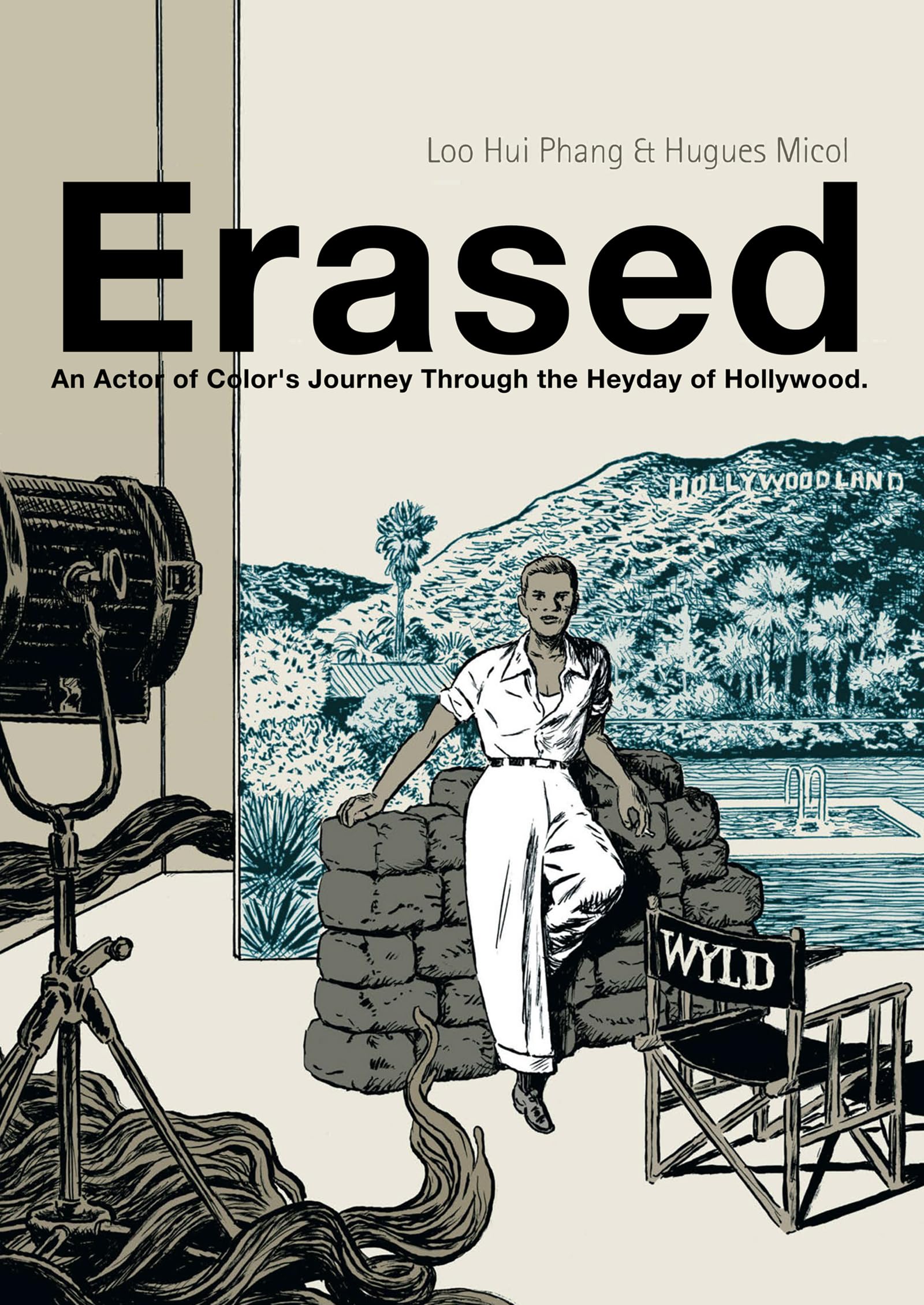
ERASED: An Actor of Color's Journey Through the Heyday of Hollywood
$16.99
by Loo Hui Phang



Maximus Wyld had his heyday in 1940s-50s Hollywood. Of mixed race Black, Chinese and Native American descent, he was "the actor with a thousand faces”, essentially interpreting ethnic roles: Indian chief, Mexican revolutionary, oriental dandy... A veritable reinterpretation of the myth of American cinema through the prism of minorities, Erased reveals the political and social dimension of Hollywood productions. Maximus Ohanzee Wildhorse, renamed “Maximus Wyld” by Hollywood, was a talented, prized, admired comedian. His filmography is an anthology of cinema: Vertigo, the Maltese Falcon, Sunset Boulevard, the Prisoner of the Desert, Rebecca... Copper faced and with unprecedented beauty and animal presence, he paved the way for colored stars in a segregationist climate. After him, Sydney Poitier, Harry Belafonte and Yul Brynner, were able to reach the rank of stars. His charisma ignited white cinema and shamelessly swayed its racial hegemony. Maximus Wyld was a pioneer. However, no credits mention his name. On celluloid there is no imprint of his face. Maximus the precursor rests in the graveyard of Hollywood amnesia. What event pushed him into limbo? What occult and superior force has stored his career in a cinematic Bermuda Triangle? "A masterful revisiting of the history of Hollywood cinema... Rendering all ethnicities invisible."― Radio France "It is gorgeous and aims high." ― Andrew Wheeler , The Antick Musings of G.B.H. Hornswoggler, Gent. "[A] fascinating take on the less glittery parts of Hollywood." ― Patti Martinson , Sequential Tart "The book addresses a broad range of social issues through an early Hollywood lens, including the treatments of women and marginalized people...With its moody black-and-white panels... Erased is a dazzling graphic biography."― Foreword Review "Readers interested in entertainment history and the long arc of social justice will be drawn to this glimpse of Hollywood as it almost was." ― Publishers Weekly "...an inventive dissection of the history of Hollywood filmmaking and its role in shaping American racial stereotypes that have lingered into the present day." ― Publishers Weekly "...an exciting, disturbing portrait of Hollywood’s cultural power during its heyday." ― New York Journal of Books "...one is transported into what feels like a solid work of non-fiction which...makes for a much more powerful work of fiction." ― Lindsay Pereira, Broken Frontier "Unreservedly recommended!"― Midwest Book Review "...an exquisite tour de force." ― Samuel Edme, Sam's Studios Loo Hui Phang was born in 1974 in Laos. She has written plays, children's books with Jean-Pierre Duffour, as well as scripts for short films, cartoons and comics. Hugues Micol was born in 1969 in Paris. First spotted with Chiquito la Muerte, an offbeat western, this emerging talent then distinguished himself by drawing animal comics, crazy thrillers, a Japanese historical series... His output is proof that this artist has a rich graphic culture. By teaming up with another artist of great culture, David B., he offers us a new version of wild America, less known because of its location in Tierra del Fuego. It was with a twilight western, Scalp, that he won the International Töpffer Prize from the city and county of Geneva.