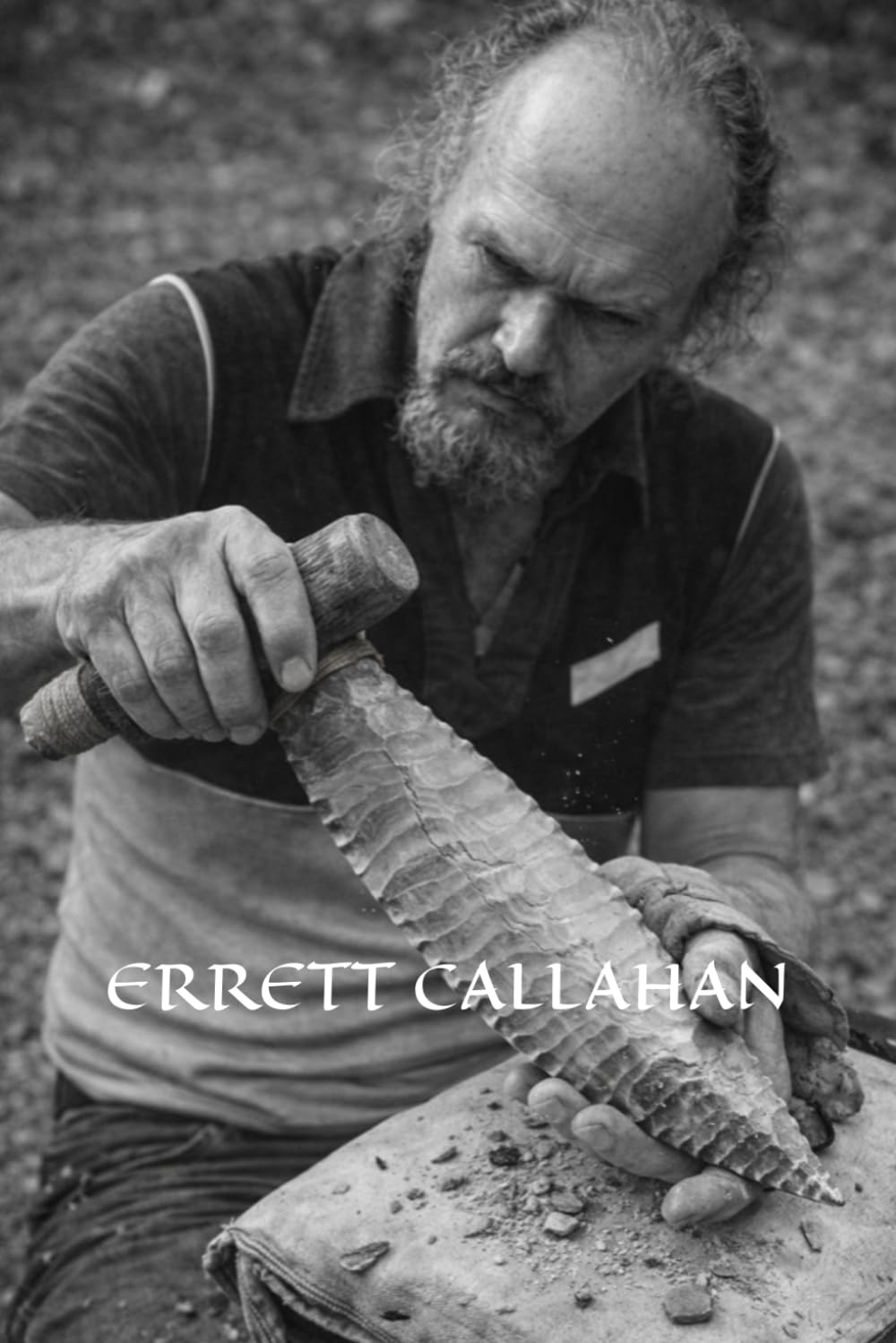
ERRETT CALLAHAN (Revised): FLINTKNAPPER'S MAGAZINE Spring 2026 (FLINTKNAPPING AND LITHIC TECHNOLOGY)
$7.50
by Ray Harwood



In recent decades, the replication of prehistoric stone tools and projectile points—commonly referred to as flintknapping —has experienced a remarkable revival. The practice of shaping chipped stone artifacts is not only a rewarding intellectual and manual pursuit but also provides profound insights into the technological sophistication of our ancestors. For both hobbyists and professional archaeologists, flintknapping serves a dual purpose: as a creative, tactile endeavor and as a methodological tool for understanding past human behavior. The study of flintknapping is integral to archaeological research. Experimental replication allows archaeologists to reconstruct the sequence of actions, decisions, and problem-solving strategies employed at ancient flintknapping sites around the world. Controlled experiments reveal patterns in material selection, fracture mechanics, and reduction sequences that are often invisible in excavated assemblages. As the late Dr. Donald Crabtree observed, “There is nothing as potent as experimentation for verifying lithic techniques…careful analysis of various stages of the manufacturing process can give clues to functional need” (Crabtree, 1972). The study of lithic technology bridges theory and practice. For decades, early humans were often simplistically portrayed as relying solely on brute strength or repetitive, rudimentary movements. Experimental flintknapping has revealed a more nuanced picture: many techniques traditionally considered “primitive” demand exceptional dexterity, planning, and precision. The craftsmanship evident in surviving lithic artifacts suggests that prehistoric artisans possessed sophisticated motor skills and cognitive strategies that are often underestimated in traditional accounts. Human behavior, as revealed through lithic replication, lies along a continuum between observable motor actions and complex, less visible cognitive processes. This publication is also a tribute to J.B. Sollberger, whose contributions to experimental archaeology and lithic technology are unparalleled. A self-taught expert, Sollberger has advanced understanding of fracture mechanics, pressure flaking, and tool function. His innovative techniques, including refined fork-and-lever pressure methods, have preserved knowledge that might otherwise have been lost. Sollberger’s replicas—particularly his Folsom points—demonstrate a combination of technical mastery, scientific insight, and cultural reverence that continues to inspire flintknappers and archaeologists alike. Dr. Errett H. Callahan brings decades of experience in experimental archaeology, flintknapping, and lithic technological research. He has instructed field schools worldwide, consulted for museums from Denmark to the Americas, and serves as chairman of the board and manager of Aztecnics, producing obsidian blade scalpels for medical and educational applications. Dr. Callahan has authored over 150 articles on flintknapping and archaeology and has received numerous honors for his achievements. REVISED