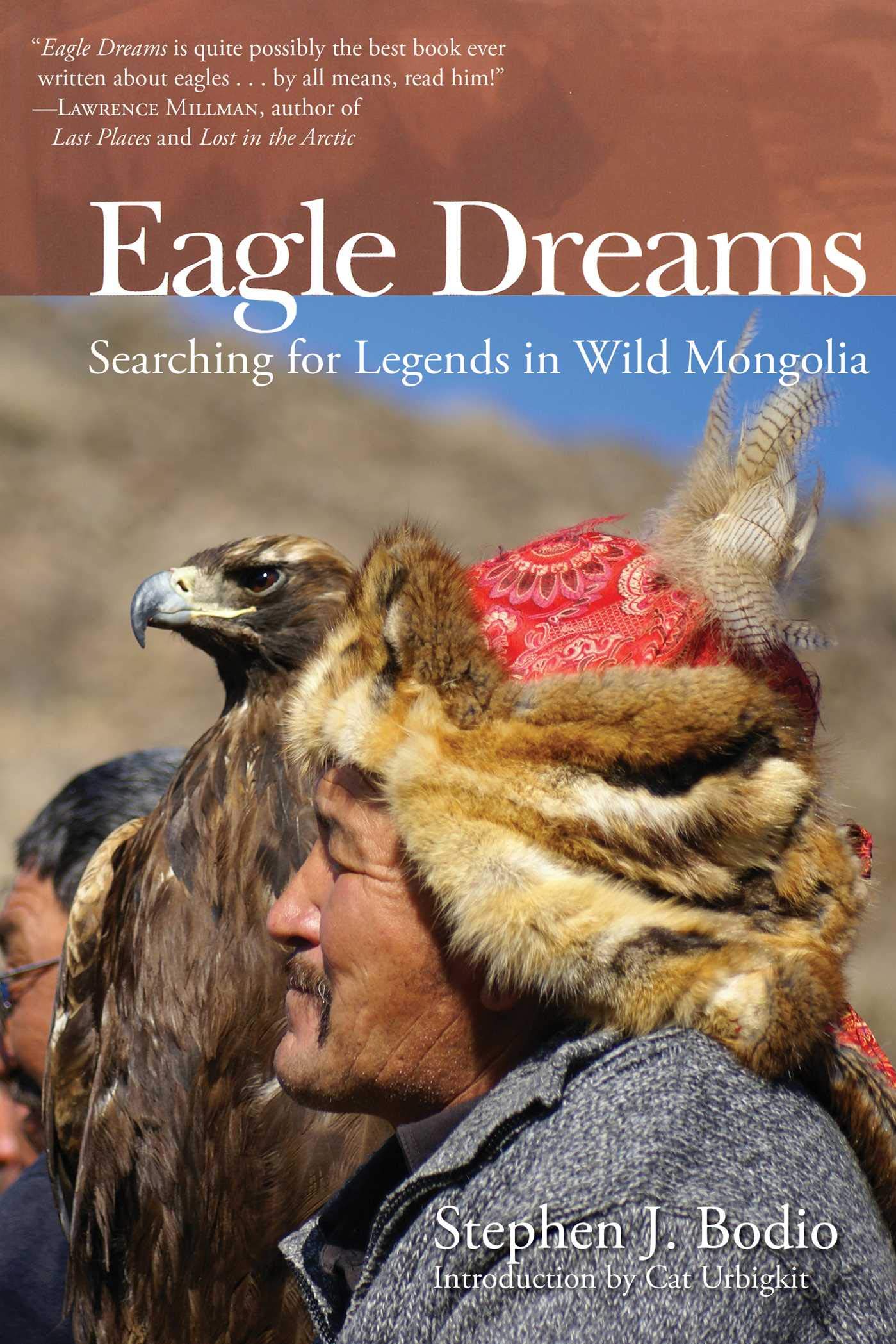



Mongolia is a vast country located between Siberia and China, and little-known to outsiders. As Mongolia had long been under Soviet rule, it was inaccessible to Westerners. That was until 1990, when Stephen J. Bodio began planning his trip. As a boy, Bodio was always fascinated with nature. When he saw an image in National Geographic of a Kazakh nomad, dressed in a long coat and wearing a fur hat, holding a huge eagle on his fist, his life was changed from then on. When Mongolia became independent in 1990, Bodio knew that his dream to see the eagle hunters from the picture in National Geographic< so many years ago was soon to become a reality. In Eagle Dreams , readers follow Bodio on his long-awaited trip to Mongolia, where he spent months with the people and birds of his dreams. He is finally able to visit the birth place of falconry and observe the traditions that have survived intact through the ages. Not only does he get to witness things most people will never be able to, but he’s also able to give life to his dreams and the people, landscapes, and animals of Mongolia that have become part of his soul. Stephen J. Bodio is a renowned writer and naturalist. His articles have appeared in magazines such as Sports Afield and Smithsonian , and he is the author of several books, including Querencia and Aloft . He currently divides his time between New Mexico and Bozeman, Montana. Eagle Dreams Searching for Legends in Wild Mongolia By Stephen J. Bodio Skyhorse Publishing Copyright © 2015 Stephen J. Bodio All rights reserved. ISBN: 978-1-62914-479-5 Contents Introduction, Prologue, Part 1: Dream, Part 2: The Dream Made Real, Part 3: Return, Epilogue, Acknowledgments, Appendix I: Tour Addresses, Appendix II: Bibliography, Appendix III: A Note on Conservation, Appendix IV: Berkut, CHAPTER 1 PART 1 Dream I saw a picture once, in a book I have forgotten, in an old city neighborhood of three-decker wooden tenements I may never visit again. I heard stories there, and saw animals: real ones, images in books, and ones I made in my head from the words in the stories. My parents made images then. My father was an artist turned civil engineer and draftsman; my mother, a commercial fashion artist. Now I make stories for a living, and live with other animals around me. Fur-hatted nomads, horsemen from shining mountains, gallop through my flickering brain at night, while great birds soar and dive overhead. Some are dreams, where they mix with animals and people from Africa, or New Mexico. Some are memories. Another memory: My mother in the yellow light at the foot of my bed, on a sweltering midsummer night, reading to me from a pretty new edition of Kipling's Jungle Book: the first story, "Mowgli's Brothers." There's the baby, fleeing through a night no darker than the one outside my window; the terrifying presence of Sher Khan, looming in the cave's mouth; the green-eyed defending demon of Raksha, Mowgli's wolf foster-mother, backing him away. Surely I create these from later readings? But I still have the book, marked and stained by childhood meals, and the memories of those characters are as real to me as those of the black coal chute in the cellar, the smell of it burning blue coal in the stove, the popped paper caps of frozen milk bottles on the back stoop, the cries of the ragman ("Rags and Bones! Rags and Bones!") as he passed on the street with his horse-drawn wagon — all those fragments of another lost world. That was in 1953, in Dorchester, a blue-collar neighborhood in Boston. In New Mexico nights, on the edge of sleep, the images still come to me, not in flashes nor in orderly narratives, but in sensory bursts like a kind of natural virtual reality. Do I pull them up out of the lightless well in my head, or create them out of still-tinier fragments because they are appropriate? Or did they build molecular structures in my developing brain, because they meant something important? Words, images, animals. In 1953 I was already, improbably, fascinated by animals. They were so scarce I can remember each individual: a mouse that drowned in my bedside glass; a nest of sparrows that blew down from the eaves in a hurricane; my cousin's cat, Snoozy, who lived briefly upstairs and was run over by a car; the ragman's cart horse, which in 1953 still made the rounds every week. It was probably no accident, given the neighborhood, that most of these were dead. More lively animals ran through the colorful magazines that my parents brought home. My parents told me I learned to read by matching the names of animals under the fold-out dioramas in Life to their owners: weasel, fox, deer, blue jay. I can recall, a little later, matching the head of a jaguar on the cover of some glossy color magazine to the word "sports" in the magazine's title, except that I, understandably, thought the word was "spots." It was in a magazine that I first saw The Picture. No amount of me