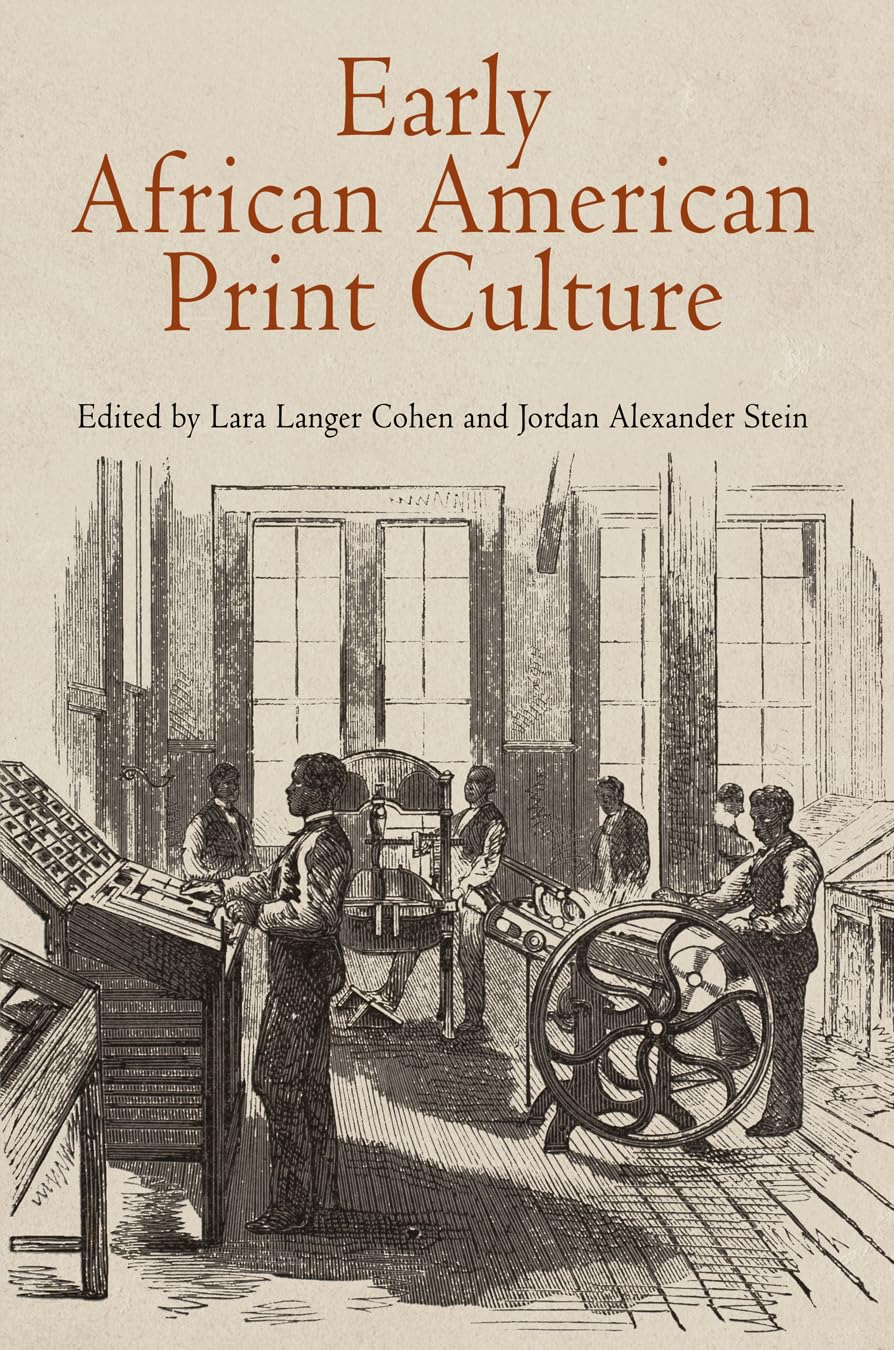



The eighteenth and nineteenth centuries saw both the consolidation of American print culture and the establishment of an African American literary tradition, yet the two are too rarely considered in tandem. In this landmark volume, a stellar group of established and emerging scholars ranges over periods, locations, and media to explore African Americans' diverse contributions to early American print culture, both on the page and off. The book's chapters consider domestic novels and gallows narratives, Francophone poetry and engravings of Liberia, transatlantic lyrics and San Francisco newspapers. Together, they consider how close attention to the archive can expand the study of African American literature well beyond matters of authorship to include issues of editing, illustration, circulation, and reading—and how this expansion can enrich and transform the study of print culture more generally. "A must-read for scholars of African American literature and those who study the development of print culture in the early American republic. . . . The book's seventeen chapters admirably illuminate the multifaceted ways African Americans engaged with the world of print between the mid-eighteenth and the early twentieth centuries." ― Journal of American History "Lara Langer Cohen and Jordan Alexander Stein have fashioned seventeen well-conceived and -executed works into an anthology that advances our understanding of how early African American literature fits into the historical landscape of communication arts." ― African American Review "Illustrated by engrossing and, at times, disconcerting visual images, [the book] productively brings together the work of established critical figures." ― Modern Language Review " Early African American Print Culture reads like a manifesto, a call to action-sometimes directly, by cataloging the work that remains to be done, and sometimes simply by offering models of scholarship on familiar and unfamiliar authors and texts. The central point, of course, is that we need to attend to the whole of American print culture if we are to understand the complexities of African American writing throughout the nineteenth century." ― John Ernest, West Virginia University Lara Langer Cohen teaches English at Swarthmore College and is author of The Fabrication of American Literature: Fraudulence and Antebellum Print Culture, also available from the University of Pennsylvania Press. Jordan Alexander Stein teaches English at Fordham University. Introduction Early African American Print Culture Lara Langer Cohen and Jordan Alexander Stein The present volume takes its cue from a historical convergence. The late eighteenth and nineteenth centuries witnessed the consolidation of what historians have come to know as "print culture" in the United States. Spurred by technological improvements to the printing press, innovations in papermaking and binding, increasing divisions of labor and automation, and the expansion of distribution networks enabled by railroad and steamship, print shops turned out a huge variety of printed goods in unprecedented quantities. These goods included recognizably literary items such as books, newspapers, magazines, pamphlets, and broadsides, as well as nonliterary items such as stationery, lottery tickets, currency, and ledgers. Printed matter became a part of everyday life, mediating and reshaping the already fluctuating social relations of the early United States. At the same time, these years also mark the inauguration of what scholars have identified as an African American literary tradition. Despite the fact that education was often explicitly prohibited for slaves, and effectively placed out of reach for many freepersons, publications by African American authors appeared in increasing numbers. The year 1760 saw both the first published poem by an African American, Jupiter Hammon's broadside "An Evening Thought: Salvation by Christ, with Penetential Cries," and the first published prose text, Briton Hammon's A Narrative of the Uncommon Sufferings, and Surprizing Deliverance of Briton Hammon, a Negro Man . (The first known poem by an African American, Lucy Terry's "Bar's Fight," probably composed in 1746, was transmitted orally before being committed to print in 1855.) The first black publishing house, the African Methodist Episcopal Book Concern, was founded in 1817. The first black newspaper, Freedom's Journal , appeared in 1827, and over the next thirty years, black periodicals from Albany to Cleveland to New Orleans to San Francisco followed suit. During the late eighteenth and early nineteenth centuries, African Americans also established numerous literary societies, circulating libraries, political conventions, and church organizations, all of which articulated themselves through print media. African Americans worked alongside whites as compositors in print shops, as sailors transporting both raw and printed materials, and as educators instructing w