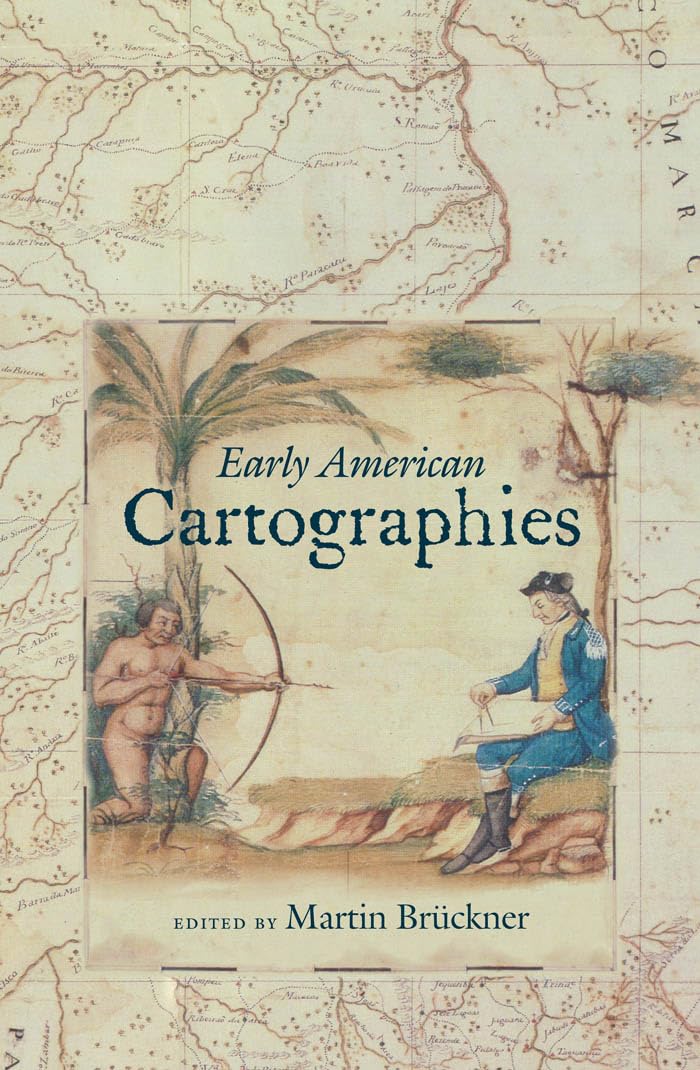
Early American Cartographies (Published by the Omohundro Institute of Early American History and Culture and the University of North Carolina Press)
$38.75
by Martin Brückner



Maps were at the heart of cultural life in the Americas from before colonization to the formation of modern nation-states. The fourteen essays in Early American Cartographies examine indigenous and European peoples' creation and use of maps to better represent and understand the world they inhabited. Drawing from both current historical interpretations and new interdisciplinary perspectives, this collection provides diverse approaches to understanding the multilayered exchanges that went into creating cartographic knowledge in and about the Americas. In the introduction, editor Martin Brückner provides a critical assessment of the concept of cartography and of the historiography of maps. The individual essays, then, range widely over space and place, from the imperial reach of Iberian and British cartography to indigenous conceptualizations, including “dirty,” ephemeral maps and star charts, to demonstrate that pre-nineteenth-century American cartography was at once a multiform and multicultural affair. This volume not only highlights the collaborative genesis of cartographic knowledge about the early Americas; the essays also bring to light original archives and innovative methodologies for investigating spatial relations among peoples in the western hemisphere. Taken together, the authors reveal the roles of early American cartographies in shaping popular notions of national space, informing visual perception, animating literary imagination, and structuring the political history of Anglo- and Ibero-America. The contributors are: Martin Brückner, University of Delaware Michael J. Drexler, Bucknell University Matthew H. Edney, University of Southern Maine Jess Edwards, Manchester Metropolitan University Júnia Ferreira Furtado, Universidade Federal de Minas Gerais, Brazil William Gustav Gartner, University of Wisconsin–Madison Gavin Hollis, Hunter College of the City University of New York Scott Lehman, independent scholar Ken MacMillan, University of Calgary Barbara E. Mundy, Fordham University Andrew Newman, Stony Brook University Ricardo Padrón, University of Virginia Judith Ridner, Mississippi State University "Better than any other study, this remarkable collection elucidates the complex dynamics that determined what kinds of--and whose--Americas were put on maps during the long colonial era." --Pekka Hämäläinen, University of California, Santa Barbara "This volume will transform scholars' own mental maps of the early American geographical imagination." --Neil Safier, University of British Columbia "Brückner's jeweled introduction on maps and their relation to the early modern Americas draws the broad conceptual lines of thirteen stunning essays that tie cartography to areas in which graphic reason is shown to shape history and ideology...." --Tom Conley, Harvard University “This volume will transform scholars' own mental maps of the early American geographical imagination.” — Neil Safier, University of British Columbia The new history of cartography from an early American perspective Maps were at the heart of cultural life in the Americas from before colonization to the formation of modern nation-states. The fourteen essays in Early American Cartographies examine indigenous and European peoples' creation and use of maps to better represent and understand the world they inhabited. Maps were at the heart of cultural life in the Americas from before colonization to the formation of modern nation-states. The fourteen essays in Early American Cartographies examine indigenous and European peoples' creation and use of maps to better represent and understand the world they inhabited. Martin Brückner is associate professor of English and material culture studies at the University of Delaware.