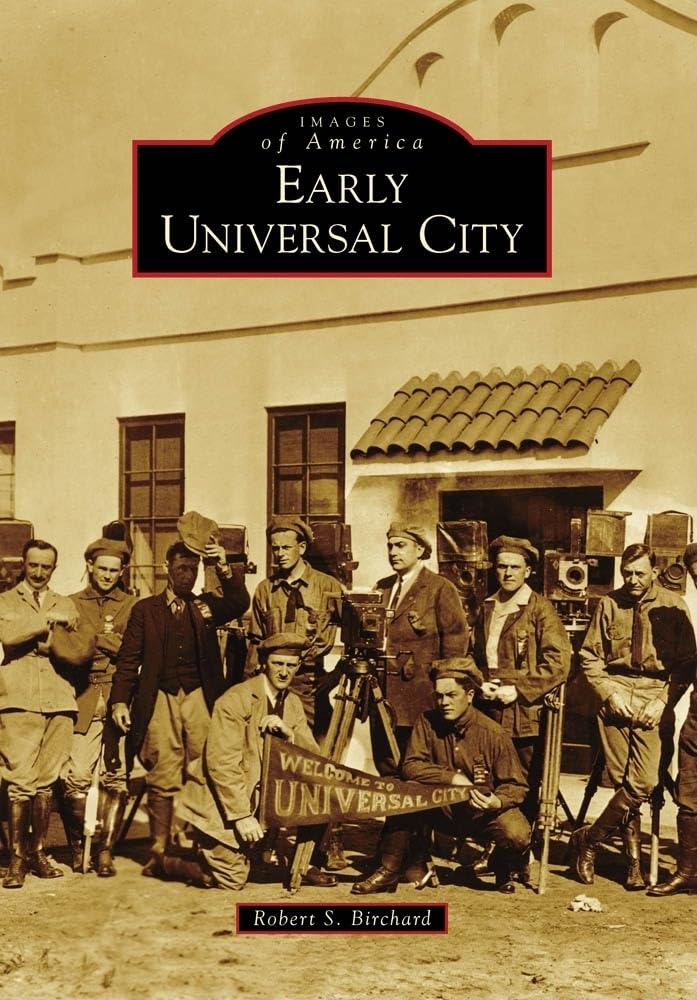



Known as much today for its theme park, Universal City is also the largest and the longest continuously operating movie studio in "Hollywood." The Universal Film Manufacturing Company was formed by a dozen independent producers in 1912, and Universal City was designed to provide a single facility in which to make their films. Since its official opening on March 15, 1915, Universal City has served as a training ground for great directors such as John Ford, William Wyler, and James Whale and as home to stars like Hoot Gibson, Deanna Durbin, Boris Karloff, Bela Lugosi, Lon Chaney Sr. and Jr., and Tom Mix. This evocative volume explores the studio that brought The Hunchback of Notre Dame (1923), The Phantom of the Opera (1925), All Quiet on the Western Front (1930), Dracula (1930), Frankenstein (1931), and 100 Men and a Girl (1936) to the screen. Title: Book Review: A fun look at movie-making history Author: James Famera Publisher: Burbank Leader Date: 12/29/09 Universal City opened for business March 15, 1915. It's been nearly 100 years, yet the Strangest City in the World, as it was originally dubbed, is still the oldest operating movie studio in Los Angeles. Today, Universal City is mostly known for its world-renowned theme park and other tourist attractions. The city, however, played a prominent role in the early days of filmmaking and is the subject of a new book by author and La Crescenta resident, Robert S. Birchard. As part of Arcadia Publishing's "Images of America" series, "Early Universal City" is an engaging and at times captivating look at the city's long history told through black and white photographs. The book charts the city's rise from a barren ranch, to its full blossoming into a major Hollywood studio with smash hits like 1930's Academy Award-winner for Best Picture, "All Quiet on the Western Front," and 1931's "Frankenstein," starring Boris Karloff. Most if not all of the credit to Universal's early success lies in the hands of its founder and champion, Carl Laemmle. A titan of the silent era, Laemmle emigrated from Germany in 1884 at the age of 17 and saw the potential in movies early on. He opened his first nickelodeon in Chicago in 1906 and within six months established the Laemmle Film Service. His company's name would go through a multitude of changes in the years to come, but would eventually settle on the Universal Film Manufacturing Co. (which would eventually be shortened to Universal). By 1912, Laemmle had followed suit with the rest of the film industry, at that time based primarily on the East Coast, and moved his company west for its consistent weather and sunlight. Birchard mentions that Universal City had three grand openings before its "official opening" March 15, 1915. An estimated 10,000 were on hand that day and Laemmle spared no expense. As Birchard details with several rare photographs, visitors were treated to movie-making exhibitions and even a Western-style rodeo show. Of the various rare photographs included of the day's events, those of a staged Indian raid on a Western village stand out as the most visually striking. The action is beautifully captured and one could only imagine what a treat it would have been to see it firsthand. One of Universal's biggest stars in the late teens and '20s was Erich von Stroheim, "That Man You Love to Hate" as he was known to be called for his series of villainous German roles during World War I. Stroheim eventually persuaded Laemmle to let him direct and churned out a number of box office hits for Universal, including 1922's "Foolish Wives," a film that Laemmle touted as the "first million-dollar picture." Laemmle once again spared no expense on production costs for the film and re-created the lavish Monte Carlo Casino, which figures prominently in the film, on the studio back lot. In a daytime photograph of the Casino, Birchard notes how Stroheim and his cameraman avoided showing a brush-covered hill that's clearly visible in the background, so as to create the illusion that the movie was shot on location in France. Laemmle was known to hire family for various jobs around the studio (he even set up an egg ranch on the lot to employ relatives not suited to work in the movies) so it came as no shock when in 1929 he handed over the studio to his 21-year-old son Carl. The young Laemmle oversaw some of the studio's most enduring classics, including its many horror pictures of the early 1930s, but the studio ran into financial difficulties and in 1936 Carl Laemmle sold all of his stock. For those not familiar with the "Image of America" series, it strives to tell the "hidden stories" of small towns and communities through the timelessness of photography. "Early Universal City" is not for those wanting an in-depth history of one of Los Angeles' enduring legacies, but a fun look at movie-making's colorful past. Author Robert S. Birchard is an award-winning film and video editor and noted film historian whose