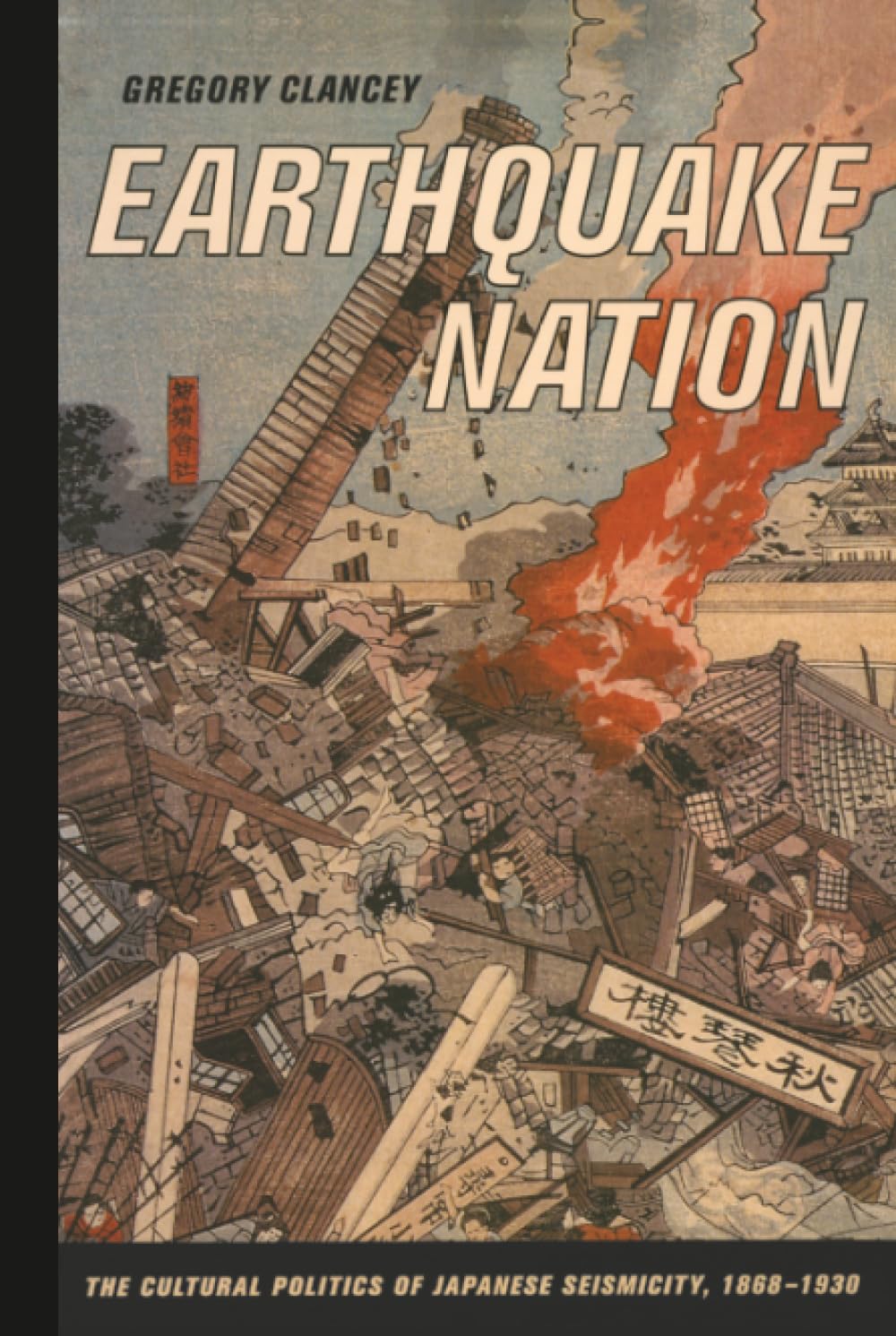
Earthquake Nation: The Cultural Politics of Japanese Seismicity, 1868-1930
$76.16
by Gregory Clancey



Accelerating seismic activity in late Meiji Japan climaxed in the legendary Great Nobi Earthquake of 1891, which rocked the main island from Tokyo to Osaka, killing thousands. Ironically, the earthquake brought down many “modern” structures built on the advice of foreign architects and engineers, while leaving certain traditional, wooden ones standing. This book, the first English-language history of modern Japanese earthquakes and earthquake science, considers the cultural and political ramifications of this and other catastrophic events on Japan’s relationship with the West, with modern science, and with itself. Gregory Clancey argues that seismicity was both the Achilles’ heel of Japan's nation-building project―revealing the state’s western-style infrastructure to be surprisingly fragile―and a new focus for nativizing discourses which credited traditional Japanese architecture with unique abilities to ride out seismic waves. Tracing his subject from the Meiji Restoration to the Great Kant Earthquake of 1923 (which destroyed Tokyo), Clancey shows earthquakes to have been a continual though mercurial agent in Japan’s self-fashioning; a catastrophic undercurrent to Japanese modernity. This innovative and absorbing study not only moves earthquakes nearer the center of modern Japan change―both materially and symbolically―but shows how fundamentally Japan shaped the global art, science, and culture of natural disaster. "Clancey's account of the Nobi earthquake is riveting and it should be read by everyone interested in Japanese history and the history of seismic activity in populated areas." --History in Review Clancey shows how the meaning of earthquakes extend far beyond death and destruction . . . because Clancey writes with verve and wit, Earthquake Nation will prove valuable to anyone seeking to understand Meiji Japan. --Journal of Asian Studies Earthquake Nation is reminiscent of a dramatic performance with new actors entering the stage at each chapter to . . . enrich the multithreaded plot. In the process, Clancey breathes new life into well-worn topics --Journal of Japanese Studies In this groundbreaking work, Gregory Clancey argues that earthquakes are more than natural phenomena. --Technology and Culture The real strength of the book lies in the author's ability to link cultural discourses with hard science . . . [and] the politics of the state, a rare combination at any time but especially so for a non-western setting --NZ Journal of Asian Studies "This is a work of extraordinary originality and lucidity. It reveals the surprising fact that earthquakes, in addition to being natural phenomena, have also been eminently social constructions. Clancey offers numerous insights on the origins of technical disciplines in Japan, and manages to do so in an expository style that is as engrossing as a detective novel." Jordan Sand, author of House and Home in Modern Japan: Architecture, Domestic Space, and Bourgeois Culture, 1880-1930 "This is a work of extraordinary originality and lucidity. It reveals the surprising fact that earthquakes, in addition to being natural phenomena, have also been eminently social constructions. Clancey offers numerous insights on the origins of technical disciplines in Japan, and manages to do so in an expository style that is as engrossing as a detective novel."―Jordan Sand, author of House and Home in Modern Japan: Architecture, Domestic Space, and Bourgeois Culture, 1880-1930 Gregory Clancey is Associate Professor of History at the National University of Singapore (NUS) and Leader of the Science, Technology, and Society (STS) Research Cluster at the Asia Research Institute. He is also Master of Tembusu College at NUS. He received his PhD in the Historical and Social Study of Science & Technology from MIT, and was a Fulbright Graduate Fellow at the University of Tokyo. He is co-editor of Historical Perspectives on East Asian Science, Technology, and Medicine (2002) and Major Problems in the History of American Technology (1998). His book Earthquake Nation won the Sidney Edelstein Prize from the Society for the History of Technology in 2007 and was selected as one of the 11 "Best Books on Science" for the UCBerkeley Summer Reading List in 2009