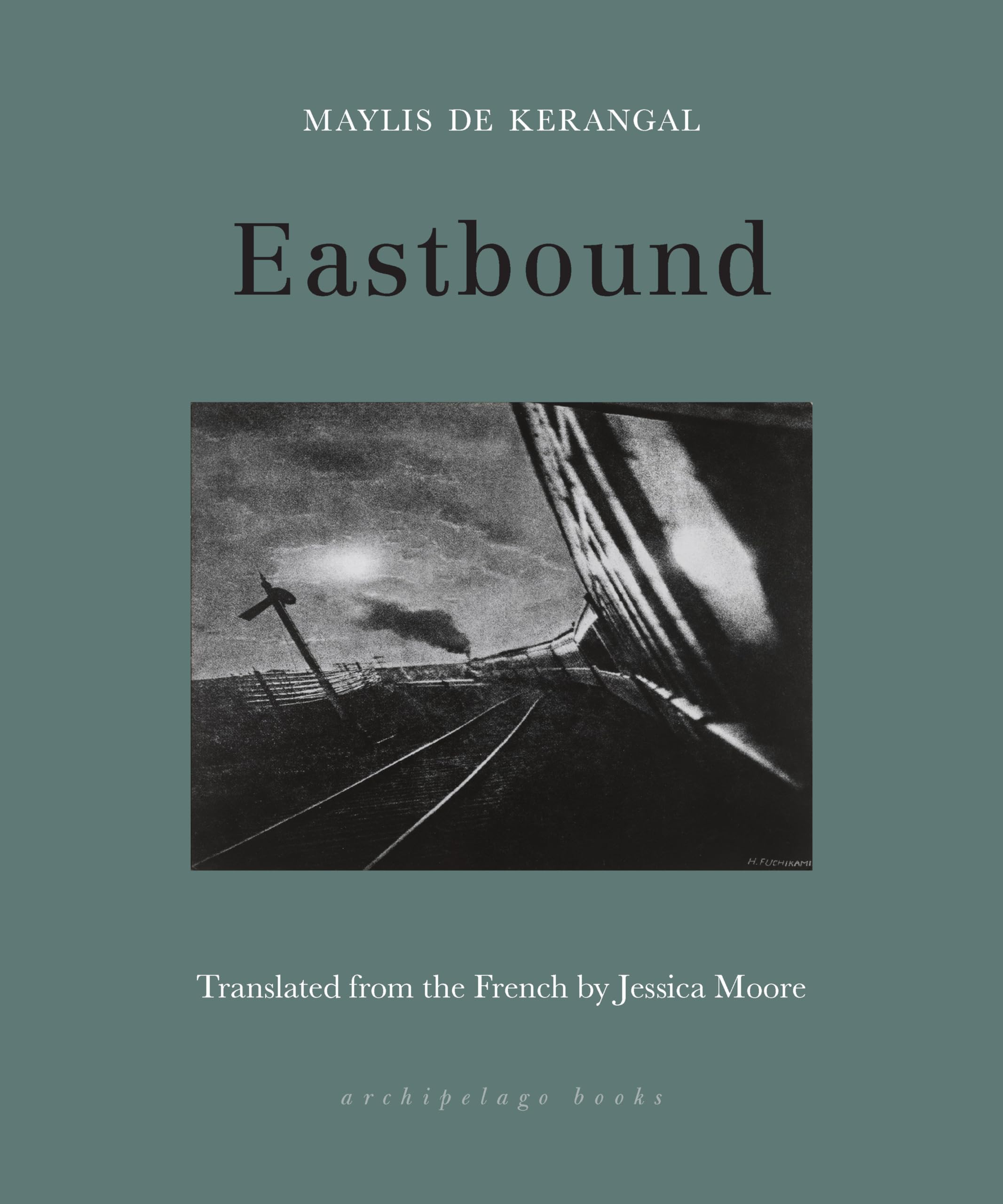



** SELECTED BY THE NEW YORK TIMES AS 1 OF THE 10 BEST BOOKS OF THE YEAR ** ** INCLUDED ON THE NEW YORKER'S BEST BOOKS OF 2023 ** “At The New York Times Book Review , I think it's fair to say we were dazzled by the way the author creates . . . a miniature masterpiece of narrative tension and compression” – Emily Eakin, "The Book Review" podcast In this gripping tale, a Russian conscript and a French woman cross paths on the Trans-Siberian railroad, each fleeing to the east for their own reasons Perfect for fans of Maggie Shipstead's Great Circle and The Lincoln Highway by Amor Towles Eastbound is both an adventure story and a duet of two vibrant inner worlds. In mysterious, winding sentences gorgeously translated by Jessica Moore, De Kerangal gives us the story of two unlikely souls entwined in a quest for freedom with a striking sense of tenderness, sharply contrasting the brutality of the surrounding world. Racing toward Vladivostok, we meet the young Aliocha, packed onto a Trans-Siberian train with other Russian conscripts. Soon after boarding, he decides to desert and over a midnight smoke in a dark corridor of the train, he encounters an older French woman, Hélène, for whom he feels an uncanny trust. A complicity quickly grows between the two when he manages to urgently ask—through a pantomime and basic Russian that Hélène must decipher—for her help to hide him. They hurry from the filth of his third-class carriage to Hélène’s first-class sleeping car. Aliocha now a hunted deserter and Hélène his accomplice with her own inner landscape of recent memories to contend with. " Eastbound briskly unfolds the events of this crazy but thrilling little Mission: Impossible, allowing itself speedy diversions into the backgrounds of both Aliocha and his accomplice . . . . The crisp cascading sentences; the delicious mixture of fear and romance; the harmonious balance of story and language: these are characteristics of each of Ms. de Kerangal's books." — Sam Sacks, Wall Street Journal "In Maylis de Kerangal’s luminous vision, conveyed by the inspired translator Jessica Moore, Siberia’s immensity dwarfs human perspective. The insecurity of existence across this vastness and on board the train emphasizes the significance of human connection. In a time of war, this connection may bring liberation and salvation." — Ken Kalfus, New York Times “De Kerangal is a master at building suspense . . . This book is not only a sort of miniature masterpiece of narrative tension and compression, it's also memorably cinematic. De Kerangal captures the claustrophobic closeness of the train cars and the compartments teeming with passengers, all with different agendas and objectives, with the same level of detail that she evokes the landscape, this vast Siberian forest, and lakes and sunsets that we encounter outside the train window.” — Emily Eakin, The New York Times' "The Book Review" podcast "The physical book…has this very appealing feel in your hand. It's just a beautiful package of a book. It’s worth getting your hands on." — The New York Times' "The Book Review" podcast “In this slim, sleek tale that hurries along at the speeding train’s clip, de Kerangal draws on classic train capers while also poetically, ravishingly conveying the immensity and harsh beauty of this haunted land of exile and torment . . . With each new novel, de Kerangal secures her place as a writer of stunning, incisive, enrapturing fiction; it’s a boon to have this sensuous, soulful, and suspenseful earlier work so gorgeously translated into English by Jessica Moore.” — Donna Seaman, Booklist "Impeccable . . . De Kerangal’s triumphant achievement is powered by mellifluous prose with a rhythm as steady as the train. Readers are in for a dazzling literary ride." — Publishers Weekly , starred review “An antiwar story in which no bullets are fired and not a single battle is fought . . . Sneakily funny . . . As he anxiously ponders the “woolly mauve wilderness,” in translator Moore’s inspired phrasing, it’s evident that Aliocha is a casualty of the militaristic posture that has such a warping effect on people and nations.” — Kevin Canfield, World Literature Today "As a choreographer knows, if you place a man and a woman on the stage even in an abstract ballet, you already have a story. As Maylis de Kerangal, one of the three or four best French novelists working today, reveals, the story need not be one of physical desire but of shared loneliness and the longing for escape—and of mammalian empathy." — Edmund White "On the Trans-Siberian railroad an encounter between a young Russian conscript and a French woman becomes a gripping tale of loneliness and escape. Told with lyrical precision, Eastbound is a rare feat: razor sharp and abundant in human emotion. It's difficult to think of a writer who does so much, so well, in so few pages. Breathtaking." — Mark Haber, Bookseller at Brazos Books