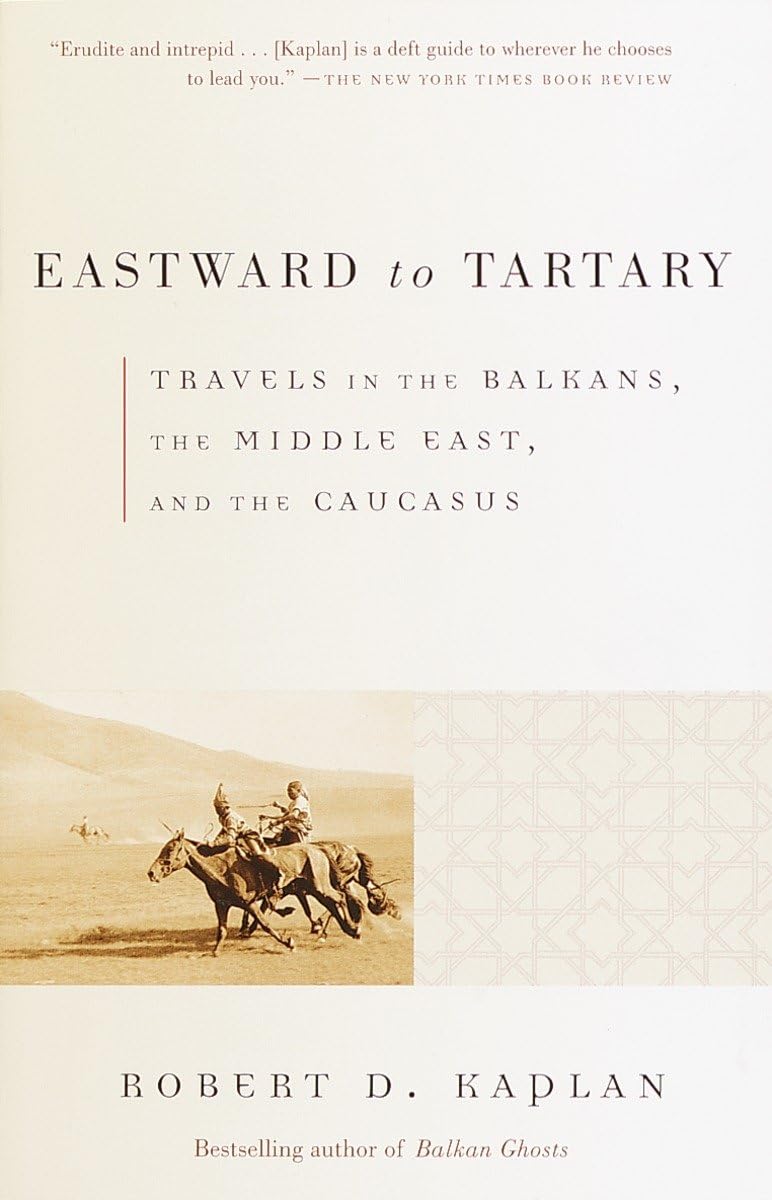
Eastward to Tartary: Travels in the Balkans, the Middle East, and the Caucasus
$12.48
by Robert D. Kaplan



Eastward to Tartary , Robert Kaplan's first book to focus on a single region since his bestselling Balkan Ghosts , introduces readers to an explosive and little-known part of the world destined to become a tinderbox of the future. Kaplan takes us on a spellbinding journey into the heart of a volatile region, stretching from Hungary and Romania to the far shores of the oil-rich Caspian Sea. Through dramatic stories of unforgettable characters, Kaplan illuminates the tragic history of this unstable area that he describes as the new fault line between East and West. He ventures from Turkey, Syria, and Israel to the turbulent countries of the Caucasus, from the newly rich city of Baku to the deserts of Turkmenistan and the killing fields of Armenia. The result is must reading for anyone concerned about the state of our world in the decades to come. "Erudite and intrepid... [Kaplan] is a deft guide to wherever he chooses to lead you." -- The New York Times Book Review "Packed with provocative insights." -- Washington Monthly "A graceful writer... Providing historical (and cultural and religious) context is what Kaplan does best." -- Los Angeles Times Eastward to Tartary , Robert Kaplan's first book to focus on a single region since his bestselling Balkan Ghosts , introduces readers to an explosive and little-known part of the world destined to become a tinderbox of the future. Kaplan takes us on a spellbinding journey into the heart of a volatile region, stretching from Hungary and Romania to the far shores of the oil-rich Caspian Sea. Through dramatic stories of unforgettable characters, Kaplan illuminates the tragic history of this unstable area that he describes as the new fault line between East and West. He ventures from Turkey, Syria, and Israel to the turbulent countries of the Caucasus, from the newly rich city of Baku to the deserts of Turkmenistan and the killing fields of Armenia. The result is must reading for anyone concerned about the state of our world in the decades to come. Eastward to Tartary," Robert Kaplan's first book to focus on a single region since his bestselling Balkan Ghosts, introduces readers to an explosive and little-known part of the world destined to become a tinderbox of the future. Kaplan takes us on a spellbinding journey into the heart of a volatile region, stretching from Hungary and Romania to the far shores of the oil-rich Caspian Sea. Through dramatic stories of unforgettable characters, Kaplan illuminates the tragic history of this unstable area that he describes as the new fault line between East and West. He ventures from Turkey, Syria, and Israel to the turbulent countries of the Caucasus, from the newly rich city of Baku to the deserts of Turkmenistan and the killing fields of Armenia. The result is must reading for anyone concerned about the state of our world in the decades to come. Robert D. Kaplan is the bestselling author of twenty books on foreign affairs and travel translated into many languages, including Adriatic, The Good American , The Revenge of Geography, Asia’s Cauldron, Monsoon, The Coming Anarchy, and Balkan Ghosts. He holds the Robert Strausz-Hupé Chair in Geopolitics at the Foreign Policy Research Institute. For three decades he reported on foreign affairs for The Atlantic . He was a member of the Pentagon’s Defense Policy Board and the U.S. Navy’s Executive Panel. Foreign Policy magazine twice named him one of the world’s “Top 100 Global Thinkers.” 1 RUDOLF FISCHER, COSMOPOLITAN The scent of plum brandy and red wine mixed with the mildew and dust from old books and maps. It was ten in the morning, February 17, 1998. I was in an apartment in the drab eastern outskirts of Budapest. My host, Rudolf Fischer, suggested that we start drinking. "The slivovitz is kosher—look at the Hebrew label! And the wine is young—from a barrel in Villá¡nyi, in southern Hungary. It will rest easy in your stomach and loosen our tongues.â€" Peasant rugs, folkloric weavings, and other Balkan bric-a-brac filled Fischer's small living room, which also functioned as his library: early-twentieth-century volumes, in several languages, on Balkan nationalism, the Persian and Ottoman empires, the Byzantine heritage of Greece, and other subjects having to do with Europe's back-of-beyond. Fischer, with thick white hair, a mustache, and a wistful expression, wore suede trousers and a sleeveless sheepskin shepherd's vest. His rakish appearance and the backdrop of maps and trinkets reminded me of the Victorian explorer, linguist, and secret agent Sir Richard Francis Burton in old age, in his library in Trieste.1 It was to Fischer that I had come for advice before beginning my journey through the Near East, from the Balkans to Central Asia, what the Elizabethans called Tartary. "I was born in 1923," Fischer told me, "in Kronstadt, in Transyl- vania, a mainly German city, which is now called Brasov in Romania. My father was a Hungarian Jew from a strictly Orthod