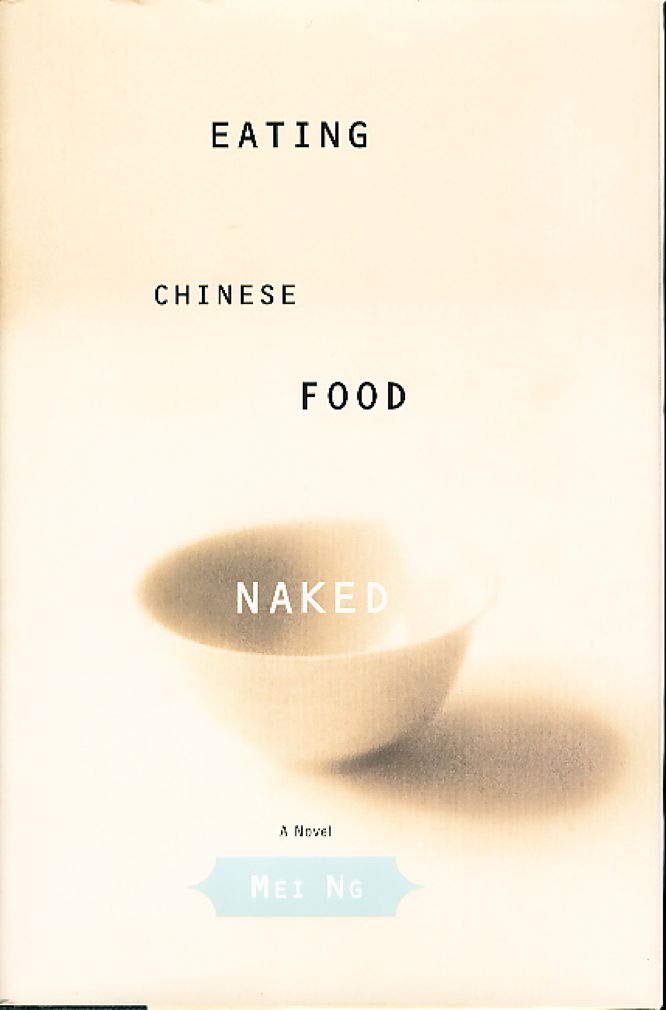



Returning to her family's home in Queens after graduating from Columbia University, twenty-two-year-old Ruby Lee must confront her emotions, her parents, and her burgeoning sexual maturation as she comes to grips with post-college life and her future "When Ruby was a kid, around the time when other little girls were being dandled on their daddy's knee... and thinking about marrying him when they grew up, she was dreaming about marrying her mother and taking her away." Right off the bat Mei Ng's novel promises to be different from the run-of-the-mill mother-daughter saga so beloved of young, female first novelists of every ethnic persuasion. Ruby Lee, the heroine of Eating Chinese Food Naked , has just graduated from college and come back home to live with her parents over the family's laundry business. Her parents, Bell and Franklin, are hardly a match made in heaven, and for all of her life Ruby has been her mother's defender--a role she can't give up even as she longs to be free of it. During the course of her summer at home, Ruby must navigate the choppy waters of familial relations--her mother and father's estrangement, her irresponsible older brother's volatile relationship with everyone, her sister's recent marriage to a non-Chinese--as well as sort out her own feelings about Nick, a young man whom she loves but cannot seem to remain faithful to. Ng's melancholy novel perfectly captures her heroine's dislocation both within her family and within herself, at the same time offering readers a glimpse of the urban Chinese American experience across two generations. --Margaret Prior In this contemporary novel, readers find Columbia University graduate Ruby Lee returning home to Queens, New York, to stay temporarily with her parents. Living in the four rooms behind Lee's Hand Laundry, which is owned and operated by her aging father, Ruby finds herself unable to escape issues past, present, and future as she battles with her identity as a Chinese American woman, a daughter, a sister, a friend, and a lover. Realistically portrayed, each possessing her or his own strengths, weaknesses, and individual personalities, Ruby and her family all evolve over the course of this first novel, much to the satisfaction of the reader. With strong female protagonists inhabiting worlds that are both Chinese and American, Ng's writing can be likened to that of Amy Tan and Gish Gen. A nice addition to most general fiction collections.?Shirley N. Quan, Orange Cty. P.L., Stanton, Cal. Copyright 1997 Reed Business Information, Inc. Asian American mother-and-daughter genre stories were in danger of becoming a clicheafter Maxine Hong Kingston's Woman Warrior and Amy Tan's Joy Luck Club dominated best-seller lists during the 1970s and 1980s. Fortunately, Mei Ng has arrived to update the genre for the 1990s and delight readers with her excellent first novel. Naked is terrific. Ng writes in an earthy, rhythmic prose that captivates the reader. She expertly captures the sadness and frustration of Franklin and Bell, immigrants toiling in a Queens, New York, laundry; the alienation of Van, their rebellious son; the emptiness of Lily, the eldest daughter; and the confusion of Ruby, the prodigal and prodigious daughter, living at home with her parents after graduating from college. Ng can write at any level, expertly combining the explicit and sublime, humor and tragedy. Sex is the glue that holds the book together: dispassionate sex between Franklin and Bell; Ruby's random sex with strangers, passionate sex with her boyfriend, and dreaming of sex with other women. The title refers to one of Ruby's postcoital rituals that also serves as the denouement. A marvelous book. Ted Leventhal A Chinese-American's ambitious but flat first novel in which recent college graduate Ruby Lee comes home to face the family she fled. Settings, people, and activities (especially the preparation of remarkable meals) play prominent roles and are vividly and lovingly evoked. But that's not enough to carry a narrative that often seems an underpowered vehicle for characters whose problems feel more contrived than convincing. Ruby is confused about a lot of things: her sexual identity; her relationship with her parents, Bell and Franklin, and with her boyfriend Nick; as well as her reasons for coming home. While she was at Columbia, she rarely visited, even though her mother and father live in nearby Queens, where her father owns a laundry. Since childhood, Ruby has always felt protective of her mother, a quirky character who works in a garment factory, hoards food in the basement, and sews clothes for a granddaughter she's never seen. Ruby's parents sleep in separate rooms, and their relationship is also one of the issues that she's come home to resolve. She describes her father's trip to China to marry Bell; her parents' uneasy relations with her two siblings; and her own sexual needs and anxieties (she finds herself increasingly drawn to women), which h