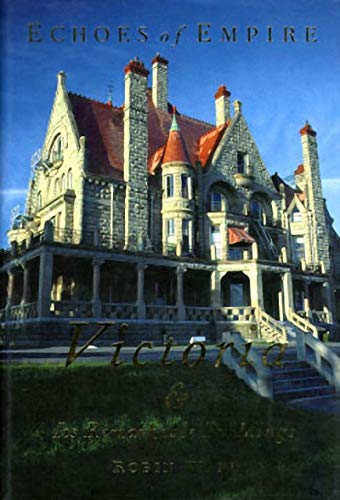



Victoria, the capital of British Columbia, is home to some of the finest turn-of-the-century architecture in Canada. Through Ward's wry, piercing and knowledgeable eye, we meet Francis Rattenbury, the flamboyant twenty-five-yearold designer of the opulent Parliament Buildings and Empress Hotel, whose career dissolved in scandal; Robert Dunsmuir, the tycoon who built an extravagant Scottish baronial castle; artist Emily Carr, premier Amor De Cosmos, and the Natives, missionaries and military men who made Victoria a city where cedar shakes, classical columns, pagoda roofs and heavenly spires jostle in a beautiful and contented ensemble. Robin Ward was born in Glasgow in 1950, studied graphic design at the Glasgow School of Art, drew and wrote about Victorian buildings for the Glasgow Herald , and published three books on the buildings of Glasgow and Edinburgh. After travelling throughout Europe and Canada, he and his wife settled in Vancouver. He soon became a well-known local, drawing and writing his enormously popular weekly column, "Robin Ward's Vancouver," for the Vancouver Sun and working as an artist, writer, photographer, book designer and architecture critic. Author and illustrator of the bestselling Robin Ward's Vancouver , Robin Ward's Heritage West Coast and Echoes of Empire: Victoria and Its Remarkable Buildings , and co-author and photographer of Exploring Vancouver , Ward has won two City of Vancouver Heritage Awards and a Heritage Canada Achievement Award. He is a favourite guest on local radio and television, speaking on architecture and heritage issues. TO DESCRIBE VICTORIA, AND TO DO FULL JUSTICE TO HER MANIFOLD CHARMS, WOULD REQUIRE THE PENCIL OF BOTH POET AND ARTIST - the Colonist , 1891 VICTORIA, founded in 1843 by the Hudson's Bay Company, is known and admired by visitors and locals alike for its old-world charm and idyllic natural setting: by the sea, in sheltered waters, with verdant parks and gardens and views of snow-capped mountains on the horizon. Its cultural character is enquiring but unaggressive. There is an absence of heavy industry and commercial bustle. Victoria is a centre of learning and leisure with a lingering, somewhat eccentric, British air. In 1904 the local publicity bureau began to advertise the city as an "Outpost of Empire." Rudyard Kipling, writing in 1907, likened it to Bournemouth with the Himalayas in the background. But what sets Victoria apart from many other former colonial cities is its buildings. Victoria's nineteenthcentury architecture - the most cohesive and best preserved in Canada defines the city. Victoria evolved into a tight little HBC trading and farming community of about six hundred Europeans, coexisting with a fluid Native population that often outnumbered whites during seasonal trading. This delicate balance was irreversibly upset in 185 8, the year the Fraser River gold rush jolted the trading post into a boom town - the stopping-off point on the way to the gold fields for some twenty thousand prospectors from around the world. Residents who were, according to newspapers of the time, aghast at the "habitual drunkenness and disgusting language and the houses of ill-fame" that accompanied gold fever, took small comfort from the town's most imposing building of the time - a battlemented fortress-like jail. But rising above the shambles, ornate cornices hinted at grandeur to come. Bureaucrats, merchants, skilled tradesmen and well bred sons and daughters of the empire set the tone of the town. By the 1880s, industry and commerce had made the city the biggest and wealthiest in British Columbia. The Inner Harbour was lined with warehouses, shipyards and factories; the port - from which vessels sailed to Europe and Asia - was the busiest in the province. In 1891 the Board of Trade had 150 members. Victoria was the main supply centre for frontier communities, mining and logging camps and salmon canneries on the mainland and on Vancouver Island. Gas streetlights were lit in 1860 and water pipes laid in 1864, the first telephone in the city was tested in 1878; street lighting was electrified in 1889 and the the city's first electric tram line opened in 1890. An economic recession had followed the gold rush, but colonial administration and civic pride - the city became the capital of BC in 1868 - saw Victoria ascend to a bourgeois fin-de-siecle apogee. In 1897 the magnificent new Parliament Buildings were illuminated for Queen Victoria's Diamond jubilee. But the same year, the city's streetcar company was sold to London-based investors, and its main office was relocated to Vancouver - a sign that Victoria's metropolitan veneer was cracking. The erosion had begun in 1887 when the first Canadian Pacific Railway passenger train from Montreal arrived at Vancouver. Victoria - which had been promised the railway terminus - found its big-city ambitions switched to a slower track. Vancouver became Canada's prime Pacific port and BC's principal i