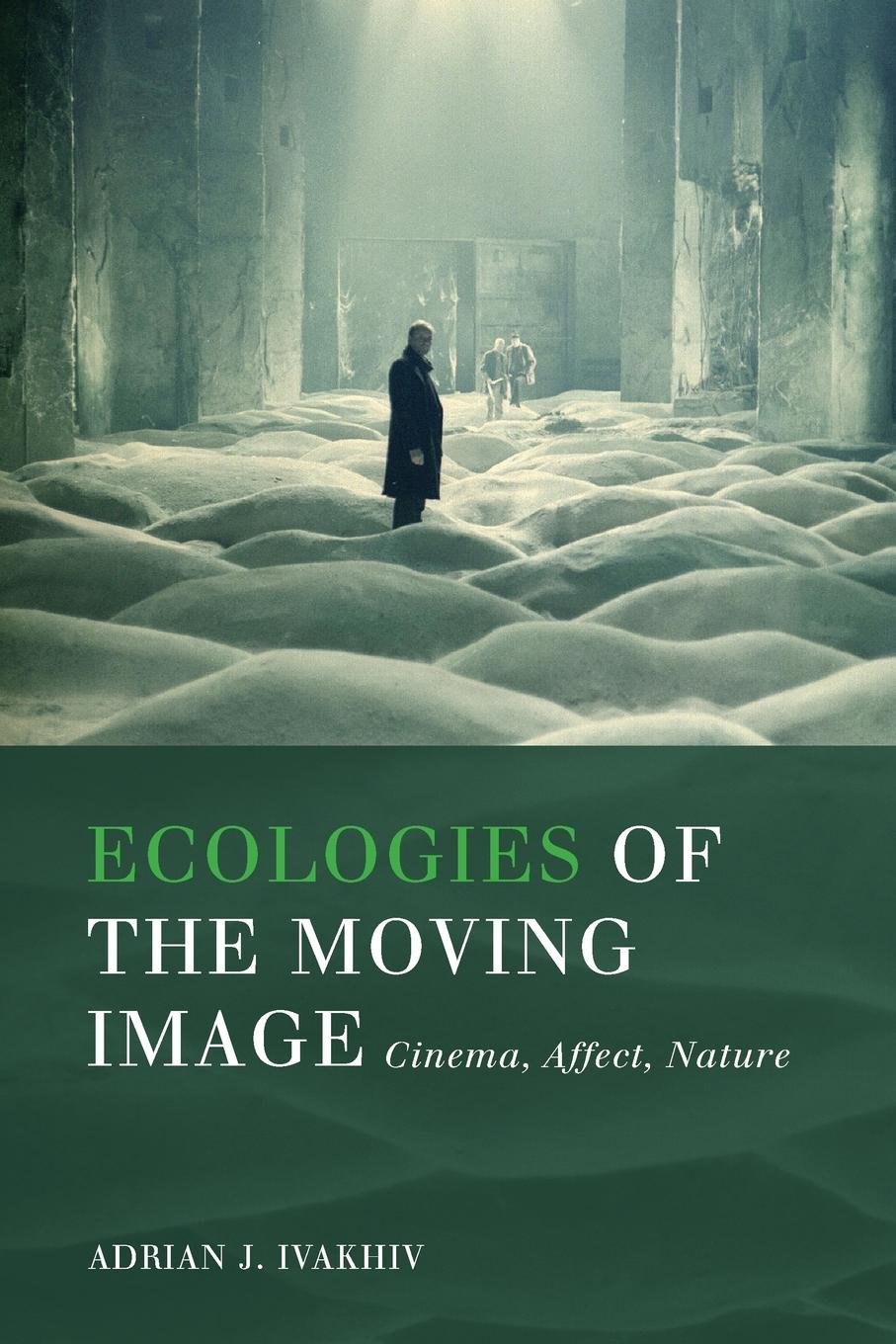
Ecologies of the Moving Image: Cinema, Affect, Nature (Environmental Humanities)
$54.99
by Adrian J. Ivakhiv



Moving images take us on mental and emotional journeys, over the course of which we and our worlds undergo change. This is the premise of Ecologies of the Moving Image, which accounts for the ways cinematic moving images move viewers in ways that reshape our understanding of ourselves, of life, and of the Earth and universe. This book presents an ecophilosophy of the cinema: an account of the moving image in relation to its lived ecologies—the material, social, and perceptual relations within which movies are produced, consumed, and incorporated into cultural life. Cinema, Adrian Ivakhiv argues, lures us into its worlds, but those worlds are grounded in a material and communicative Earth that supports them, even if that supporting materiality withdraws from visibility. Ivakhiv examines the geographies, visualities, and anthropologies—relations of here and there, seer and seen, us and them, human and inhuman—found across a range of styles and genres, from ethnographic and wildlife documentaries to westerns and road movies, and from sci-fi blockbusters and eco-disaster films to the experimental and art films of Tarkovsky, Herzog, Greenaway, Malick, Dash, and Brakhage as well as YouTube’s expanding audiovisual universe. Through its process-relational account of cinema, drawn from philosophers such as Whitehead, Peirce, and Deleuze, the book boldly enriches our understanding of film and visual media. "Adrian Ivakhiv makes a major contribution to eco-film studies and film philosophy by proposing a process-relational theory of cinema... Ivakhiv's film analysis is superbly researched and insightfully synthesises existing criticism of his chosen films with his Peircian conceptual framework... The range of reference makes it indispensable for anyone interested in studying film from an ecocritical perspective." (David Ingram, Brunel University, London, UK, Green Letters: Studies in Ecocriticism ) "A capacious and authoritative ecophilosophy of the cinema... Ivakhiv's grasp of ecocinema as a body of work is truly impressive. It would be hard to find a film with any hint of an environmental theme that he does not mention and discuss." (Joni Adamson, Arizona State University) "The publication of Adrian J. Ivakhiv's Ecologies of the Moving Image marks an important moment in the development of ecocritical film studies... Ivakhiv's book surveys and synthesizes a vast number of critical perspectives and systematically and intelligently analyzes a staggering array of primary texts... will come to be viewed as required reading for the growing ranks of ecocinema scholars." (Bart Welling, University of North Florida, Interdisciplinary Studies in Literature and Environment ) "[Ivakhiv's project] generate[s] three separately enjoyable products: (1) a history of classic films seen from the perspective of ecological awareness, (2) an ecological ontology of cinema, and (3) a history of ideas knitting together a significant strand of philosophy and film theory building up to an ecology of cinema." (Helen Hughes, University of Surrey, Film-Philosophy ) "Ivakhiv impressively draws upon a century of film history [and] scholarship from anthropology and geography to discuss an astonishing array of films: ethnographies, wildlife films, blockbuster science fiction and action cinemas, experimental and essay films, digital cinema, documentaries, animated films, Westerns, road movies, European art films... [A] timely and significant meditation on the material realities of moving images and shared connections between humans and non-humans, to the benefit of scholars and graduate students alike." (R. Webb Jekanowski, Journal of Ecocriticism ) Adrian J. Ivakhiv is Professor of Environmental Thought and Culture at the Rubenstein School of Environment and Natural Resources, University of Vermont. He is the author of Claiming Sacred Ground: Pilgrims and Politics at Glastonbury and Sedona (2001) and numerous other publications in environmental studies, film and cultural studies, religious studies, and human geography. He blogs at Immanence: EcoCulture, GeoPhilosophy, MediaPolitics, blog.uvm.edu/immanence. Excerpt from Ecologies of the Moving Image: Cinema, Affect, Nature by Adrian J. Ivakhiv PREFACE The world around us contains a wild phantasmagoria of images. Put more provocatively: the world around us is a wild phantasmagoria of images. We live and move in a world that swirls with tempestuous currents made of a kind of audiovisual image-substance. Photographs, films and television programs, videos and computer games – these and other moving images blend and mix with images of the external and internal worlds produced by a global array of instruments, from satellites that face down at us, to telescopes that face away from us, to MRIs, EEGs, and ultrasound sonographs that face into us, to the personal computers, cell phones, and iPads that have become our bodily and mental extensions. Together these make up imagescapes full of moti