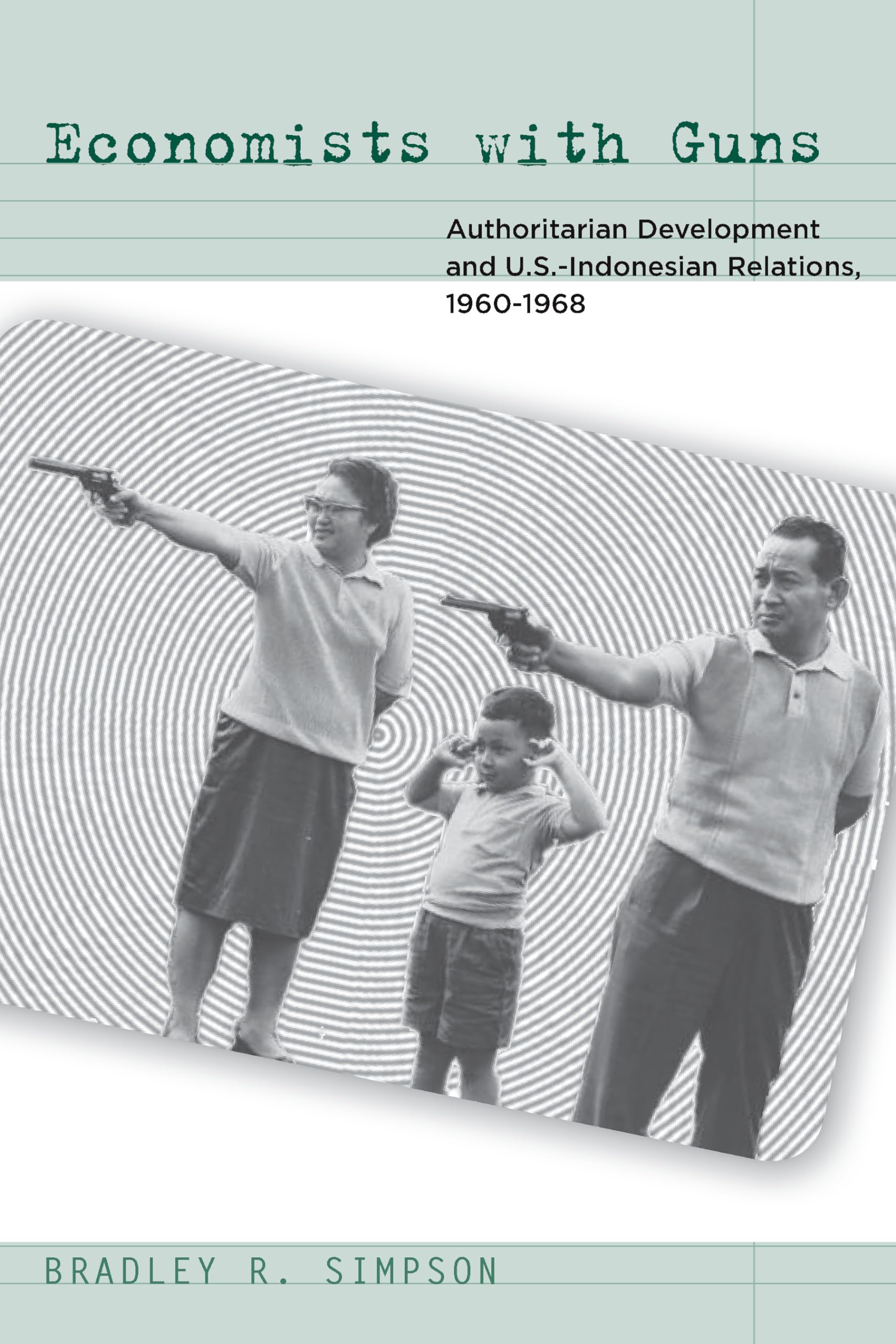
Economists with Guns: Authoritarian Development and U.S.-Indonesian Relations, 1960-1968
$32.00
by Bradley R. Simpson



Offering the first comprehensive history of U.S relations with Indonesia during the 1960s, Economists with Guns explores one of the central dynamics of international politics during the Cold War: the emergence and U.S. embrace of authoritarian regimes pledged to programs of military-led development. Drawing on newly declassified archival material, Simpson examines how Americans and Indonesians imagined the country's development in the 1950s and why they abandoned their democratic hopes in the 1960s in favor of Suharto's military regime. Far from viewing development as a path to democracy, this book highlights the evolving commitment of Americans and Indonesians to authoritarianism in the 1960s on. "Bradley R. Simpson's outstanding new book, Economists with Guns , provides chilling new evidence of American complicity with what the CIA itself referred to as 'the worst mass killings' since the era of Hitler and Stalin Simpson's book is highly significant in one other respect: it shows the perils of authoritarian models of economic development and the fallaciousness of the military modernization theories promoted by Kennedy-era intellectuals, which continue to hold some credence among foreign policy elites today." ― History News Network "Based upon a remarkable wealth of recently declassified U.S. government documents, this meticulous study permits both new insights into well-known events and revelations of unknown events. A major contribution to the study of Indonesia's postcolonial history and to the field of U.S. Cold War diplomacy, it will remain a standard reference work for many years to come." -- John Roosa "Simpson's book constitutes an important addition to our knowledge of the global Cold War. It is based on meticulous archival research, frames its detailed finding within a larger argument and is written in a direct and accessible prose style. This text will be of interest to scholars and students of U.S. foreign policy, the international Cold War, and the modern history of Southeast Asia and Indonesia." -- Edward Aspinall "The author successfully applies the ideas of modernization theory to the Indonesian case, tracing America's ideologically informed notions of Indonesia's place in the regional and world economy. This comprehensive work offers a valuable new perspective." -- Matthew Jones ― University of Nottingham Bradley R. Simpson is Assistant Professor of History and International Affairs at Princeton University. He is also the director of a National Security Archive project to declassify U.S. documents concerning Indonesia and East Timor during the reign of General Suharto (1965-1998). Economists with Guns Authoritarian Development and U.S.-Indonesian Relations, 1960-1968 By Bradley R. Simpson STANFORD UNIVERSITY PRESS Copyright © 2008 Board of Trustees of the Leland Stanford Junior University All rights reserved. ISBN: 978-0-8047-7182-5 Contents Title Page, Copyright Page, Acknowledgments, Introduction, CHAPTER 1 - Imagining Indonesian Development, CHAPTER 2 - The Kennedy Administration Confronts Indonesia, CHAPTER 3 - Developing a Counterinsurgency State, CHAPTER 4 - The Road from Stabilization to Konfrontasi, CHAPTER 5 - From High Hopes to Low Profile, CHAPTER 6 - Indonesia's Year of Living Dangerously, CHAPTER 7 - The September 30th Movement and the Destruction of the PKI, CHAPTER 8 - Economists with Guns, Conclusion, Abbreviations, Notes, Works Cited, Index, CHAPTER 1 Imagining Indonesian Development The only prophet without a significant Indonesian following is probably Adam Smith. — Max Millikan The collapse of Japanese and European colonialism and the rise of revolutionary nationalist movements in East and Southeast Asia in the 1940s was a signal event of twentieth-century international history. The post — World War II attempt by a generation of U.S. and European policymakers to direct the inevitable process of decolonization along lines compatible with Western interests and the efforts of indigenous forces to assert their own visions of self-determination helps to explain much of the Cold War in Asia, which produced two devastating wars in Korea and Indochina and myriad instances of covert intervention. The historical trajectory of Indonesia, then the world's fifth most populous nation and its largest Muslim state, would be decisively shaped by these efforts. Since the surrender of Japanese forces in August 1945, which ended World War II, U.S. policy toward the former Netherlands East Indies has lagged consistently behind the aspirations of its nationalist leaders to sever the economic, political, and cultural sinews of European colonialism. Concerned more with the implications of rapid decolonization of Asian empires for Europe and Japan than with the demands for independence of anticolonial leaders, the Truman administration initially acquiesced to Dutch efforts to reestablish control over their former colonial empire, express