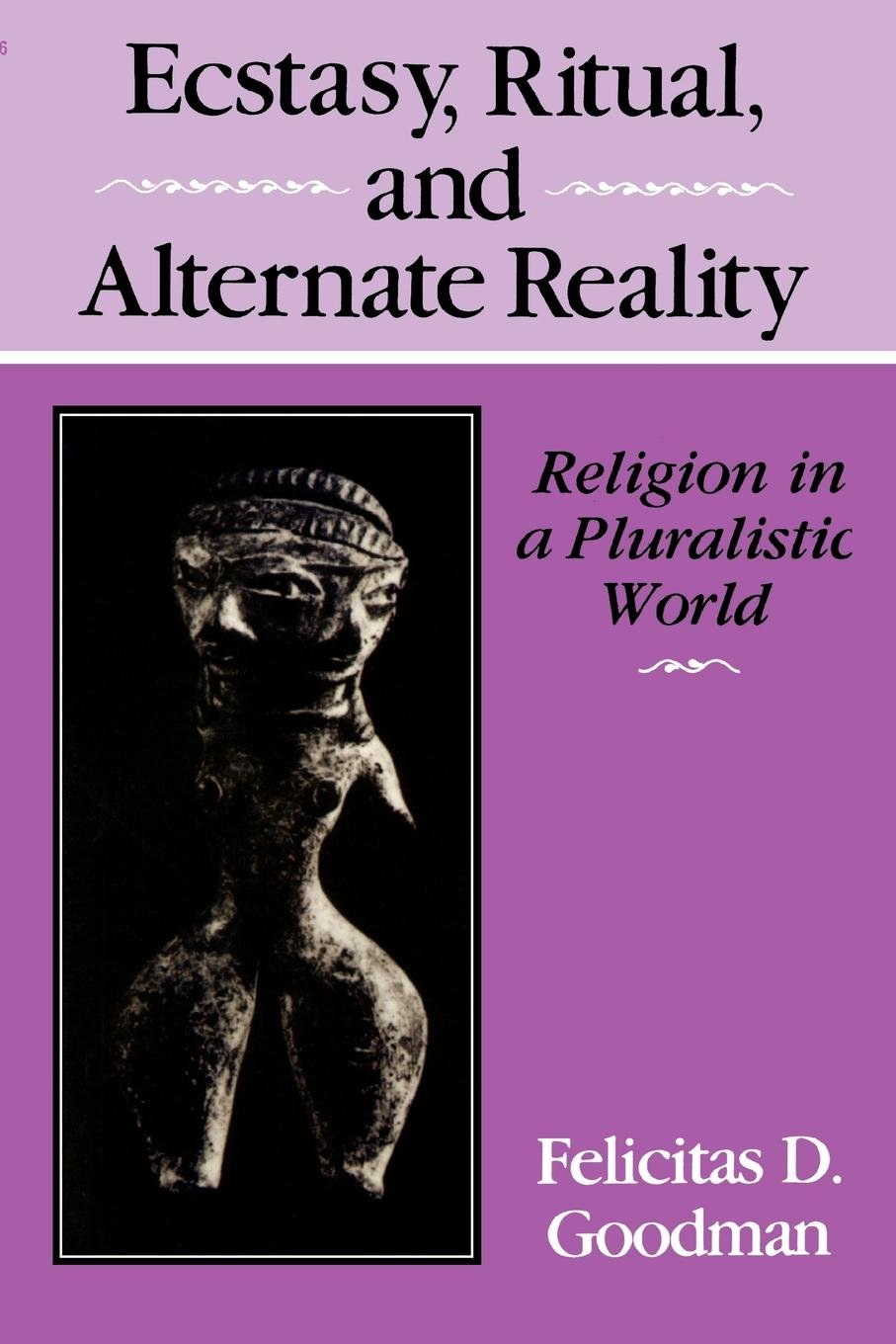
Ecstasy, Ritual, and Alternate Reality: Religion in a Pluralistic World
$19.94
by Felicitas D. Goodman



"An important book which deserves the careful attention of serious students of religion." ―Religious Studies Review Anthropologist and spiritual explorer Felicitas Goodman offers a "unified field theory" of religion as human behavior. She examines ritual, the religious trance, alternate reality, ethics and moral code, and the named category designating religion. In this cross-disciplinary exploration of comparative religion, Felicitas Goodmand offers a unified field theory of religion as human behavior. She examines ritual, the religious trance, alternate reality, ethics and moral code, and the named category designating religion. Ecstasy, Ritual, and Alternate Reality Religion in a Pluralistic World By Felicitas D. Goodman Indiana University Press Copyright © 1988 Felicitas D. Goodman All rights reserved. ISBN: 978-0-253-20726-5 Contents Acknowledgments, Introduction, Part One: Theory, Chapter 1. The Religious: Can It Be Defined?, Chapter 2. Human Evolution and the Origins and Evolution of Religious Behavior, Chapter 3. The Independent Variable: Interaction with the Habitat, Chapter 4. Dependent Variables, Ritual Behavior, The Religious Trance, The Alternate Reality, Good Fortune, Misfortune, and the Rituals of Divination, Ethics and Its Relation to Religious Behavior, The Semantics of "Religion", Part Two: Ethnography, Chapter 5. The Hunter-Gatherers, Chapter 6. The Horticulturalists, Chapter 7. The Agriculturalists, Chapter 8. The Nomadic Pastoralists, Chapter 9. The City Dwellers, Conclusion, Notes, Bibliography, Index, CHAPTER 1 The Religious Can It Be Defined? Magic versus religion. In contrasting the so-called "great religions' and others, the term magic is often employed to describe the latter. In the past, this usage was popular because it seemingly supported the superiority of the "great religions." There, a religious ceremony, so the argument went, was designed to elevate, to praise, etc., while a magical rite of savages was thought to be able, "falsely, of course," to manipulate the objects and circumstances of the real world. Even when a somewhat more balanced view of non-Western humanity began to dawn, the topic of magic proved to be surprisingly slippery, despite the fact that at first blush it seemed to represent an apparently neat and well-defined category. Recognizing the difficulty, social scientists tried repeatedly to redefine the difference between religion and magic. To the French sociologist Emile Durkheim, it lay in the fact that a religious rite was obligatory, while a magical one was optional. Frazer, also much quoted on the topic of magic, subdivided the category into types, such as "contagious magic," "imitative magic," etc. He considered magic "false science": Science worked, magic did not. The British social anthropologist Bronislaw Malinowski, consistent with his view that all cultural behavior was "functional," i.e., directed toward the goal of satisfying physical needs, advanced the suggestion that magic had a definite practical purpose, while religious rites were expressive without purpose. Harking back to Frazer's "false science," he felt that magical practices attempted to bridge the hiatus between knowledge and practical control, so that magic was applied when the practitioner felt that there was an element of uncertainty involved. In a now-famous example (1954), he described how in the Trobriand Islands, where he did fieldwork in the first decade of this century, no fishing magic was used to enhance the catch and provide protection within the lagoon. Such rituals were carried out only on the high seas. Weston La Barre attempted to stretch the phenomena of religious behavior to fit the Procrustean bed of Freudian psychoanalysis. As to the nature of magic, he makes the intriguing suggestion that "mothers make magicians; fathers, gods" (1970: 109). In an entirely Freudian vein, he points to the distinction between the father figure as instilling fear, while the infant can summon the mother simply by crying. In the same way, magic is an outcry for help: "Magic is ... an oral context adaptation: the magic cry summons succorance, coerces reality, and the inchoate infant ego emotionally consumes the world" (1970: 95). Magic is seen as the "self-delusory fixation at the oral-anal phase of operation" (1970: 10). Upon closer scrutiny, none of the suggestions advanced by the above writers holds up. Rites are not either elevating or manipulative, obligatory or optional, abstract or practical. They usually combine these various features, which in addition do not correlate with a religious/magical opposition. Contrasting magic as "false science" and our presumably "true" one is so ethnocentric, it hardly warrants comment. In fact, Malinowski was the one who early pointed out that non-Western societies had "true" science, or else how could they have survived? As to La Barre, he twists his own metaphor later in the same discu