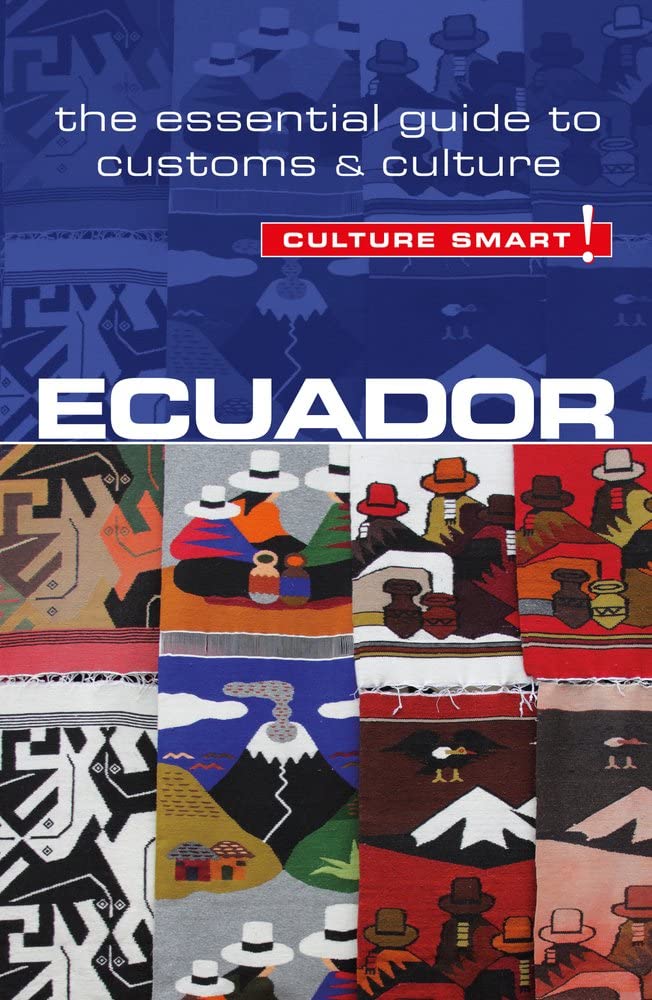
Ecuador - Culture Smart!: The Essential Guide to Customs & Culture (56)
$8.31
by Russell Maddicks



Squeezed between Colombia in the north and Peru in the south, Ecuador is named for its location on the Equator and has a landscape so varied that it has been described as a microcosm of every microclimate found in South America. This diversity makes it a magnet for tourists, mountain trekkers, volunteers, and increasing numbers of US retirees looking for a warm, culturally interesting, economical, and safe place to spend much of their time. The country is booming, thanks to high oil prices and investment in tourism, and a massive infrastructure program and the poverty-reduction measures launched by President Rafael Correa have endeared him to the poorest in society. Ecuador’s multiethnic population reflects a unique blend of cultures, from traditionally dressed mountain peoples, whose ancestors inhabited their highland villages before the arrival of the Incas, to the Afro-Ecuadorians of Esmeraldas and the Chota Valley and the tribal peoples of the Amazonian rainforest. The Ecuadorians are proud, friendly, hospitable, and hardworking, but to know them well the foreign visitor needs to understand the complex historical divisions between the highlands and the coast, and the rigid class and racial hierarchy that has shaped the country’s history. Culture Smart! Ecuador takes you beyond the usual descriptions of where to go and what to see, and gives you an insider’s view of the people, their history, their food, and their culture. Special sections are designed to help food lovers get the most out of the menu, assist business travelers to gain an edge on the competition, and show expats, volunteers, and visitors how to meet and get on well with the Ecuadorians, who are as diverse and varied as the country’s amazing geography. Russell Maddicks is a BBC-trained writer, translator, and journalist. A graduate in Economic and Social History from the University of Hull, England, he has spent the last twenty years traveling, living, and working in South and Central America, most recently as Latin American Regional Specialist for BBC Monitoring. A fluent Spanish speaker, he has made many extended trips to Ecuador, one of his favorite South American destinations, where he has explored the length and breadth of the country both for work and for pleasure. He is also the author of Culture Smart! Venezuela (2012) and the Bradt Guide to Venezuela (2011). Ecuador By Russell Maddicks Bravo Ltd Copyright © 2015 Kuperard All rights reserved. ISBN: 978-1-85733-683-2 Contents Cover, Title Page, Copyright, About the Authors, Map of Ecuador, Introduction, Key Facts, Chapter 1: LAND AND PEOPLE, Chapter 2: VALUES AND ATTITUDES, Chapter 3: CUSTOMS AND TRADITIONS, Chapter 4: MAKING FRIENDS, Chapter 5: ECUADORIANS AT HOME, Chapter 6: TIME OUT, Chapter 7: TRAVEL, HEALTH, AND SAFETY, Chapter 8: BUSINESS BRIEFING, Chapter 9: COMMUNICATING, Further Reading, Acknowledgments, CHAPTER 1 LAND & PEOPLE GEOGRAPHY Covering 109,483 square miles (283,561 sq. km), Ecuador is the smallest of the Andean countries and the fourth-smallest country in South America, similar in size to the US state of Colorado. It straddles the Equator on South Americas western coast, and the long Pacific coastline stretches some 1,452 miles (2,337 km) from the border with Colombia in the north to the border with Peru in the east and south. Off the coast lie the Galápagos Islands. Ecuador has a diverse geographic terrain that includes Andean mountains, active and inactive volcanoes, montane valleys, cloud forests, steamy Amazon jungle, arid deserts, and its long Pacific coast. The four main geographic regions are the Sierra, or Andean highlands, running from north to south in the center of the country; the Costa, or Pacific coast in the west; the Oriente, or Amazon region, in the east; and the Galápagos Islands. La Sierra — the Andean Mountains and Valleys The Ecuadorian Andes run from north to south along two mountain chains known as the Eastern Cordillera and the Western Cordillera. Between them is a high intermontane valley. The highest peaks are the volcanoes Chimborazo, at 20,702 feet (6,310 m), Cotopaxi, at 19,347 feet (5,897 m), and Cayambe, at 18,996 feet (5,790 m). Ecuadorians are proud to point out that, due to the bulge at the equator, Chimborazo is the farthest point on the planet from the center of the earth, making it technically higher than Mount Everest. One of the most active volcanoes is Tungurahua at 16,456 feet (5,016 m), which rises above the popular tourist town of Baños, named for its sulfurous hot springs, which are believed to have health-giving properties. The capital, Quito, is in a mountain valley at 9,350 feet (2,850 m) above sea level. Overlooking Quito are the twin peaks of Guagua Pichincha, at 15,696 feet (4,784 m), and Rucu Pichincha, at 15,413 feet (4,698 m). La Costa — the Pacific Coast The Costa comprises a wide coastal belt that runs from the border of Colombia to the border of Pe