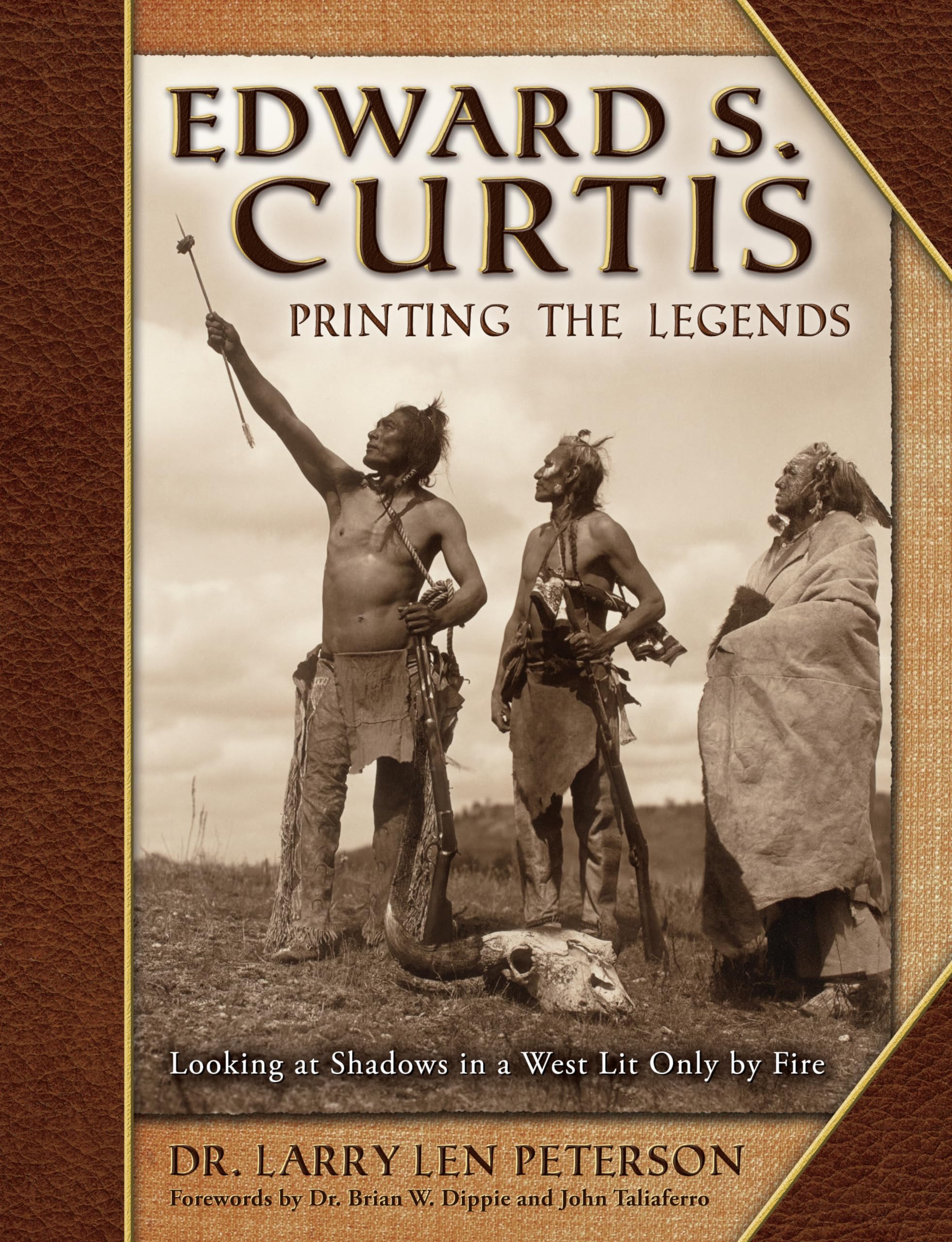
Edward S. Curtis, Printing the Legends: Looking at Shadows in a West Lit Only by Fire
$51.90
by Dr. Larry Len Peterson



If you think you know the Curtis story, think again. This landmark publication is not only packed with stunning illustrations but also astounding discoveries about Curtis's life. For example, the 1898 perpetually repeated legend of Curtis rescuing George Bird Grinnell and other famed scientists on Mount Rainier actually never happened. Grinnell was thousands of miles away. Clearly, genius loves company. One of the main focuses of this book is to contextualize Curtis's life in the cultures in which he and his subjects lived. Curtis fell in love with Native Americans and was captivated by Pictorialism, photography inspired by Romanticism where beautiful people were captured in beautiful settings, which made the picture appear to be like a painting. Art for art's sake was the aim. The end result of his passion and unequaled drive was The North American Indian TNAI), a twenty-volume portfolio and book set with over 2,200 photogravures and 2.5 million words of scholarly, ethnographic text on eighty Western tribes. His efforts were supernatural. From 1896 when he took a picture of Princess Angeline, eldest daughter of Chief Seattle, to the final journey to Alaska to photograph the Inuit in 1927, Curtis compiled the greatest photojournalistic publication in American history, TNAI (1907-1930). Over 10,000 Indigenous people proudly participated. And during that span he had countless grand adventures and stupendous failures, but he never gave up. In contrast to Curtis, other visual artists of his era focused almost entirely on a dozen tribes or so on the Northern Plains and in the Southwest. That's because those regions were promoted by the railways, which generated patrons. Their tasks were easy compared to Curtis's. That said, one of his greatest contributions was bringing other Western American, Alaskan, and Canadian tribes to the forefront so they could also be showcased. This publication is a deep dive into Curtis's life and works that is at once intimate and panoramic. With over 250 illustrations and a 150,000-word text, the reader will learn why Curtis stands proudly on top of the pantheon of Western American artists. We will be speaking his and his Native American friend's names for generations to come. Today, seven decades after his passing, Edward S. Curtis is considered one of the most creative, artistic and visionary photographers in American history. Over the past two decades the value of his photography and ephemeral material has skyrocketed as his life has become well-examined by historians, biographers and art museum curators. Award-winning Western author and collector Dr. Larry Len Peterson, who is well-known for his beautiful Western art books has just published what will undoubtedly be considered the finest book ever published on the photographer: Edward S. Curtis: Printing the Legends, Looking at Shadows in a West Lit Only by Fire (Sweetgrass Books, $79.95) - Dr. Stuart Rosebrook, Editor, True West Magazine Anyone with the slightest interest in the American West or Native American cultures is familiar with the work of Edward S. Curtis. His work adorns the walls and bookshelves of many a home in Sisters—and across the globe. Curtis' journey and the resulting treasure trove of work is the subject of the latest publication by Dr. Larry Len Peterson of Sisters. Peterson, an award-winning physician and scientist of dermatology, has won renown for his extraordinary coffee table books on Western artists Charles M. Russell and Philip R. Goodwin, and for his highly regarded American Trinity: Jefferson, Custer, and the Spirit of the West . Edward S. Curtis, Printing the Legends: Looking at Shadows in a West Lit Only by Fire is printed on wood-free paper made of silk and coated with marble from Garda, Italy. This very high-end paper facilitates the best possible reproduction. The end product is a magnificent six-pound tome of heirloom quality. - Jim Cornelius, Editor, Nugget News and author of Frontier Partisans Blog 2025 Best Author and Historical Nonfiction Book of the Year by True West Magazine in their Best of the West edition. "With his latest book, Edward S. Curtis, Printing the Legends: Looking at Shadows in a West Lit Only by Fire , Dr. Larry Len Peterson has produced the definitive tribute to one of the early twentieth century's most legendary photographers. Above all, the book, like Curtis's photography, is beautiful. Even a quick glance reveals the stunning quality of the volume's 250 full-color illustrations. While the majority of these images are, of course, Curtis's, Peterson also utilizes the works of other Western-art icons—ranging from Thomas Moran and Charlie Russell to E. I. Couse and Maynard Dixon—to aid readers in visualizing the artistic milieu in which Curtis worked. A deeper dive into Printing the Legends's exhaustive text tells the photographer's full story in spectacular detail. Curtis was a master of Pictorialism, a turn-of-the-twentieth-century movement tha