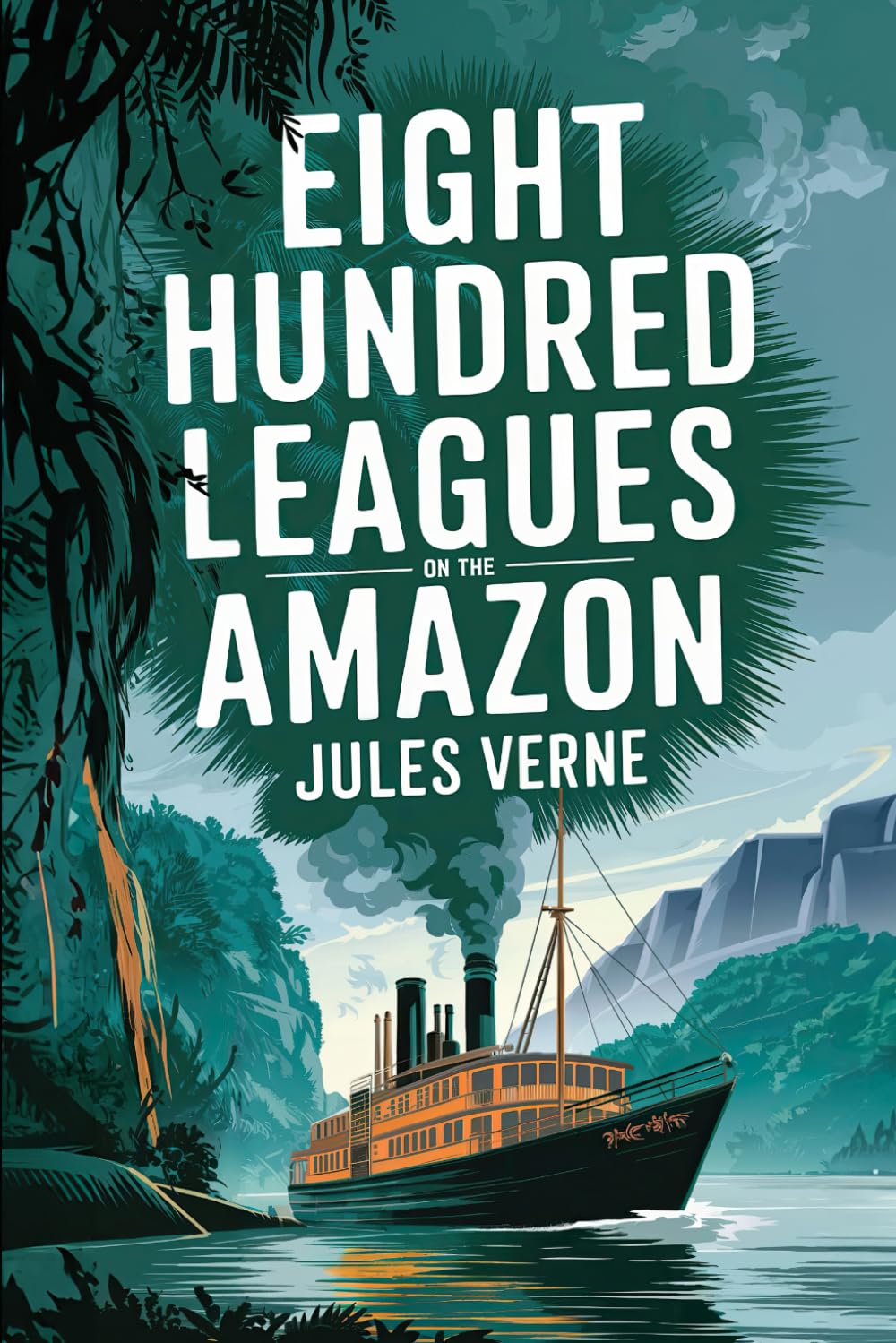
Eight Hundred Leagues on the Amazon (“La Jangada”): A New Translation in Modern Accessible English
$14.79
by Jules Verne



Jules Verne published Eight Hundred Leagues on the Amazon ( La Jangada ) in 1881, during a period of intense European fascination with South American geography. The Amazon existed in the Western imagination as both scientific frontier and symbol of untamed nature—a waterway so vast it seemed to resist the categorical impulses of nineteenth-century exploration. Verne, who never visited the Amazon himself, constructed his narrative from travel accounts, scientific journals, and cartographic studies, creating what amounts to an imaginative colonization of a landscape he knew only through documentation. The novel follows Joam Garral, a Brazilian rancher who has built a prosperous life in the Peruvian interior, far from the coastal cities where his past might catch up with him. When his daughter's impending marriage requires the family to travel to Belém, Joam constructs an enormous jangada—a floating village, really—and embarks on an eight-hundred-league journey down the Amazon. But the river voyage becomes something more complicated than transportation: it transforms into a slow-moving trial, with the Amazon itself serving as both witness and judge. The complication lies in Joam's history. Decades earlier, he was falsely accused of a crime that would mean death if discovered. His only path to exoneration involves deciphering a cryptogram left by the actual perpetrator—a puzzle that must be solved before the family reaches Belém and the past overtakes the present. Verne structures the novel around this dual movement: the inexorable downstream progress of the jangada and the race against time to decode a document that holds either salvation or condemnation. What distinguishes this novel within Verne's corpus is its unusual fusion of domestic drama with geographic spectacle. The jangada carries not just Joam's family but an entire household—servants, livestock, the material infrastructure of daily life—creating a floating microcosm of Brazilian society as it drifts through wilderness. Verne's Amazon teems with natural threats (caimans, rapids, hostile tribes in the colonial framing of the era), but the real danger emanates from human systems: law, memory, the persistence of injustice across decades and distances. The cryptogram element reveals Verne's fascination with codes and systematic knowledge. Deciphering the document requires not heroic action but patient intellectual labor—the application of logic to seemingly random information. That this puzzle determines a man's fate suggests Verne's belief in reason's power to unlock truth, even as the novel acknowledges how rarely justice and truth align in practice. Verne's Amazon is less a real place than a textual construct, assembled from other people's observations and filtered through European assumptions about tropical excess and danger. Yet this constructed quality becomes part of the novel's interest: we watch Verne attempt to master through prose what the actual Amazon consistently refused to yield to European mastery—a river so immense and complex that its full mapping remained incomplete well into the twentieth century. This edition makes the novel accessible to contemporary readers while preserving its period tensions—between innocence and guilt, between the claustrophobia of carrying an unjust past and the apparent freedom of river travel, between Verne's documentary ambitions and the fundamental strangeness of a place he could only imagine.