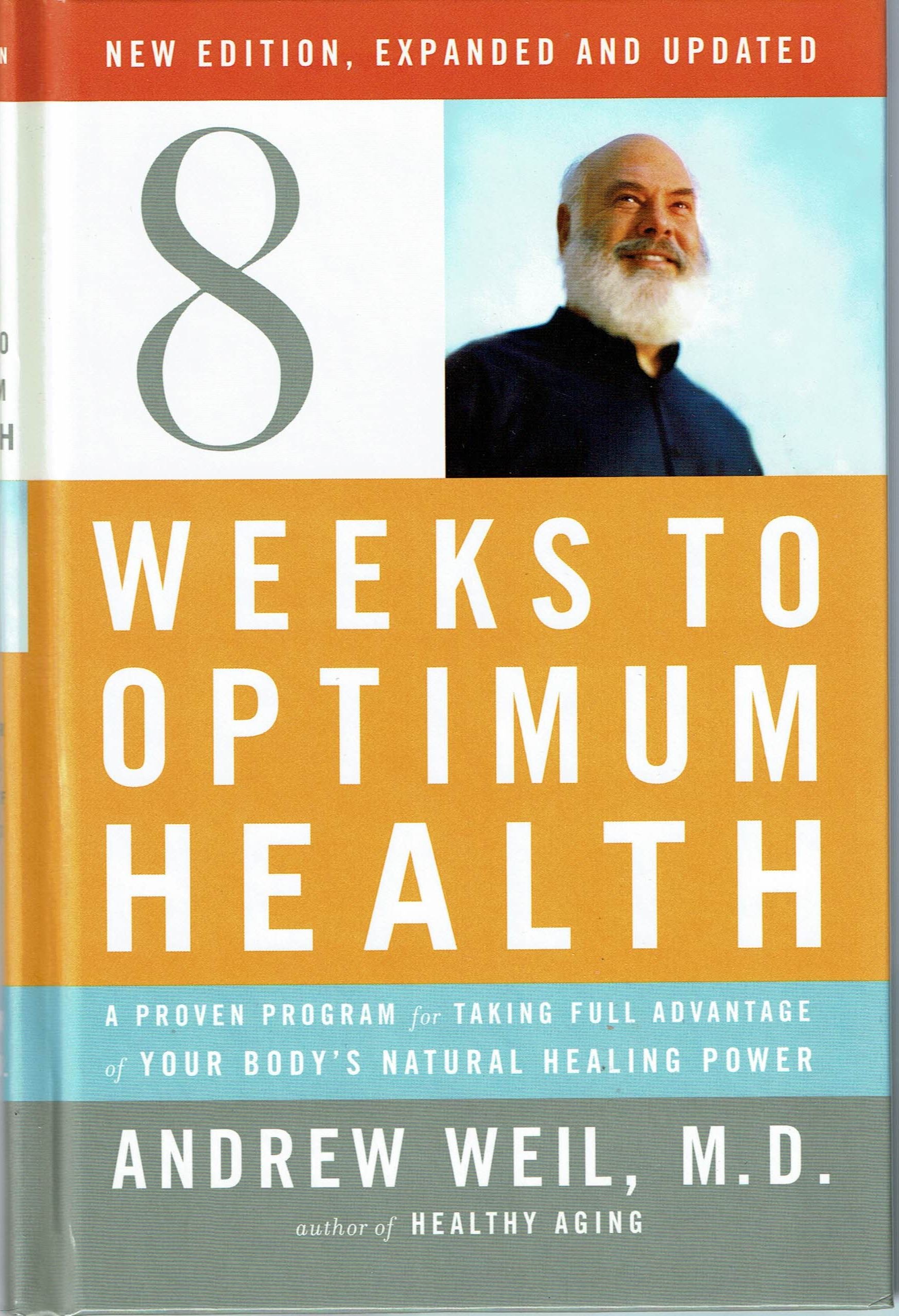
Eight Weeks to Optimum Health, Revised Edition: A Proven Program for Taking Full Advantage of Your Body's Natural Healing Power
$25.18
by Andrew Weil M.D



Now expanded and updated: The book in which one of America's most brilliant and respected doctors gives us his famous program for improving and maintaining health—already the program of choice for hundreds of thousands. Eight Weeks to Optimum Health focuses all of Andrew Weil's expertise in both conventional and alternative medicine on a practical week-by-week, step-by-step plan, covering diet, exercise, lifestyle, stress, and environment—all of the aspects of daily living that affect health and well-being. And he shows how his program can be tailored to the specific needs of pregnant women, senior citizens, overweight people, and those at risk for cancer, among others. Dr. Weil has added the most up-to-date findings on such vital subjects as cholesterol, antioxidants, trans fats, toxic residues in the food supply, soy products, and vitamins and supplements, together with a greatly enhanced source list for information and supplies. Preventive in the broadest sense, straightforward, and encouraging, Eight Weeks to Optimum Health has proved to be, and in this updated version will continue to be, an essential book. Chapter 1 People Can Change You have in your hands a tool for changing your life, an Eight-Week Program for improving health and gaining access to the power of spontaneous healing in your body. I will guide you through this program step by step, explaining the changes I will ask you to make in how you eat, how you exercise, how you breathe, and how you use your mind. I will recommend vitamins, minerals, and herbs you can use to protect your body’s healing system, and I will give you ideas about how you can change long-standing patterns of behavior that impair optimal health. Maybe you have picked up this book because you want to have more energy. Maybe you want to lose some weight. Maybe you worry about getting older and developing diseases that disabled your parents. Perhaps you travel frequently and find it hard to maintain a healthy lifestyle on the road. Or perhaps you have a chronic illness, minor or major, and want to be less dependent on pharmaceutical drugs. Regardless of the specific nature of your need or concern, the information I have assembled in these pages will help you draw on your body’s own resources for natural healing. The Eight-Week Program consists of small steps that build on each other until, by the time you complete it, you have laid the foundation for healthy living. You can then decide how much of the program you want to maintain on a permanent basis. I assume that you want to make changes in your life—otherwise you wouldn’t be reading this book. I see my job as pointing you in the right direction. I have no doubt that you can change, because I know from my own experience that people can do so if they really want to. In moving files recently, I came across a yellowed clipping from The New York Times of August 12, 1971, with the headline: “Meat-Eating 230-Pound Doctor Is Now 175-Pound Vegetarian.” The article was the featured story in the Food–Fashions–Family Furnishings section of that day’s paper and carried the byline of Raymond A. Sokolov, then a Times food writer. It concerns a twenty-nine-year-old physician in rural Virginia who gave up animal foods except for dairy products, with a resultant increase in energy, well-being, and overall health. There is a photograph of the doctor in his kitchen preparing fresh corn. He has a full black beard, is wearing blue jeans and a work shirt, and looks content. Next to the picture is his recipe for a rich corn soup containing milk and butter, and another recipe for a barley-and-vegetable casserole that calls for a quarter-cup of peanut oil. According to the article, the doctor’s interest in consciousness led him to experiment with yoga and meditation, and “since yoga calls for a vegetarian diet, he gave up meat ‘in order to really do it right.’ He has been vegetarian ever since, to the amazement of his friends, who remember him as a voracious meat eater and a fat person while at Harvard. . . . In one year on his new diet [he] has reduced [his weight] from 230 to 175 pounds. His recurring colds and allergies have vanished.” My beard is no longer black, and I have not been able to maintain my weight at 175 pounds. I am still mostly vegetarian (I have eaten fish for the past twenty years), though now I don’t make rich soups with milk and butter, use oil in such quantities, or ever cook with peanut oil. I think I am wiser with age and in general feel much happier now than I did when I was twenty-nine. That was a watershed year for me. I had quit a frustrating job with the National Institute of Mental Health in July 1970, dropped out of professional medicine to write my first book, and made a great many changes in my way of living besides giving up meat. For the first time ever, I lived alone in a natural setting well away from a city. I had no office to go to, no obligations to meet. I began each morning with sittin