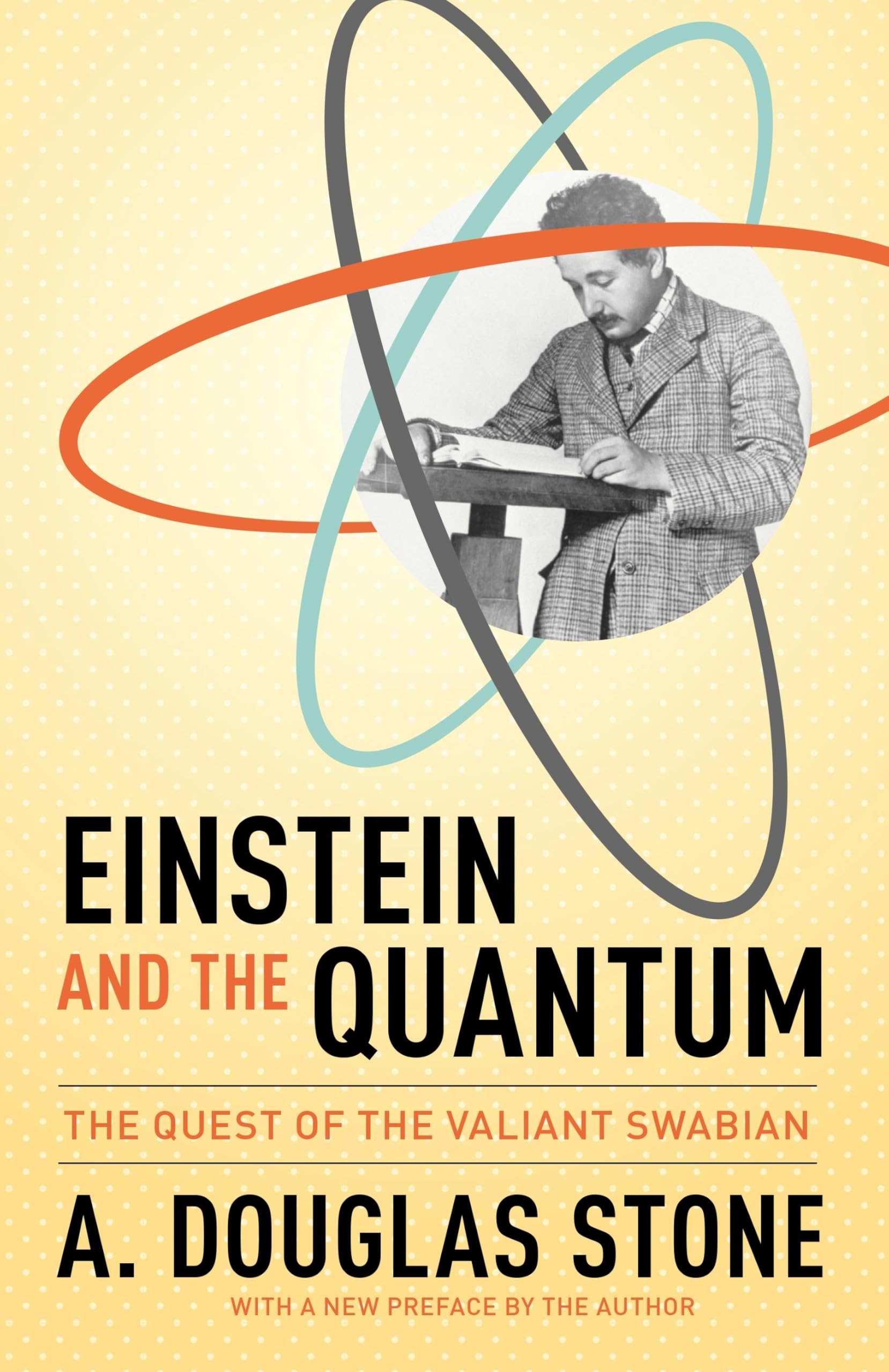



The untold story of Albert Einstein's role as the father of quantum theory Einstein and the Quantum reveals for the first time the full significance of Albert Einstein's contributions to quantum theory. Einstein famously rejected quantum mechanics, observing that God does not play dice. But, in fact, he thought more about the nature of atoms, molecules, and the emission and absorption of light―the core of what we now know as quantum theory―than he did about relativity. A compelling blend of physics, biography, and the history of science, Einstein and the Quantum shares the untold story of how Einstein―not Max Planck or Niels Bohr―was the driving force behind early quantum theory. It paints a vivid portrait of the iconic physicist as he grappled with the apparently contradictory nature of the atomic world, in which its invisible constituents defy the categories of classical physics, behaving simultaneously as both particle and wave. And it demonstrates how Einstein's later work on the emission and absorption of light, and on atomic gases, led directly to Erwin Schrödinger's breakthrough to the modern form of quantum mechanics. The book sheds light on why Einstein ultimately renounced his own brilliant work on quantum theory, due to his deep belief in science as something objective and eternal. "Winner of the 2014 Phi Beta Kappa Award in Science, Phi Beta Kappa Society" "One of Physics World's Top Ten Books of the Year for 2014" "One of Choice's Outstanding Academic Titles for 2014" "One of Scientific American’s Best 2013 Books for the Physics Fan, chosen by Jennifer Ouellette" "One of Science Friday’s Science Book Picks for 2013, chosen by Ira Flatow" "One of nbc.com’s "Holiday Gift Books Span the Science Spectrum" for 2014" "Brief, pacey and lucid. . . . The breadth and depth of Einstein's contribution in this area becomes overwhelmingly clear. . . . Worth a read because it demonstrates that there is more to Einstein's oeuvre than even most quantum physicists know. Stone concludes that Einstein's work was worthy of four Nobel prizes, and it is a measure of the book's achievement that his claim sounds quite reasonable." ---Graham Farmelo, Nature "Albert Einstein (1879-1955) is as famous for his paradigm-shifting theories of relativity as he is for his grudge against quantum mechanics, but Stone's (Physics/Yale Univ.) engaging history of Einstein's ardent search for a unifying theory tells a different story. Einstein's creative mind was behind almost every single major development in quantum mechanics. . . . The author adeptly weaves his subject's personal life and scientific fame through the tumult of world war and, in accessible and bright language, brings readers deep into Einstein's struggle with both the macroscopic reality around him and the quantum reality he was trying to unlock. . . . A wonderful reminder that Einstein's monumental role in the development of contemporary science is even more profound than history has allowed." ― Kirkus Reviews "A fascinating book, so well written lay people can easily understand this. It is full of science and personality." ---Ira Flatow, Science Friday "In Einstein and the Quantum: The Quest of the Valiant Swabian (Princeton University Press), a historical analysis leavened by many personal stories about Albert Einstein, A. Douglas Stone argues persuasively and engagingly that although this iconic scientist rejected quantum theory as a final theory of microscopic physics, he was responsible for most of its central concepts, including wave-particle duality, indeterminacy and the implications of identicalness." ---Sir Michael Berry, Times Higher Education "Professor Douglas Stone has written an engaging book about Einstein's contributions to early quantum theory. He makes a convincing case that these contributions, most of which were made in the 20 year period between 1905 and 1925, have been historically undervalued and that it was Einstein himself, not Planck or Bohr, who deserves most credit for the initial development of quantum theory. . . . Excellent." ---Paul Edwards, Australian Physics "This is an excellent book that I recommend without reservation. . . . Any academic library should acquire this book as should any medium-to-large public library system. It would also make a wonderful gift for the physics or science fan in your life." ---John Dupuis, Confessions of a Science Librarian "In consummate detail and with a flair for the written word, [Stone] delves into Einstein's original rationale for espousing the quantum, his use of it to account for the mysterious behavior of specific heats at low temperatures, his explanations of spontaneous and stimulated emissions, and the derivation of the statistics of integer-spin particles. Readers benefit from Stone's deep understanding of quantum physics as well as his thoroughness in citing primary Einstein documents--rather than regurgitating the opinions of others--to support his concl