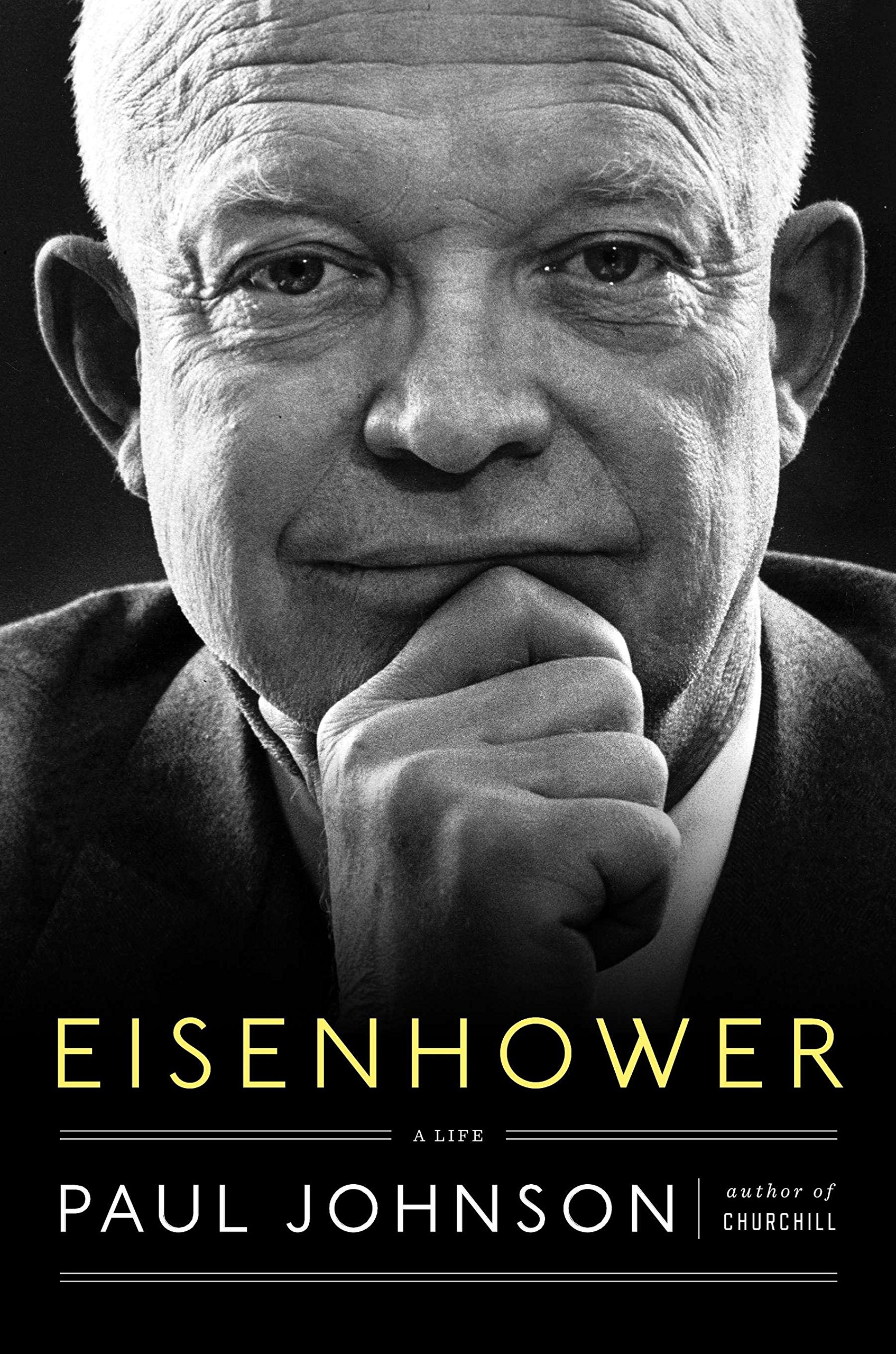



Acclaimed historian Paul Johnson’s lively, succinct biography of Dwight D. Eisenhower explores how his legacy endures today In the rousing style he’s famous for, celebrated biographer Paul Johnson offers a fascinating portrait of Dwight D. Eisenhower, focusing particularly on his years as a five-star general and his time as the thirty-fourth President of the United States. Johnson chronicles President Eisenhower's modest childhood in Kansas, his college years at West Point, and his rapid ascent through the military ranks, culminating in his appointment as Supreme Commander of the Allied Forces in Europe during World War II. Beginning when Eisenhower assumed the presidency from Harry Truman in 1952, Johnson paints a rich portrait of his two consecutive terms, exploring his volatile relationship with then-Vice President Richard Nixon, his abhorrence of isolationism, and his position on the Cold War, McCarthyism, and the Civil Rights Movement. Johnson notes that when Eisenhower left the White House at age 70, reluctantly passing the torch to President-elect John F. Kennedy, he feared for the country’s future and prophetically warned of the looming military-industrial complex. Many elements of Eisenhower’s presidency speak to American politics today, including his ability to balance the budget and skill in managing an oppositional Congress. This brief yet comprehensive study will appeal to biography lovers as well as to enthusiasts of presidential history and military history alike. “A concise biography of the five-star general and two-term president.” — USA Today , a “New and Noteworthy” pick “Johnson deftly sketches Eisenhower’s political profile . . . Inviting.” — The Boston Globe “[E]ssential rather than exhaustive. Johnson gives the basic facts, but always with the aim of illustrating a salient point about Ike's character. . . . [Eisenhower] looks better than ever.” — The Denver Post “An ideal primer for novices or those looking to brush up on America's thirty-fourth president . . . a satisfying snapshot of a life dedicated to public service.” — Booklist “Accomplished historian and biographer Johnson . . . covers all the major facets of Eisenhower's career, beginning with his boyhood in rural Kansas and ending with his tenure as president of the United States . . . with an emphasis on his personality and character, including his flair for public relations. Johnson's contribution will serve as a great introduction to 'Ike' the man.” —Publishers Weekly “[An] admiring, opinionated account by veteran British journalist and historian Johnson. Johnson astutely points out that Eisenhower enjoyed being president since, unlike generals Washington, Jackson and Grant, his best qualities were not those of a warrior but a staff officer: efficiency, administration, economy and flexibility.” —Kirkus Praise for Paul Johnson: “Johnson brings to his subject a vitality that can’t be matched.” — The New York Times “Frequently surprises, even startles, us with new views of past events and fresh looks at the characters of the chief world movers and shakers in politics, the military, economics, science, religion, and philosophy.” — The Wall Street Journal “Johnson is a brilliant writer, fluent, precise, crisp, and in full command of the music of words.” — The Baltimore Sun “His zesty, irreverent narratives teach more history to more people than all the post-modernist theorists, highbrow critics, and dons put together.” — Times Literary Supplement Paul Johnson is the author of the bestselling books Napoleon: A Penguin Life and Churchill, among others. He writes a monthly column for Forbes and has also written for The Wall Street Journal, The New York Times, and many other publications. He lives in London. PART ONE Evolution of the Perfect Staff Officer Dwight David Eisenhower was born on October 14, 1890, the third son, out of a total of seven sons, of David Jacob Eisenhower and Ida Elizabeth Stover. His place of birth was Denison, Texas, but when he was one, his family moved to Abilene, Kansas. This is the place where he grew up and went to school, where he is buried and where all his documents are stored in the splendid Eisenhower Presidential Library. The Eisenhowers, who were of German origin (the name means “iron hewer”), had come to what is now the United States in 1741. They were Mennonites, an Anabaptist sect that fled European militarism and practiced the austere virtues of primitive Christianity. The father, David, received 160 acres and $2,000 from his family, but lost it all when his business failed, an event that had a powerful impact on all his boys. He was deeply religious and read the Bible in Greek, but he ruled with a stick. When Ike, as he was always known, was asked at a press conference in July 1954 about his pacifist background, he replied, laughing, “There was nothing pacific about my father.” His mother, on the other hand, who played the piano and taught the