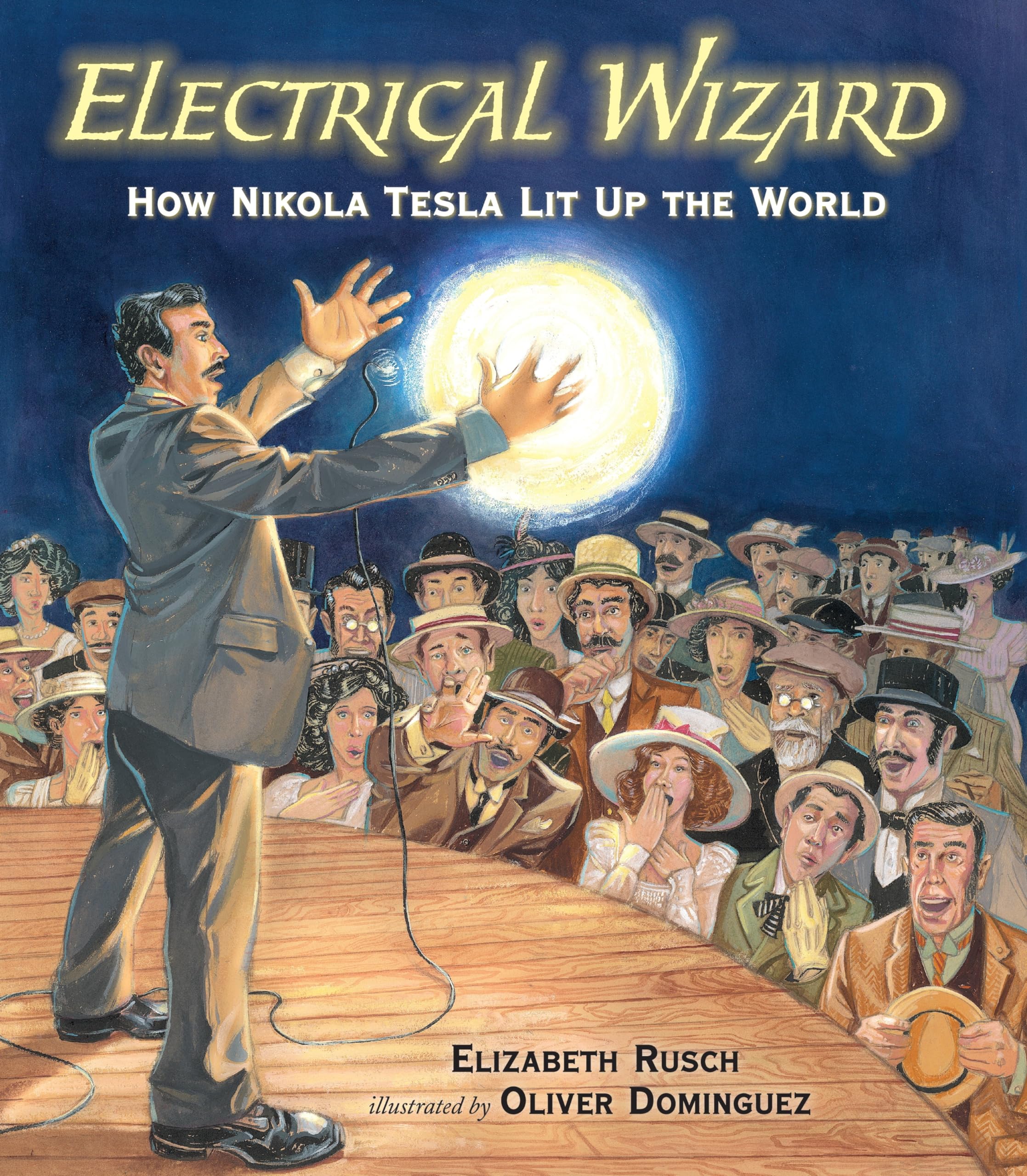



Move over, Thomas Edison! Nikola Tesla takes the spotlight in a biography of the man who pioneered modern electrical engineering — and changed the course of history. When a Serbian boy named Nikola Tesla was three, he stroked his cat and was enchanted by the electrical sparks. By the time he was a teenager, he had made a vow: Someday I will turn the power of Niagara Falls into electricity. Here is the story of the ambitious young man who brought life-changing ideas to America, despite the obstructive efforts of his hero-turned-rival, Thomas Edison. From using alternating current to light up the Chicago World’s Fair to harnessing Niagara to electrify New York City and beyond, Nikola Tesla was a revolutionary ahead of his time. Remote controls, fluorescent lights, X-rays, speedometers, cell phones, even the radio — all resulted from Nikola Tesla’s inventions. Established biographer Elizabeth Rusch sheds light on this extraordinary figure, while fine artist Oliver Dominguez brings his life and inventions to vivid color. Back matter includes additional information about Tesla, scientific notes and explanations, source notes, a bibliography, and suggestions for further reading. Gr 2-5–Although Edison's inventions are celebrated in many children's books, his rival, Nikola Tesla, receives little attention. Rusch's picture-book biography starts to correct that inbalance. From childhood experiments through college studies, Tesla exhibited an interest in electricity. By the time he designed his alternating current (AC) system, he had moved from Eastern Europe to Paris but could find no investors to fund his projects. Convinced that Edison would recognize AC's value, Tesla came to America. Rather than welcome him, Edison set out to discredit AC because it threatened the direct current (DC) power stations he owned. Tesla's breakthrough came when Westinghouse, which used his inventions, won the bid to supply electricity to the Chicago World's Fair. That success was followed by Tesla's achievements in harnessing power generated by Niagara Falls to supply electricity for New York cities. Dramatic incidents such as Tesla's lighting a bulb with his hand are explained in scientific notes at the end. Diagrams and text clarify how AC and DC work, and Rusch stresses the dangers of experimenting with electricity. She provides source notes for quotations and offers detailed explanations of the Tesla-Edison rivalry and of other Tesla inventions. Dominguez's gouache and acrylic illustrations include impressive panoramas of the World's Fair and Niagara Falls, but the people lack animation. A more serious problem is the failure to provide historical context. There are no dates in the text itself, and there is no time line. Despite this oversight, most libraries should consider purchasing the book for its clear biographical details reinforced by scientific explanations. Students might compare Rusch's presentation with one or more books about Edison.–Kathy Piehl, Minnesota State University, Mankatoα(c) Copyright 2013. Library Journals LLC, a wholly owned subsidiary of Media Source, Inc. No redistribution permitted. Thomas Edison’s name may be better known, but as the man who made alternating current a practical means of delivering electrical power, Tesla has had a far greater influence on our world. Rusch highlights the Serbian-born inventor’s lifelong fascination with electricity as she traces his training, bitter rivalry with Edison (whose attempts to market direct current as the “safer” choice ultimately failed), and the spectacular triumph wiring the 1893 Chicago World’s Fair. Along with lucid explanations of AC’s advantages over DC, Rusch closes with an analysis of Tesla’s significance, plus simplified descriptions of his best-known demonstrations and devices—prefaced by a cogent, strongly worded warning about fiddling with electrical current. There’s also a bountiful resource list. Less illuminating is the graphite and gouache art, which has lightning striking low spots rather than higher ones and shows Tesla arriving in New York as the Brooklyn Bridge was being built (he actually arrived a year after it opened). Still, this may be the first time readers have met Tesla, and this portrait gives them a solid appreciation for his talents and achievements. Ed: needs cataloging. Grades 3-5. --John Peters This is a lively introduction to the life of an important figure in technology, someone whose ideas are still at the center of today’s world. ... An engaging volume that will encourage both budding scientists and anyone intrigued by the creative process. —Kirkus Reviews [T]his may be the first time readers have met Tesla, and this portrait gives them a solid appreciation for his talents and achievements. —Booklist Stylized illustrations ... show the drama of the man: formally dressed, showcasing his ideas at the Chicago World’s Fair; harnessing the hydroelectric power of Niagara Falls with a giant generator; and basking in the lig