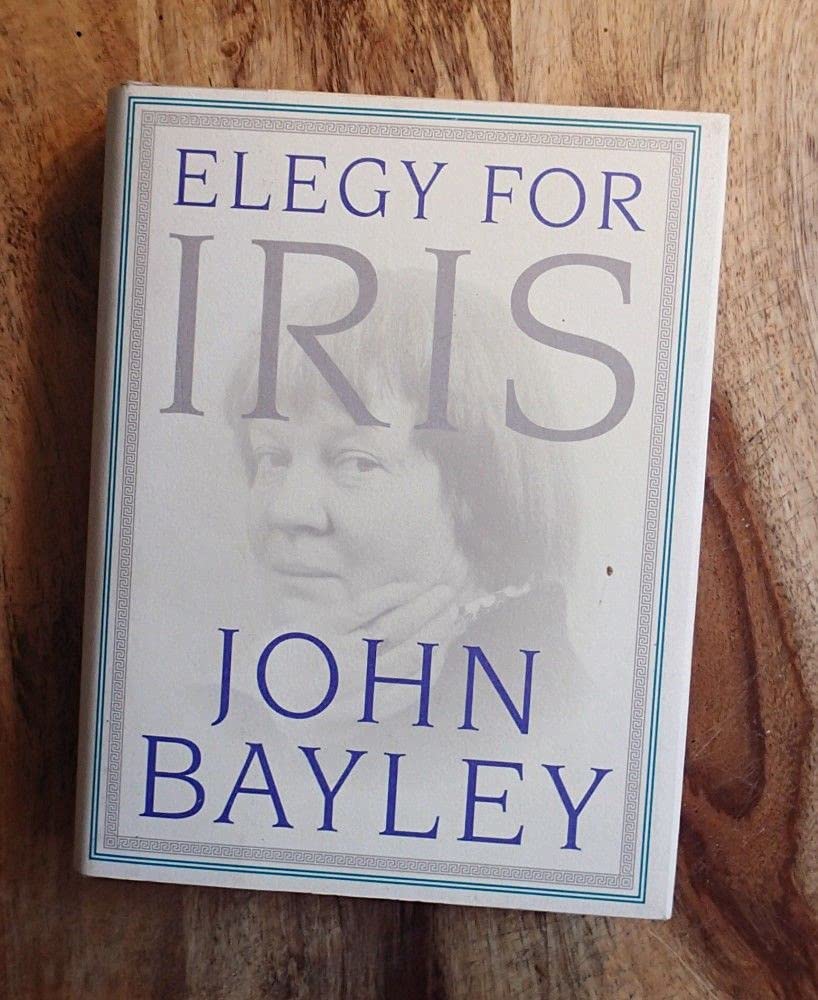



A moving memoir by the husband of the great contemporary writer Dame Iris Murdoch captures the ineffable mystery and fascination that she has exerted on both him and her readers and chronicles her recent sad struggle with Alzheimer's disease. 25,000 first printing. First serial, The New Yorker. In one of literary history's ghastlier ironies, Iris Murdoch, the author of such highly intellectual and philosophical novels as A Severed Head and Under the Net , was diagnosed in 1994 with Alzheimer's disease, which slowly destroys reasoning powers, memory, even the ability to speak coherently. Her husband, English literary critic John Bayley, unsparingly depicts his wife's affliction in prose as elegant and accessible as hers always was. Readers may wince at the spectacle of Murdoch glued to the TV watching the Teletubbies program, unable to perform tasks as simple as dressing herself and prey to devastating anxiety as the world becomes less and less comprehensible to her. We understand Bayley's occasional fits of rage when his caretaking chores overwhelm him. Yet in the end his memoir is touching, even inspiring. As he recalls their first meetings and marriage in the 1950s, it becomes clear that theirs was always an unconventional union, in which solitude was as important to each of them as togetherness and Bayley was content to let Murdoch keep her inner life to herself. He loves Iris, the woman, not the intellect, and he conveys an essential sweetness about his wife that endures even as her mental faculties deteriorate. This totally unsentimental account of their life and her illness is nonetheless a heartbreaker. --Wendy Smith English author and philosopher Iris Murdoch is best known for her novels, which are filled with characters embroiled in philosophical conflicts. In this memoir, her husband, a renowned literary critic, presents his insights into her creativity, her personality, and their relationship. Even after 42 years of marriage, Murdoch remains an enigma to him. Though he always felt safe and comfortable with her?"protected from the world"?he had "no idea of what she was doing or how." She seemed to spread "an involuntary aura of beneficence and goodwill," yet it was in her ceaseless invention that she seemed to live most fully. Reminiscences of the past are juxtaposed with the reality of the present, in which Bayley tries to cope with the daily frustrations of caring for Murdoch now that she has Alzheimer's disease. His bouts of worry, anger, and pity are always tempered by his deep concern for her welfare. This book will appeal to Murdoch fans and is appropriate for public and academic libraries.?Ilse Heidmann, San Marcos, TX Copyright 1998 Reed Business Information, Inc. A sweet if somewhat old-fashioned memoir about a literary marriage. Bayley, author of the novel The Red Hat and a noted critic, met novelist and philosopher Dame Iris Murdoch (Jackson's Dilemma, 1996, etc.) while he was teaching at Oxford's St. Anthony's College and instantly came under her sway. Though Murdoch was less quick to return his affection, she too fell in love after a delightfully disastrous date in which a well-advertised restaurant served them ``nasty'' food and Murdoch herself fell down some stairs on her way to the dance floor; these mishaps unearthed the couple's deepest connection: a fine sense of humor, indeed, their joy in private jokes and laughs. In her time, Murdoch was a woman of unconventional intelligence and independenceshe had a long string of lovers, did not want children, had an almost slovenly disregard for her appearance, and was in no hurry to get married, though she never seems to have doubted that Bayley should be the groom. Using flashbacks, Bayley lightens his accounts of Murdoch's present disappearance into Alzheimer's disease with happier memories of their long, comfortable life together, a life filled with trips, summer swims, and pleasure in books. Bayley clearly adores and admires his celebrated wife, and his care of her illness is a model of devotion. This unalloyed affection is refreshingly sweet, but too often his descriptions of Murdoch edge over into the saccharinefor him she is ``Christ-like''and the result is an unusual lack of insight into her abilities. Would the woman who never took any interest in children really have ``looked after [her own child] better and more conscientiously than most mothers, and no doubt would have brought it up better, too''? Nonetheless, this seems an appropriate error for a loving husband to make, and the book's intimate tone will surely please both his fans and hers. (6 b&w photos, not seen) (First serial to the New Yorker) -- Copyright ©1998, Kirkus Associates, LP. All rights reserved. ...Bayley's memoir offers a touching and decidedly British look at who Murdoch was beyond the pages of her books. What is most refreshing about Elegy for Iris is how well Bayley has captured the complex, layered, rich, rewarding and confounding nature of a li